







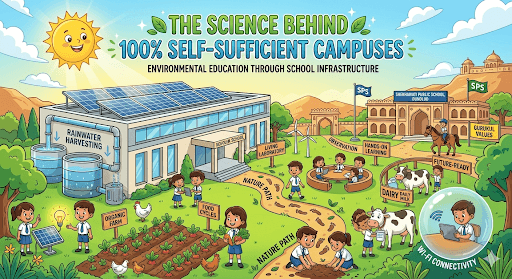

A kid can ace a quiz on food chains, yet still not feel the soil under their shoes when walking through the woods. What shapes that gap isn't only curriculum, it's whether lessons happen inside four walls or with wind in hair and dirt on hands. A school's structure goes beyond walls and floors. What teaches often makes no sound at all. Food from an on-site field fuels meals without fanfare. Panels fixed overhead pull power from sunlight, day after day. Milk arrives daily thanks to nearby animals.
These things do not serve comfort; they shape understanding. Learning happens while walking between buildings that breathe with the land. Sustainability slips into bones before words form on tongues. One school in Rajasthan shows what real independence looks like. What does it mean when a campus runs on its own? The answer hides in walls, roofs, water systems, things most ignore.
Across India, parents searching for the best boarding schools in India are no longer asking only about academics. They are asking: Is this campus future-ready?
In this article, we explore the science behind 100% self-sufficient campuses, how infrastructure becomes a living laboratory for environmental education, and how schools like Shekhawati Public School are redefining sustainability in education.
Also Read | Holistic Development Through Academics and Activities
Why School Infrastructure Is the Most Underrated Teacher?
Endless chatter fills the halls: curriculum tweaks, shiny teaching methods, digital tools. Yet silence stays where it counts, the open, air school, the living campus, always in session.
Kids raised near lively outdoor areas tend to care more about nature when they see how things work firsthand. See, a student sees milk move from cows at school straight into morning meals, learning clicks faster that way compared to just reading lines on paper.
The Hidden Curriculum of Physical Spaces
A rooftop dressed in panels drinks the sun while kids learn without words. Over there, windows frame rows of growing things so meals carry lessons. Not one lesson comes from a voice; most come from looking around.
Walking by something changes how you see it. Soil growing food stays in your mind longer than printed pages ever do. Quiet places speak lessons with no voice at all. The air around folks guides their choices, habits, and even feelings. How rooms meet light tells stories some never notice.
Out past the bell, lessons linger whenever walls pull thoughts back in. Morning glow on floors shifts how decisions form once dark falls.
What Does a "100% Self-Sufficient" Campus Actually Mean?
Children learn best through observation. A green campus turns sustainability into an immersive experience.
-
Solar Energy Systems
Solar installations are not just cost-saving tools. They become practical demonstrations of physics, environmental science, and economics.
Students calculate energy production, measure consumption, and understand carbon footprints in real time.
-
Rainwater Harvesting Systems
Rainwater harvesting structures teach hydrology better than any lab experiment. When students see rain collected, filtered, and reused, conservation stops being theoretical.
The Central Groundwater Board under the Government of India emphasises institutional rainwater harvesting as a key solution to groundwater depletion.
-
Organic Gardens and Biodiversity Zones
School gardens introduce children to soil health, composting, and food cycles. They learn patience while nurturing plants and responsibility while maintaining them.
Environmental education becomes sensory, emotional, and deeply personal.
Check Out: How Modern School Infrastructure Impacts Academic Performance
The Science of Learning Through Environment
There's substantial evidence in developmental psychology that experiential, environment-rich learning produces outcomes that rote education simply cannot. Studies published by the North American Association for Environmental Education (NAAEE) confirm that students engaged in outdoor and nature-based learning show measurable improvements in academic performance, problem-solving, and emotional resilience.
India's ancient Gurukul system was, in many ways, the original self-sufficient campus. Students lived with their teachers, participated in the upkeep of the ashram, grew food, and learned in nature. Modern residential campuses that integrate these values with contemporary infrastructure are, in effect, reviving this tradition with 21st-century tools.
What Parents Should Look For on a Campus?
When choosing a residential school, infrastructure is often evaluated on aesthetics alone, how modern the buildings look, whether there's a swimming pool, and how large the sports grounds are. These matter, but they don't tell the full story.
Questions Worth Asking
Here are the questions every parent should be asking about a school's campus before making an admission decision.
- Does the campus have a working farm or kitchen garden?
If yes, are students actively involved in its upkeep, or is it purely decorative?
- Where does the food come from?
Schools that source food from their own farms offer children both nutritional quality and an environmental education every mealtime.
- How is waste managed?
A campus with a clear, functional waste management and composting system is teaching sustainability in practice.
- What is the air quality like?
Distance from industrial areas, green cover, and campus size directly impact the quality of air children breathe for years on end.
- Is the campus Wi-Fi enabled and technologically current?
In a self-sufficient campus, technology and nature must coexist. Connectivity should not come at the cost of ecological integrity.
Shekhawati Public School, Dundlod: A Step Toward Sustainable Learning
Nestled in the rural belt of North-East Rajasthan, Shekhawati Public School (SPS), Dundlod, offers a compelling real-world example of what a self-sufficient campus can look like at scale.
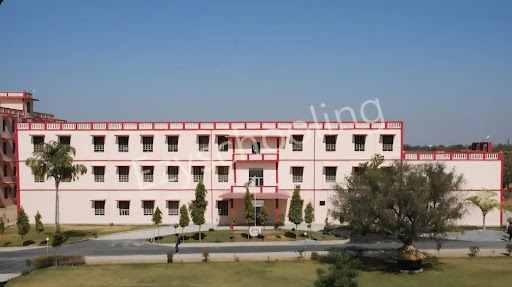
Established in 2004 under the Satwic Jeevanshala Trust, SPS is a CBSE-affiliated, co-educational residential and day school spread across 82 acres of pollution-free, lush green land in Jhunjhunu, Rajasthan. For a school that serves students primarily from rural backgrounds, this scale of campus is not a luxury; it is a deliberate design choice.
One of the best boarding schools in Jhunjhunu, Shekhawati Public School operates its own dairy, supplying fresh milk directly to students. Meals are prepared using produce from the institution's own farm, wherever possible. The cafeteria runs from morning to evening, offering balanced vegetarian meals with a doctor-advised diet for students who need it. These aren't amenities; they are environmental education made edible.
SPS's ethos draws explicitly from the Gurukul tradition, aiming to integrate India's cultural values with modern academic rigour. Round-the-clock Wi-Fi access and smart classrooms sit alongside horse riding academies, yoga, and organic food production, a rare balance that few campuses achieve. The school is also committed to accessibility, with ramps, elevators, and disabled-friendly washrooms embedded into its infrastructure.
Explore more options among the best boarding schools in India to find a place where your child’s spark can grow into a guiding light.




 as a preferred source on