







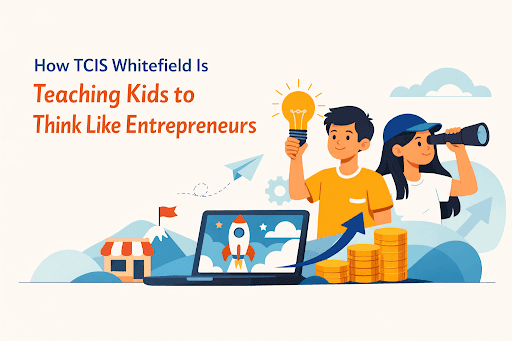

Schools today face a real question. Are they preparing students for the world, or just for exams? Most schools still follow the old model, and most students graduate without the skills they truly need. This gap between classroom learning and real-world demands is growing wider every year.
Entrepreneurship is one area where this gap shows up clearly. Children are naturally curious and creative. Yet, most schools do little to develop these qualities into practical skills. The ability to spot a problem, think of a solution, and take action is a life skill every child needs, regardless of the career they choose.
One of the best schools in Bangalore, The Cambridge International School, Whitefield, Bangalore (TCIS), takes a different approach. It treats entrepreneurship as a core life skill and builds it into the school curriculum from an early age. In this article, we look at how TCIS runs its entrepreneurship program and why teaching entrepreneurial thinking matters for every child today.
Also Read | Reimagining Student Success Via Outcome-Based Assessment at TCIS Varthur
Why Entrepreneurship Belongs in School
Many people still think entrepreneurship is only for those who want to start businesses. That is a narrow way to see it. Entrepreneurial thinking — problem-solving, risk-taking, creativity, and persistence — helps in every field.
It Builds Skills That Last a Lifetime
Students who learn to think like entrepreneurs become better problem-solvers. They learn to handle failure without giving up. They develop the habit of looking for opportunities rather than waiting for instructions. These are skills that serve them in any career they choose.
It Prepares Them for a Changing World
Technology is reshaping industries at a rapid pace. Many jobs that exist today may not exist in ten years. Children who learn to adapt, create, and take initiative will be far better prepared for this kind of uncertainty. Teaching entrepreneurship in school gives them a head start.
Starting Early: Why Age Matters in Entrepreneurial Education

Children develop their core habits and mindsets early. The years between ages eight and fourteen are particularly important for building confidence and a growth-oriented attitude.
Young Learners Absorb Mindsets Easily
Young children are not yet afraid of failure. They experiment freely and ask questions without hesitation. This natural openness makes early childhood an ideal time to nurture entrepreneurial thinking. When schools tap into this quality, they build a strong foundation for future learning.
Habits Formed Early Are Hard to Undo
Research consistently shows that habits formed in childhood tend to stay. A child who learns to be curious, persistent, and solution-oriented before age ten carries those qualities forward. Starting entrepreneurship education in primary school is not too early. In fact, it may be exactly the right time.
Also Read | How TCIS Transforms Students Into National Champions and Global Scholars
Entrepreneurship in the Classroom: What It Should Look Like
A good entrepreneurship program does more than teach business concepts. It places students in real situations where they must think, decide, and learn from outcomes.
Learning Through Real Problems
Students learn best when they work on real challenges. A classroom activity that asks children to identify a community problem and design a simple solution teaches more than any textbook exercise. The process of thinking, testing, failing, and improving builds genuine understanding.
Connecting with the Real World
When students interact with actual entrepreneurs or pitch ideas to real audiences, the experience becomes meaningful. It moves beyond classroom theory and into the kind of learning that stays with a student for life. Exposure to global platforms and real feedback from professionals makes the learning credible and motivating.
Check Out | From Ideas to Impact at Entrepreneurship Club
TCIS Whitefield: Building Entrepreneurs from Grade 3

One of the best IB schools in Bangalore, The Cambridge International School, Whitefield, Bangalore, was founded in 2016 with a clear vision. It set out to build a school that prepares students not just for exams, but for life. TCIS follows a blended curriculum that combines international best practices with CBSE standards. Its focus on multidimensional development spans academics, sports, arts, and life skills.
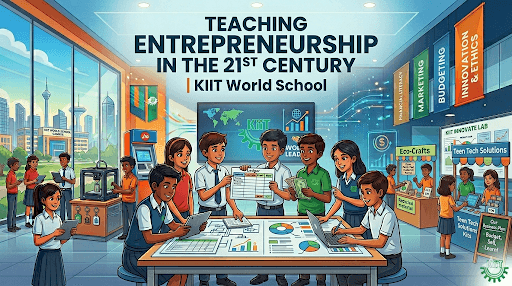
TCIS treats entrepreneurship as a life skill and builds it into the school journey from Grade 3. The program grows in depth and scale as students move through the grades. Young students begin with simple idea-generating activities that teach them to spot problems and think creatively. By the time students reach senior grades, the program becomes immersive. They develop actual start-up ideas and pitch them to real investors. TCIS gives students direct exposure to global platforms such as UQ Ventures of the University of Queensland, Australia, and the India Future Founders Competition. These are not simulations. Students present real ideas to real people and receive genuine feedback.
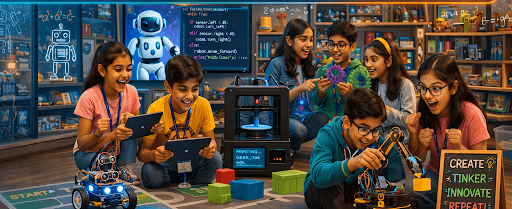
The school also runs a dedicated STEM Lab where students work on projects in robotics, coding, and environmental science. These hands-on experiences connect directly with entrepreneurial thinking by teaching students to design, build, test, and refine. The result is a student who does not wait for answers but goes out and finds them. TCIS has produced young entrepreneurs, published authors, national sports champions, and students who have gained admission to leading institutions in India and abroad. The entrepreneurship program is a key part of what makes this possible.
Conclusion
Teaching children to think like entrepreneurs is one of the most useful things a school can do today. It builds curiosity, resilience, and a bias for action. These are not soft skills. They are the hard skills of a fast-changing world. Schools like TCIS Whitefield show that it is possible to build entrepreneurial thinking into everyday school life, starting early and growing it meaningfully over time. When children learn to ask why, imagine what could be, and try to make it happen, they are ready for whatever comes next.
For more information on this and similar schools in the area, check out this list of the best schools in Bangalore



 as a preferred source on