






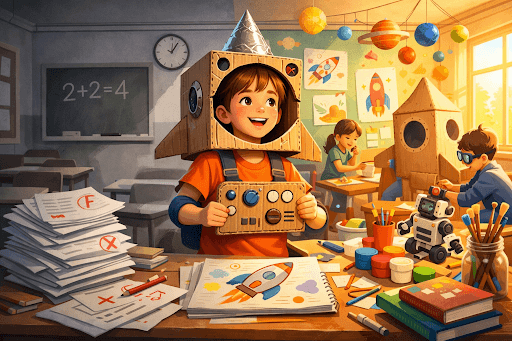

Your child was born curious. They turned cardboard boxes into spaceships and painted the sky green just to see what it felt like. Then school happened. Not all schools steal creativity, but far too many do, quietly, without a single bad intention. Research says that 98% of children score at "genius level" for divergent thinking at age 5, and that number crashes to just 2% by adulthood. The school years are where the fall happens.
It’s time to dig deep into the three silent forces that quietly crush a child's creative instinct, why most parents never notice until it's too late, and how the best schools in Greater Noida, like Sheoran International School, are building environments where creativity doesn't just survive, it thrives.
Also Read | Where Learning Meets Life: The Co-Curricular Edge at Sheoran International School
Silent Killer 1: The Obsession with the "Right Answer"
Every time a teacher circles a wrong answer in red, something else gets marked wrong too: the child's willingness to try again. When classrooms are designed entirely around one correct response, children quickly learn to play it safe. They stop guessing, stop experimenting, stop dreaming out loud.
Creativity, by definition, lives in the space between the expected and the unexpected, and when that space is penalised, children begin self-censoring before they even pick up a pencil. A 2019 study by the American Psychological Association found that fear of failure is one of the top three factors suppressing creative expression in school-age children.
The classroom environment, not the child, is often the cause. The fix isn't about abandoning academic rigour. It's about teaching children that a wrong answer is a step, not a verdict.
But fear of failure is only the first crack. The second one happens in plain sight inside your child's daily schedule.
Silent Killer 2: Packed Schedules with Zero Space to Just Think
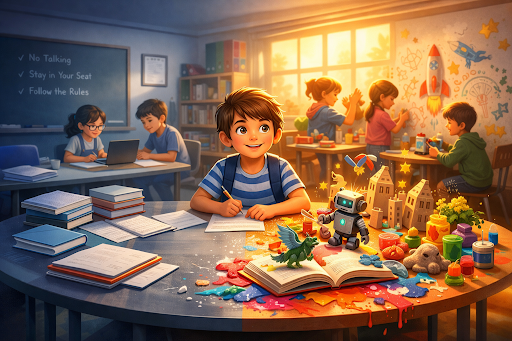
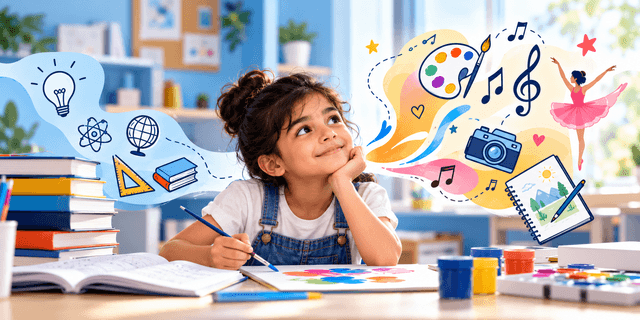
Parents today fill every hour with tuition, coding class, debate club, and swimming. The intentions are beautiful. The outcome, often, is burnout wearing a gold medal. Creativity doesn't perform on a schedule. It arrives in the gaps, and in the moment a child stares at the ceiling and suddenly connects two ideas no one told them were related.
When children are overscheduled, those gaps vanish. And with them, so does the mental wandering that is the true engine of original thought. Neuroscientists call this the "default mode network" - the brain's background processing system that fires up precisely when we are not focused on a task. This is where insight and creative problem-solving are born. Ironically, a packed schedule switches it off entirely.
Unstructured time isn't laziness, but a cognitive investment, and one of the most undervalued gifts a school can give a child. So we've looked at fear and busyness. But the third killer is the one woven deepest into the system and the hardest to spot.
Silent Killer 3: Learning That Happens To Children, Not With Them
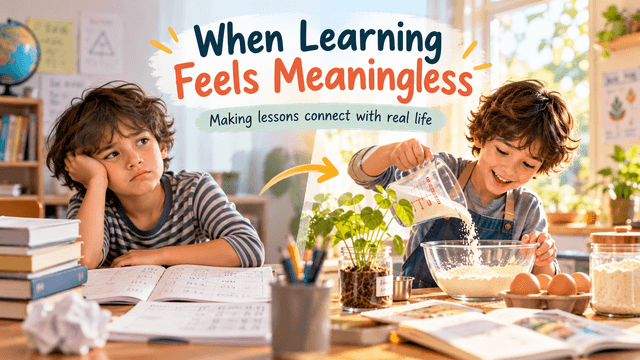
Think about the last time someone told you exactly what to do, how to do it, and when to submit it. Now think about the last time someone said, "This is the problem, and what do you think?" The first feels like compliance. The second feels like ownership. When children are passive recipients of information, sitting, listening, copying - they are consuming, not creating.
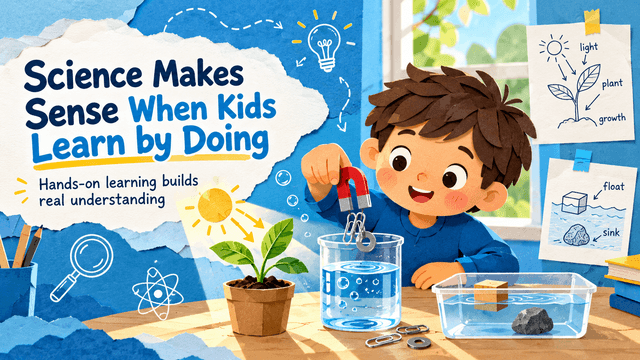
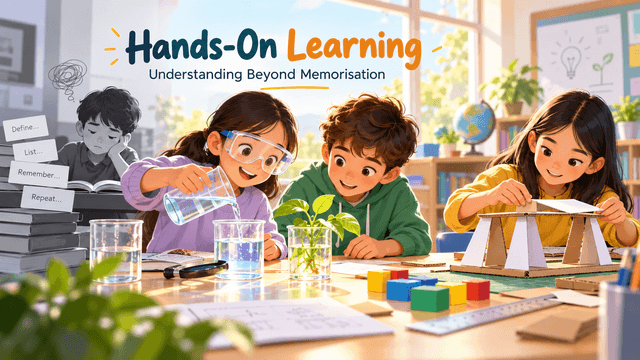
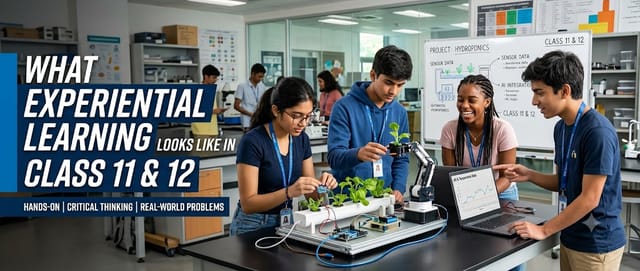
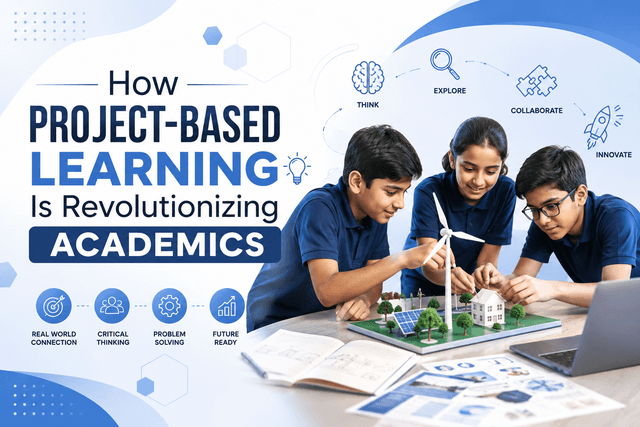
Experiential learning, on the other hand, makes the child an active agent in their own education. They question, build, fail, revise, and ultimately understand rather than merely remember. Lecture-based, one-size-fits-all teaching is still the default in far too many classrooms. When a child who learns by doing is forced to sit and absorb all day, it's not just their grades that suffer, but their belief in their own intelligence.
Now that we know what's breaking it - the real question is: Does any school out there actually know how to fix all three?
Check Out | Why Learning by Doing Produces More Confident Kids
Sheoran International School - The School That's Actively Fighting All Three Silent Killers
Knowing what kills creativity is one thing. Finding a school that refuses to let it die is a different question. Sheoran International School was built in 2018 around a philosophy that directly confronts each of these three killers. Established under the Jyoti Educational Society, the school runs on four pillars: Play, Learn, Innovate, and Experience - a framework built not around what children should memorise, but around who they should become.
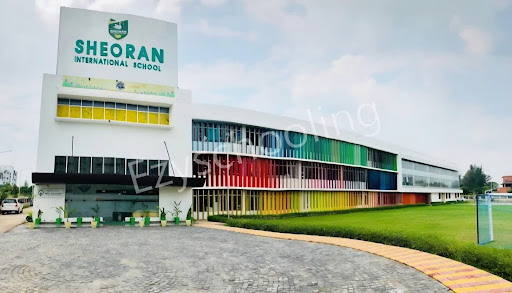
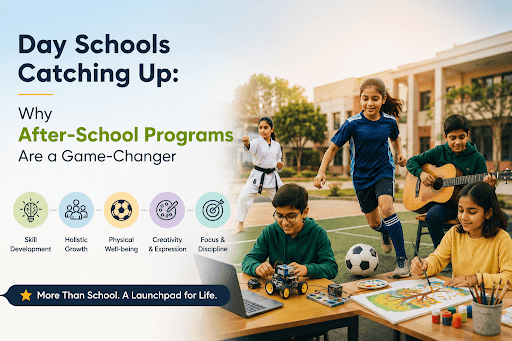
The school actively favours personalised learning, encouraging children to commit mistakes and learn from them, rather than fear them. That's not a tagline; that's a structural decision about how every classroom is run, every single day. The 10,325 sq. mtr. campus houses a robotics lab, science lab, playground, auditorium, swimming pool, and dedicated spaces for art, dance, drama, music, and debate.
These aren't add-ons, but they are the curriculum, each one designed to give children room to wander, wonder, and find what genuinely lights them up. With a 25:1 student-teacher ratio and smart, AC-enabled classrooms, the environment is built for real dialogue, not passive absorption.
Parents who've experienced SIS describe teachers who focus firmly on "holistic development, not just academics." One parent review says it best: "They help children to create, explore, imagine, and grow."
Final Words
Creativity isn't a talent a child either has or doesn't have. It's a muscle, and like every muscle, it grows with use and atrophies with neglect. The three killers we've discussed accumulate quietly, year after year, until one day your child stops raising their hand, not because they don't know the answer, but because they've stopped believing their answer matters.
The good news? The damage is reversible, but only if the environment changes. Choosing the right school is one of the most consequential decisions you'll make as a parent, not for the board results it produces, but for the human being shaped long before those results arrive.
For more information on similar schools in the area, see this list of the best schools in Greater Noida.




 as a preferred source on