







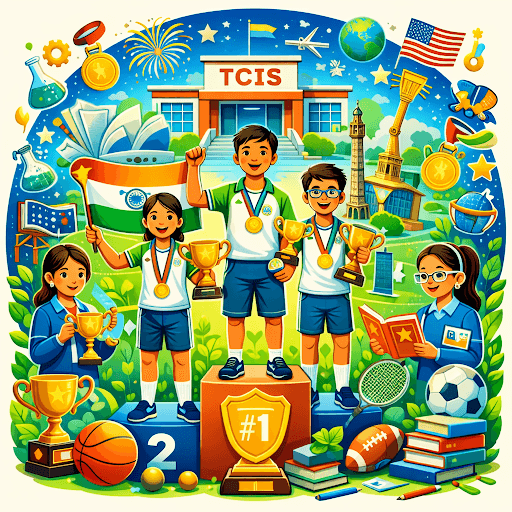

Indian education is witnessing a quiet revolution. Parents no longer settle for schools that simply prepare children for board exams. They want institutions that shape thinkers, athletes, artists, and entrepreneurs—individuals ready to thrive in a world that demands more than textbook knowledge.
The Cambridge International School (TCIS), Haralur, Bangalore, exemplifies this shift. From third-graders pitching business ideas to investors to students representing India at international sporting events, TCIS demonstrates what happens when education prioritises the whole child over rote memorisation.
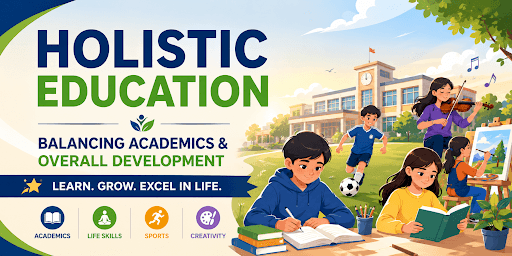
In this article, we explore the evolving landscape of progressive education in India, the importance of multi-dimensional student development, early entrepreneurship programs, global exposure initiatives, and how TCIS brings these elements together through its unique four-pillar learning model.
Also Read | Shaping the Whole Child: Multidimensional Development at TCIS Haralur
The Evolution of Progressive Education in Indian Schools
For decades, Indian schooling revolved around a singular goal: high marks in board examinations. Students memorised textbooks, attended coaching classes, and measured success by percentile rankings. This system produced academically competent individuals but often left gaps in critical thinking, creativity, and practical problem-solving abilities.
The limitations of traditional education became apparent as the world changed. Employers began seeking candidates with communication skills, adaptability, and innovative thinking—qualities rarely nurtured through conventional teaching methods.
Moving Beyond Rote Learning
Progressive education models emerged as an alternative. These approaches prioritise understanding over memorisation, encourage students to ask questions rather than passively receive information, and recognise that children learn differently. Teachers become facilitators rather than lecturers, transforming classrooms into collaborative spaces where students explore concepts through projects, experiments, and real-world applications.
Child-Centric Learning Takes Centre Stage
Modern educational frameworks place the learner at the centre. This child-centric approach acknowledges that a student passionate about robotics needs different guidance than one drawn to creative writing. Indian schools are gradually adopting differentiated instruction, tailoring teaching strategies to match individual learning styles and paces.
Why Multi-Dimensional Development Matters More Than Ever

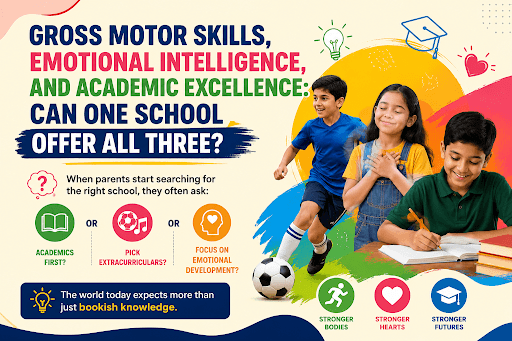
Education today extends far beyond academic achievement. The future workplace demands adaptability, critical thinking, collaboration, creativity, and resilience—competencies that transcend specific careers and are cultivated naturally through diverse experiences.
Beyond Academics: The Case for Co-Scholastic Excellence
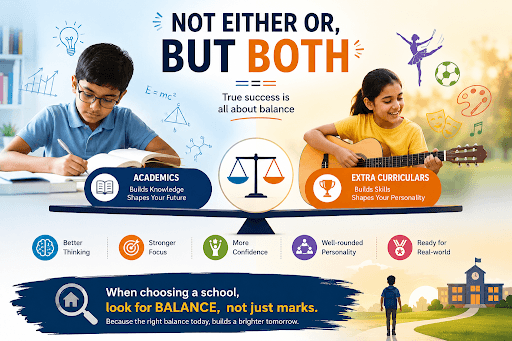
Research consistently shows that emotional intelligence predicts professional success more accurately than IQ alone. Students who participate in sports learn teamwork and time management. Those engaged in the arts develop spatial reasoning and creative problem-solving abilities. These co-scholastic activities aren't extracurricular add-ons—they're essential components of comprehensive education.
Universities worldwide now look for well-rounded applicants. A perfect academic record matters less if the student lacks leadership experience, community involvement, or passion projects.
Building Skills for Tomorrow's Challenges
A student learning classical music develops discipline and pattern recognition. An athlete understands goal-setting and incremental improvement. A theatre participant gains confidence in public speaking and emotional expression. These experiences shape character in ways traditional academics cannot replicate, preparing students for careers that don't yet exist.
Early-Age Entrepreneurship: Preparing Students for a Dynamic Future
Entrepreneurship education isn't about creating business owners—it's about fostering an entrepreneurial mindset applicable to any path. This approach teaches students to identify problems, design creative solutions, manage resources, and communicate ideas persuasively.
Why Start in Elementary School?
Introducing entrepreneurial concepts early capitalises on children's natural creativity and fearlessness. Young students think experimentally, iterate freely, and embrace failure as part of learning—precisely the mindset successful entrepreneurs cultivate throughout their careers.
Early programs focus on age-appropriate activities:
- Third-graders design products to solve everyday problems in their homes or schools
- Fifth-graders develop simple business plans and present them to classmates
- Middle schoolers engage with real-world concepts: market research, financial planning, and customer feedback
From Classroom Projects to Real Investor Pitches
Progressive schools create authentic entrepreneurial experiences. Students execute projects, present to actual investors, and sometimes launch functioning ventures. Competitions challenge students to solve social problems through innovative products or services. Mentorship programs connect aspiring founders with experienced professionals, democratizing entrepreneurship for students from diverse backgrounds.
Global Exposure and Cross-Cultural Learning in K-12 Education
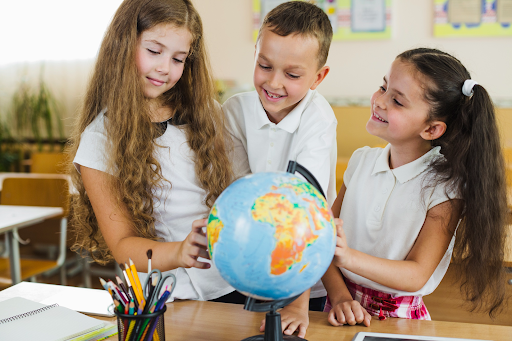
Today's students will work in globalised environments where understanding different cultures, perspectives, and systems isn't optional—it's essential. Schools that provide international exposure give students significant advantages in college admissions, career opportunities, and personal growth.
Strategic International Partnerships
Forward-thinking schools establish relationships with institutions abroad, facilitating faculty exchanges that bring global teaching methodologies into Indian classrooms. Students participate in collaborative research projects with peers from different countries, gaining exposure to varied academic approaches and cultural perspectives.
Such collaborations extend beyond surface-level cultural exchanges. Students work alongside international researchers on cutting-edge topics, attend workshops at partner institutions, or engage in virtual classrooms connecting learners across continents.
Preparing for Global Opportunities
Indian students increasingly pursue higher education internationally. Schools offering early global exposure ease this transition significantly. Students develop comfort with diverse educational approaches, learn to navigate unfamiliar systems, and appreciate varied perspectives—capabilities proving invaluable whether studying abroad or pursuing careers with global dimensions within India.
Check Out | Nurturing Tomorrow’s Global Citizens: Inside the World of KIIT World School
The Cambridge International School (TCIS), Haralur: Where Multi-Dimensional Excellence Meets Scientific Pedagogy
View Profile
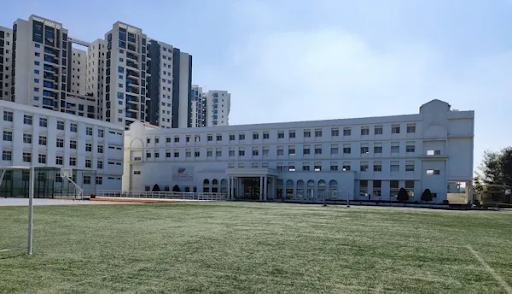
Established in 2016 in Haralur, Bangalore, The Cambridge International School represents a bold reimagining of K-12 education. Founded by educators and industry experts with four decades of combined experience, TCIS operates on a simple premise: every child possesses unique capabilities deserving recognition and cultivation. The school follows a blended curriculum combining CBSE standards with international frameworks.
TCIS structures its approach around four interconnected pillars: pedagogy, technology, well-being, and individual aptitude development. Teachers tailor instruction to match individual learning needs through inquiry-led frameworks that encourage students to question, investigate, and discover.
The STEM lab offers immersive experiences in robotics, astronomy, and environmental science. Students build robots, observe celestial phenomena, and conduct ecological research, making abstract concepts tangible. Regular assessments identify areas needing support while recognising exceptional talents across academics, sciences, arts, and sports.
TCIS introduces entrepreneurial thinking remarkably early. Through platforms like UQ Ventures and the India Future Founders Competition, students present business proposals to actual investors. These aren't theoretical exercises—students develop genuine business plans, conduct market research, and defend their ideas under questioning, building confidence and business acumen applicable across all career paths.
TCIS maintains partnerships with distinguished institutions, including the British Council, Saint Felix School London, University of Arts London, University of Mississippi, and Ashoka University. Students participate in collaborative research projects with European university researchers, exploring topics like AI Robotics. Teachers participate in exchange programs, bringing global teaching methodologies and curriculum innovations back to TCIS classrooms.
The sports program, guided by national and state-level athlete coaches, integrates athletics with academic learning. Younger students learn mathematical concepts through age-appropriate games. As they advance, sports become vehicles for understanding physics—momentum, force, and motion through basketball shots and sprints.
Results speak clearly: TCIS students have represented India at the Commonwealth Games and International Children's Olympics, with 20 national champions across skating, fencing, and basketball.
TCIS partners with Trinity College London and Berklee College of Music for advanced musical theory instruction. Visual and performing arts programs enhance spatial awareness and provide creative outlets. The Budding Novelist Program connects aspiring writers with published authors for mentorship.
Numbers tell part of TCIS's story: 100% pass rate with 85% distinctions in board examinations. Thirty per cent of graduates gain admission to IITs, NITs, NIDs, and IISERs. Twenty per cent enter prestigious international universities.
Beyond statistics, TCIS has produced published authors, young designers showcasing work professionally, musicians performing at advanced levels, and entrepreneurs launching actual ventures—proving that academic excellence and co-scholastic achievement reinforce each other when structured properly.
Progressive education is reshaping how students learn, grow, and prepare for uncertain futures. Schools like TCIS demonstrate that when education prioritises the whole child—intellectual, physical, emotional, creative, and entrepreneurial development—extraordinary outcomes become ordinary expectations. If you're seeking an environment where your child can discover their unique strengths while building skills for tomorrow's challenges, explore what multi-dimensional education can offer.
For more information on this and similar schools in the area, check out this list of the best schools in Bangalore
 as a preferred source on