







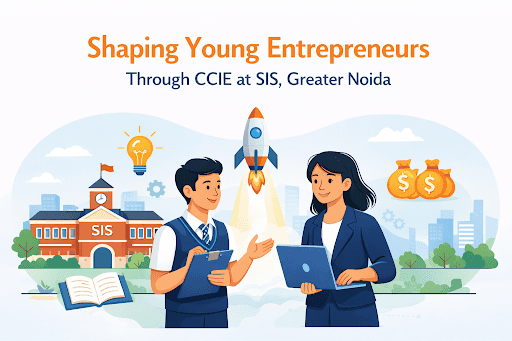

Every year, thousands of students graduate with strong grades but struggle to find their footing in the real world. They know formulas and facts, yet they freeze when asked to solve an unscripted problem. This disconnect is not a student failure. It is a signal that something important is missing from how schools have traditionally approached education. Entrepreneurship education is emerging as one of the most powerful answers to this gap. It does not just teach students how to start a business. It teaches them how to think, adapt, and act with purpose in an unpredictable world.
One of the best schools in Greater Noida, Sparsh International School (SIS), has taken a clear and purposeful step in this direction. SIS has built an environment where students do not just study subjects but also develop the mindset and skills needed to succeed in life. In this article, we explore a unique SIS initiative that places entrepreneurship at the heart of student development and examine why this approach to education matters for young learners everywhere.
Also Read | Teaching Kids to Think Like Entrepreneurs
Why Entrepreneurship Education Matters Today
Students who learn to think like entrepreneurs are more than just better businesspeople. Their character improves. Schools are grasping this. Entrepreneurship education is no longer limited to MBA and startup accelerators. It enters school hallways for good reason.
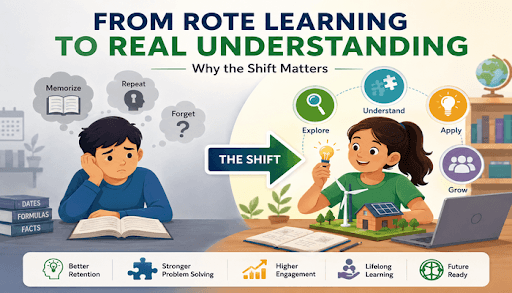
The transition began when educators observed that traditional schooling produced competent but passive learners. Students remembered information but rarely applied it. By forcing students to observe, question, experiment, and act, entrepreneurship education addresses this. Each phase mimics real-world behaviour.
It Develops a Problem-Solving Mindset
When kids learn to think like entrepreneurs, they see situations differently. Instead of waiting, they look for answers. A student working on a school entrepreneurial project may identify a neighbourhood issue, research its causes, and offer a remedy. This observation-and-action method reinforces their thinking even beyond school. They ask, "How can this be fixed?" instead of "Whose job is it to fix this?"
It Builds Confidence and Communication
Being in front of a group and presenting an idea is hard, especially for kids. Entrepreneurship programs give students regular chances to submit ideas, answer tough questions, and explain their rationale. Repeated practice reduces public expressive fear. Students learn that their voice matters and that communication may be enhanced. These experiences give individuals quiet but permanent confidence that guides their lives.
It Connects Learning to Real Life
A common criticism about school is that children don't understand what they're learning. Entrepreneurship education eliminates that complaint. When a student designs a product, calculates its cost, writes a pitch, and presents it, every subject becomes relevant. Budgeting is math. Communicate in English. Innovation from science. Life training replaces the classroom as a separate realm.
Key Skills That Entrepreneurship Education Builds

Entrepreneurship programs often present students with no right answer. On a tight budget and timeframe, a team may build a community problem solution. Students learn to analyse options, foresee repercussions, and make rational decisions under pressure. The Kauffman Foundation discovered that entrepreneurial education improves analytical thinking in pupils. Thinking critically and making sensible decisions will be useful every day, whether a kid becomes an engineer, teacher, or doctor.
Teamwork and Collaboration
Real entrepreneurs rarely work alone. People with diverse strengths must work together. School entrepreneurship programs emphasise group collaboration to reflect this. Students learn to listen, share tasks, and resolve conflicts without fighting. The World Economic Forum routinely ranks collaboration as a top employer sought talent. Entrepreneurship schools often meet this demand without students recognising it.
Financial Awareness
Adults struggle with simple financial decisions in surprising numbers. Many have never learned to budget, save, or assess risk. Entrepreneurship education makes these ideas tangible early on. A student studying financial literacy calculates the cost of creating their product and prices it for profit. According to the National Financial Educators Council, financial ignorance costs the ordinary person thousands of rupees in avoidable mistakes. Starting this education in school matters.
Creativity and Innovation
Technology and rapid change are transforming the world, yet creativity is one of the few skills that cannot be automated. Entrepreneurship education promotes this by encouraging students to experiment without fear of failure. Students in these programs learn that a failed prototype is not a loss. This is data. The information is useful. Reframing failure as a learning tool is one of the most transforming things a school can teach a child.
Also Read | From Haralur to World Stage
How Schools Can Make Entrepreneurship Education Effective
Knowing entrepreneurial education matters is one thing. Delivering well is another. Many schools try the idea but fail because the environment doesn't support it. The correct physical infrastructure, real human relationships, and real opportunity for students to test their ideas in front of actual audiences make entrepreneurship programs effective, according to research. Schools that get this right produce pupils who are better equipped for life outside the classroom.
Providing a Dedicated Space and Tools
An idea-driven student without space or resources will swiftly lose steam. Student-focused innovation labs, maker spaces, and tinkering zones demonstrate that their ideas matter. Students may turn their ideas into reality with 3D printers, electronics kits, design software, and prototyping materials. MIT discovered that students who work in hands-on creativity environments solve problems better and retain concepts longer than those who solely study theory.
Connecting Students with Real Industry Mentors
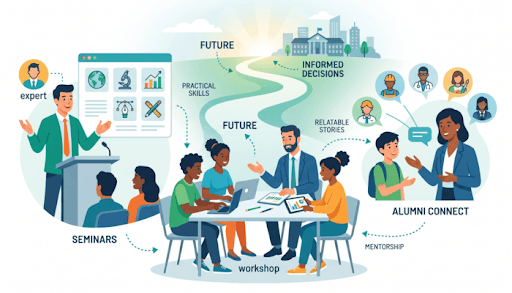
Certain information is only gained via experience. Students learn from founders, investors, and industry executives that no textbook can match. They hear about actual failures, pivots, and breakthroughs. Students' understanding becomes tangible through these exchanges. Mentorship has been shown to significantly improve student ideas through programs like the US Young Entrepreneurs Academy. Mentors do more than teach. They demonstrate possibilities to kids.
Creating Platforms to Present and Test Ideas
Public speaking sharpens ideas. Students must polish and communicate their ideas in competitions, exhibitions, and investor-style presentations. They also educate students on how to respect and use feedback to grow, a crucial entrepreneurship skill. Regular presenting opportunities in entrepreneurship programs increase student involvement and concept growth. Preparing for a presentation teaches research, organisation, and communication better than most assignments.
Check Out | Super Saturdays and Smart Classrooms
Sparsh International School, Greater Noida, and Its CCIE Initiative

One of the best CBSE schools in Greater Noida, Sparsh International School (SIS), has consistently focused on building well-rounded students since 2004. Located in Sector Omega-1, SIS follows the CBSE curriculum and places strong emphasis on both academic excellence and real-world readiness. The school has built a reputation for offering students meaningful learning experiences beyond the standard classroom.
SIS founded the CCIE, or Centre of Creation, Incubation, and Entrepreneurship. The school claims it's India's first school-level project. Students can use the CCIE to create an original idea into a product, service, or business plan. Centring isn't theoretical. With academic and infrastructural support, students think, construct, test, and refine in this live incubator.
The CCIE embraces SIS's 3C Model. The school's framework highlights Character, Competencies, and Careerism as student development cornerstones. From middle school onwards, the CCIE introduces students to entrepreneurial thinking, driving the Competencies and Careerism pillars. Students learn financial literacy, design thinking, and the UN Sustainable Development Goals. These aren't standalone lessons. They directly apply every idea to CCIE students' work.
How authentic the CCIE is sets it different. SIS encourages venture capitalists, angel investors, and financial organisations to meet shortlisted student innovators. This is not a ceremony. Students showcase their ideas, answer challenging questions, and receive structured criticism from business investors. Many kids have never experienced entrepreneurship outside of a classroom project. Students can use the school's 3D printing lab, robotics and IoT facilities, and NITI Aayog-selected Atal Tinkering Lab to develop their ideas at the CCIE.
Conclusion
Entrepreneurship education has great potential but also real challenges. The facilities, trained faculty, and institutional commitment to offer it are lacking in many schools. Since its talents don't often show up in standardised exam scores, measuring its impact is difficult. For schools that overcome these obstacles, the results are evident. Students become confident, interested, and ready to take charge in a world that requires them.
Entrepreneurship should be a basic part of student learning in schools. This requires specialised locations, mentor networks, and platforms where student ideas are scrutinised. It also requires training and support for teachers to facilitate this type of learning.
Already, SIS Greater Noida follows this approach. The institution has created an ecosystem where students not only dream about making a difference but also start doing so through the CCIE. India needs more problem-solvers and innovators, so what SIS is doing with its students may define its future.
For more information on this and similar schools in the area, check out this list of the best schools in Greater Noida.




 as a preferred source on