




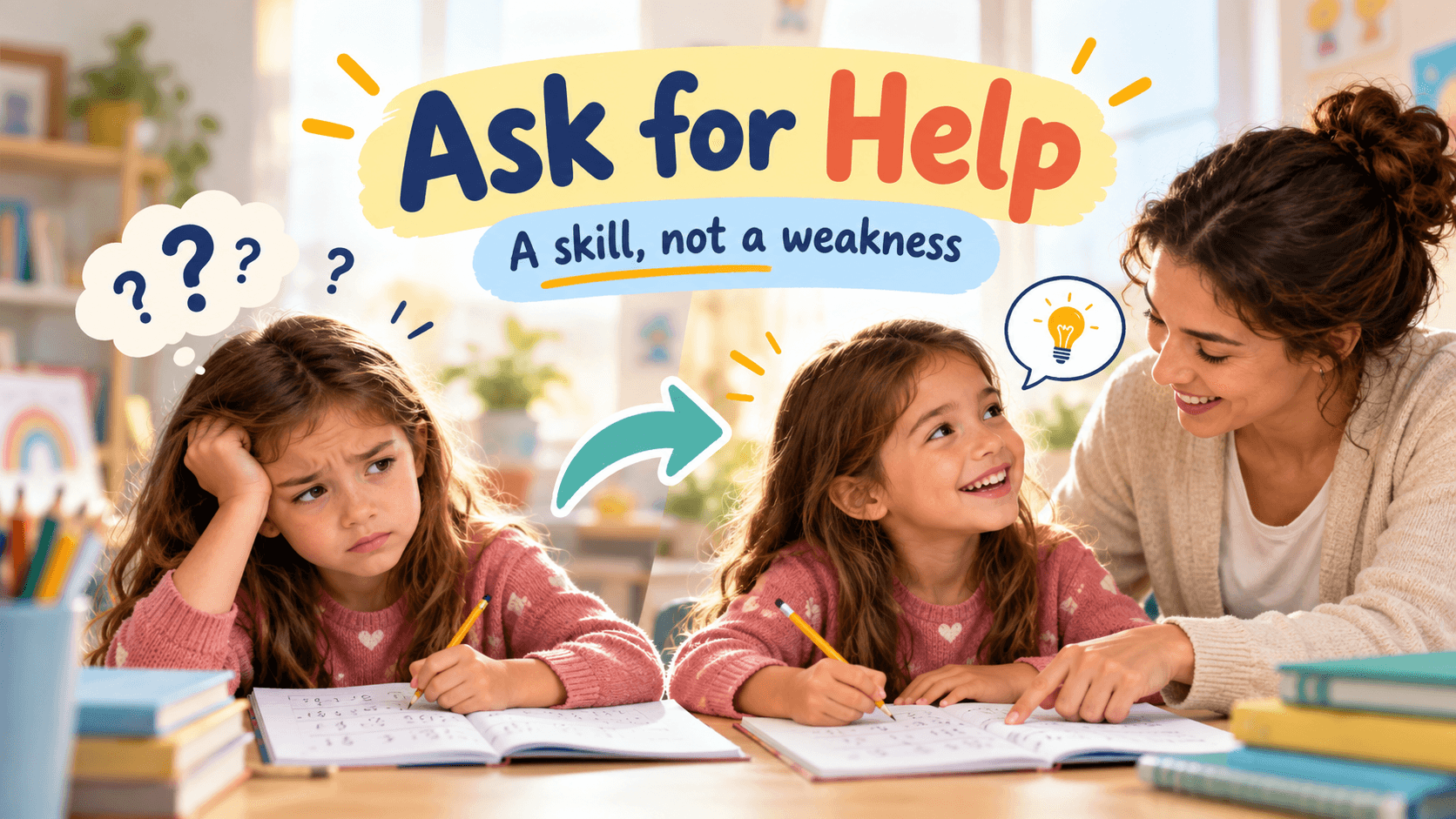

Imagine your child spending nearly an hour struggling with a mathematics problem. They erase their answer repeatedly, become frustrated, and eventually close the notebook without completing the question. When you offer assistance, they respond, "I should be able to do it myself."
Many parents encourage independence because they want their children to become confident problem-solvers. However, independence does not mean handling every difficulty alone.
Knowing when to ask for help is an equally important learning skill. For parents exploring the Best School in Gurugram, understanding how schools encourage questions and provide guidance deserves attention. The educational philosophy of Presidium School (PS), Sector 57, Gurgaon, offers a relevant connection to this approach.
Why Do Some Children Hesitate to Ask for Help?
Children may avoid asking questions even when they recognise that they need assistance.
One common reason is the fear of appearing less capable than their classmates. A child who believes everyone else understands a lesson may feel embarrassed about raising their hand.
Others may worry that teachers or parents will become disappointed if they cannot solve a problem independently.
Some children also misunderstand independence. They may believe that asking for assistance means they have failed or are not intelligent enough.
These feelings can become particularly noticeable when academic expectations increase.
Research on academic help-seeking recognises that students sometimes continue struggling or give up rather than request support, even when they know they need it.
Parents can help by explaining that seeking guidance is not a weakness. It is a practical response when existing knowledge or strategies are insufficient.
Why Asking for Help Is an Important Learning Skill
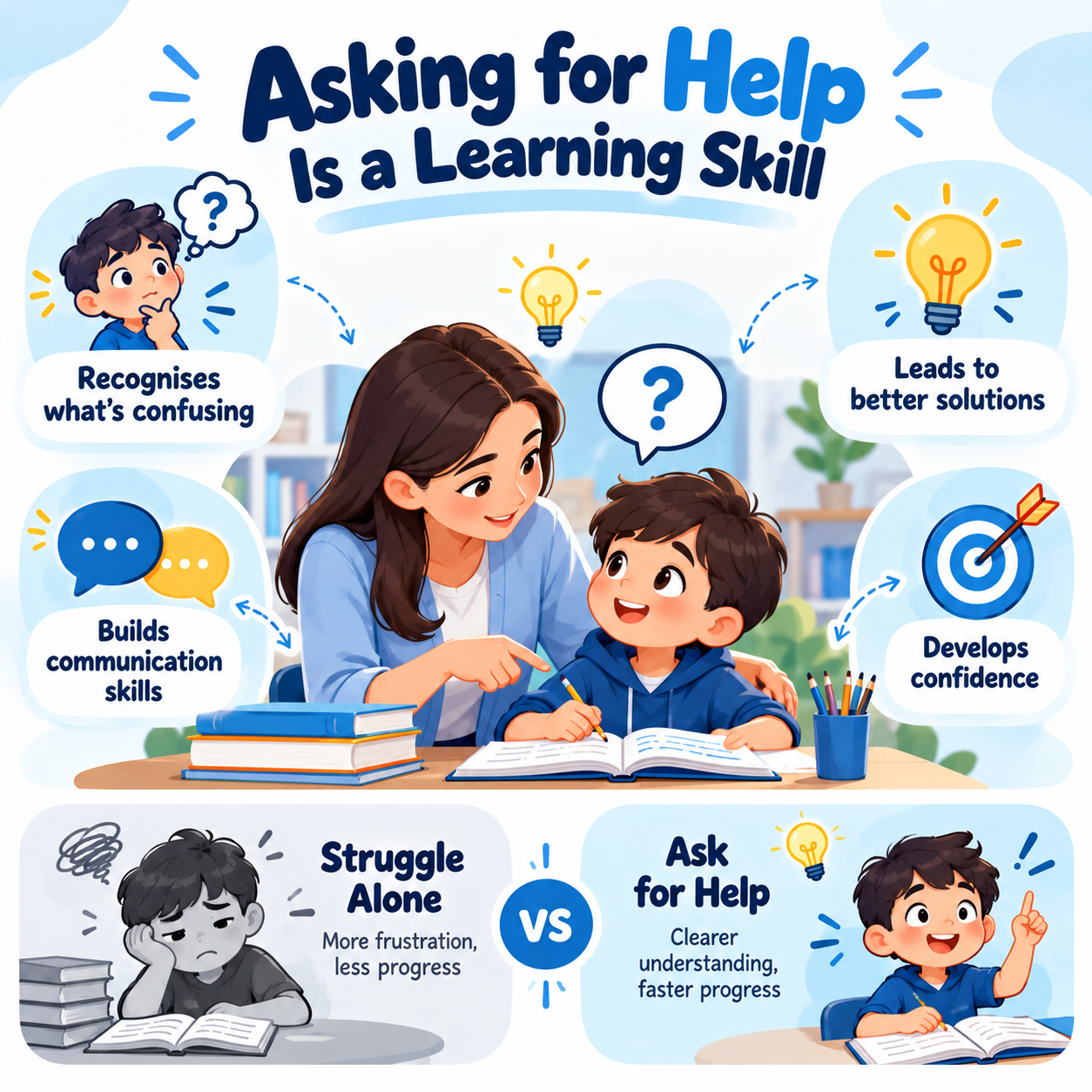
1. Helps Children Recognise Their Learning Gaps
Before asking for help, children must identify what they do not understand.
For example, a student solving a fraction problem might understand addition but struggle to identify a common denominator.
Recognising the exact difficulty allows them to ask a more useful question instead of simply saying, "I don't understand anything."
The Education Endowment Foundation highlights the value of helping students plan, monitor and evaluate their learning.
Learning to recognise when a strategy is not working is an important part of this process.
2. Encourages Better Problem-Solving
Asking for help does not always mean requesting the correct answer.
A child might ask a teacher to explain a difficult step, suggest a different approach, or provide an example.
These conversations can help children develop strategies they can use independently later.
Educational researchers distinguish between asking for explanations that support understanding and requesting answers merely to finish a task.
The first approach encourages learning, while the second may create unnecessary dependence.
3. Develops Communication and Self-Awareness
Explaining a difficulty requires children to organise their thoughts and communicate what they need.
For instance, saying, "I understand the question, but I don't know which formula to use," gives a teacher more useful information than remaining silent.
Over time, children can become more comfortable expressing uncertainty and discussing their learning needs.
However, children develop these abilities at different rates. Some may require additional encouragement or a quieter setting before they feel confident asking questions.
How Parents Can Teach Children to Ask for Help
Parents can develop healthy help-seeking habits through ordinary conversations and homework routines.
Encourage Effort Without Expecting Perfection
Allow children to attempt manageable problems independently before offering assistance.
If they become stuck, ask what they have already tried and where the difficulty begins.
This approach recognises effort while making it clear that struggling indefinitely is unnecessary.
Teach Children How to Ask Specific Questions
Instead of encouraging children to say only "Help me," teach them to describe the part they find difficult.
For example:
- "Can you explain this step again?"
- "Could you show me another example?"
- "I tried this method, but it isn't working. What should I check?"
Specific questions can help children receive explanations rather than ready-made solutions.
Respond Calmly When Children Make Mistakes
If children are criticised whenever they misunderstand something, they may become reluctant to reveal their difficulties.
When your child asks a question, listen patiently and acknowledge their effort to understand.
Avoid immediately completing the task for them. Offer hints or explanations, then encourage them to continue independently.
Help Them Identify Trusted Sources of Support
Children should know whom they can approach when different problems arise.
Teachers can help with academic confusion, while parents or other trusted adults may provide support with emotional or social concerns.
Importantly, children should understand that concerns involving bullying, safety, threats, or inappropriate behaviour should be reported to a trusted adult promptly, without waiting to solve them alone.
How Schools Can Create an Environment Where Asking Questions Feels Safe
Children are more likely to seek academic guidance when classrooms make uncertainty an acceptable part of learning.
Teachers can encourage this by welcoming questions, explaining concepts in different ways, and avoiding embarrassment when students provide incorrect answers.
Group discussions and guided problem-solving activities can also provide opportunities for students to share difficulties and learn from one another.
Research from Oklahoma State University's Motivation in Classrooms Lab recommends responding to help requests with useful explanations and hints rather than immediately supplying answers.
When comparing schools, parents can ask how teachers support hesitant students and whether children have opportunities to seek clarification outside whole-class discussions.
Such practices help make guidance available without discouraging independent effort.
How Presidium School Encourages Questions and Guided Learning
When parents search for the Best School in Gurugram, it is worth examining whether children are encouraged to ask questions and express their learning difficulties. Presidium School (PS), Sector 57, Gurgaon, is associated with an educational approach that emphasises communication, curiosity, and student participation.

According to the school's official Lifemakers curriculum information, teachers aim to encourage children to ask questions and seek answers rather than simply provide ready-made solutions. The programme also identifies communication skills, emotional awareness, and confidence as important aspects of development. These stated principles relate to helping children become comfortable expressing uncertainty while developing independent thinking. For parents comparing options for a Top School in Gurugram, understanding how teachers respond when students need guidance can provide useful insight into the learning environment.
Conclusion
Children need opportunities to solve problems independently, but they should also understand that seeking help is a responsible decision when they encounter difficulties.
Parents can encourage this balance by recognising effort, welcoming questions and providing guidance without taking over every task.
The goal is not to raise children who never need assistance, but to help them recognise when support is useful and gradually develop the skills to move forward independently.
For more information on similar schools, check out this list of the best schools in Gurugram.











 as a preferred source on