






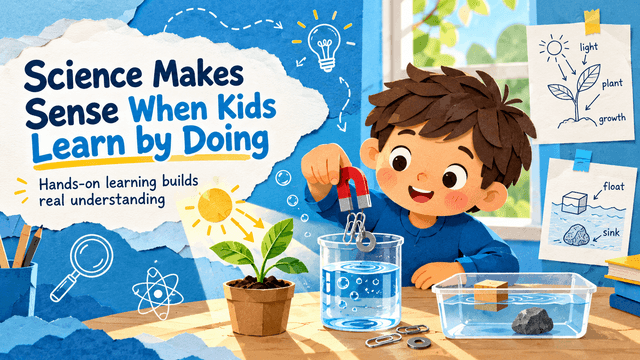
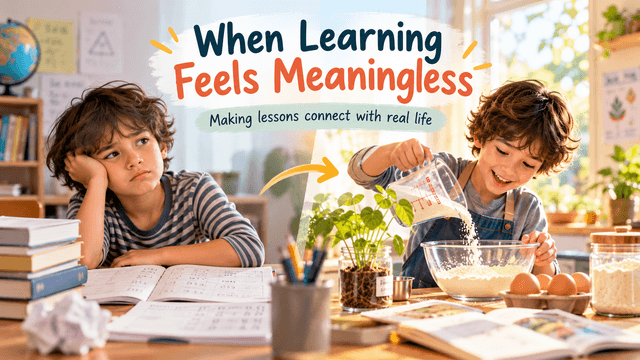
Children learn so much from their textbooks, but learning doesn't have to end with reading and memorising. They learn far more when they get the opportunity to do things for themselves. A good example would be reading about plants in a textbook and learning all the things that plants need to grow. Growing a plant themselves is a far more effective way of learning the concept.
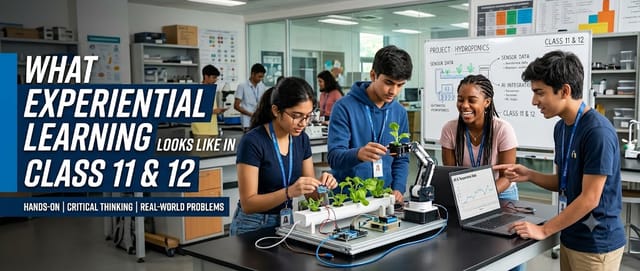
This is where the value of hands-on learning comes in. Through projects, experiments, and practical work, the child is able to explore new ideas and put what they have learned into practice. It's through these experiences that they develop a range of other skills too (problem-solving, working in teams, creativity, communication, etc.) which are all useful both in and out of the classroom.
Also Read| Fostering Global Awareness and Personal Growth
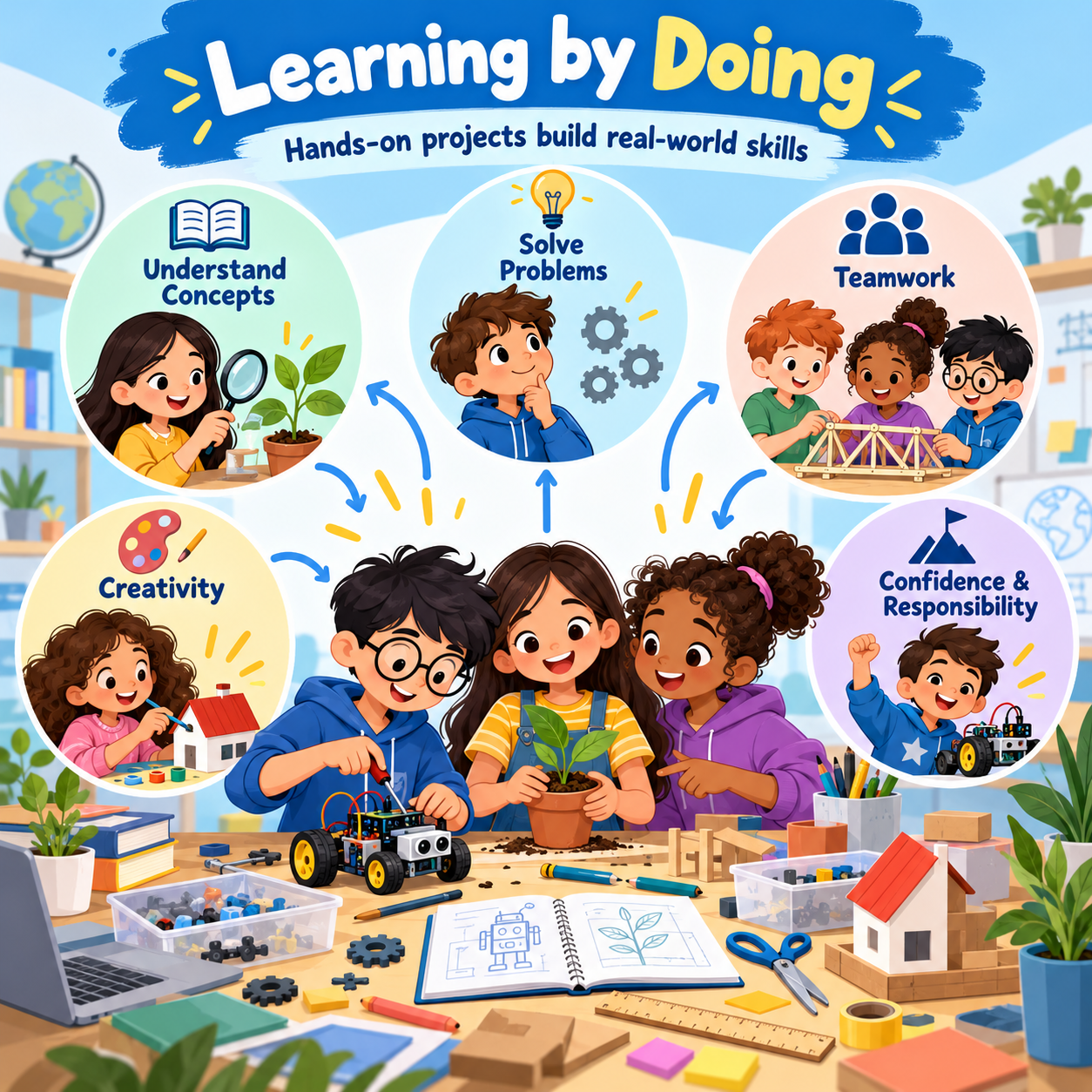
Learning by Doing Makes Concepts Easier to Understand
Sometimes kids find it hard to get their heads around a subject if they're just reading about it in a textbook. Practical work gives them the opportunity to see how things actually work in the real world, and that makes it far more interesting and easier to understand.
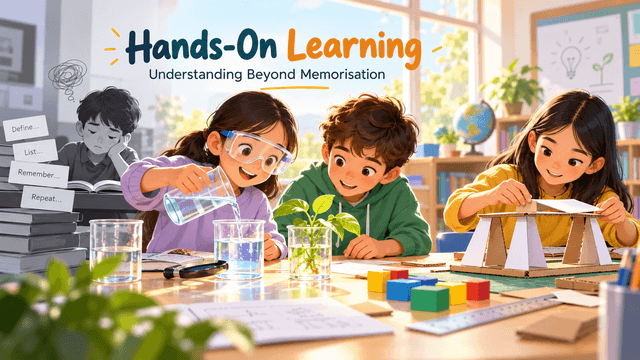
A group of kids in science might be looking at bridges and build a small bridge out of paper or ice-cream sticks. They can then put weight on it and see what happens when they alter the design. It's a very practical way of learning about strength, balance and structure.
Similarly, measuring out the ingredients as you're making a simple recipe can be a good way of teaching children about measurement and fractions. Growing plants can be a good way of teaching them about light, water and the conditions required for growth.
These activities link the classroom work to real-life experiences. The children are given the opportunity to ask questions, to investigate different options and to understand why things are as they are. Rather than just learning facts, they learn how to use them.
How Projects Teach Children to Solve Problems
Not every project works perfectly on the first go. A model may well fall to pieces, an experiment may produce an unexpected result, or an idea may simply not work. These are, however, potentially very valuable learning experiences for the child.
When kids are working on a project, they need to be thinking about what they want to achieve and how they're going to achieve it. If something does go wrong, they can go and find out why and then try a different approach. That's the way they learn to solve problems.
For example, suppose the children are asked to build a paper tower that will stand on its own. Their first attempt is likely to collapse. They can then try making the base wider, folding the paper differently, or rearranging it. Each of those attempts will give them a better understanding of what will work.
Such experiences also teach the child that making mistakes is an inherent part of the learning process. They learn that failure doesn't necessarily mean you can't do something. It may simply mean you need to try a different approach.
Over time, children can become more patient, more independent, and more willing to face the unknown. These are all qualities which will help them in dealing with problems at school and in everyday life.
Building Skills Beyond Textbooks
Hands-on projects do more than just help the children to learn the subject matter. They also give them the opportunity to develop a range of skills which are useful in many other areas of life.
Teamwork and Communication
Children do a lot of group projects in school. To complete the project, they will have to work together, share ideas, and distribute the work. While doing the project, they will learn to listen to each other and to articulate their own ideas.
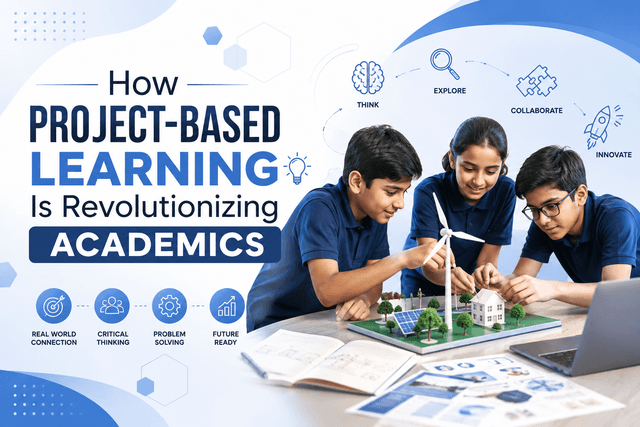
For instance, in the construction of a sustainable house model, one child might be responsible for the design, another for the model itself, and a third for gathering the information on energy conservation. To complete the project successfully, they all need to get involved in the project.
Children also learn how to deal with opinions different from theirs while working in the group. They learn that we can often arrive at a better solution if we listen to them carefully.
Creativity and Independent Thinking
Projects give the child the freedom to explore their own ideas. Unlike a question which has one correct answer, many practical activities can be done in a number of different ways.
For instance, children asked to re-use waste materials might make pen stands, storage boxes or bird feeders. Each child would be able to produce a different design.
These experiences are all about getting the child to think laterally and consider all the possibilities. They're also about learning to make decisions rather than simply waiting to be told what to do.
Confidence, Responsibility and Time Management
Completing a project can give the child a real sense of achievement. To see their own ideas become something useful is a very satisfying experience and can lead to increased confidence in their own abilities.
Projects also teach children how to plan their work. They have to source the materials, work out what they need to do first, and then complete the various tasks within the time available. The whole process of working to a deadline is a very useful lesson in planning and in taking responsibility.
Presenting a finished project to their classmates will of course also give them more opportunities to speak and explain their ideas. It's a valuable experience in itself in terms of preparing them for future work both in an academic context and in life.
Also Read| The Complete Education Experience: What Makes a School Stand Out
How Manav Rachna International School Encourages Practical Learning
Practical learning is made possible at Manav Rachna International School, Gurugram Sector 51 through the presence of facilities such as the unique Makershala, smart classrooms and digital laboratories. These learning spaces provide opportunities for students to be creative and interact with technology in a number of different ways.

Through participation in learning activities that encourage exploration and creativity, students are able to relate the theories learned in the classroom to real-life experiences. This enables children to develop problem-solving skills and other skills that they can use in their everyday life.
Preparing Children for Real-Life Challenges
Education is not only about learning the facts or getting good marks. It is about how children can apply their knowledge in different contexts. This is what the project work is all about. This gives them the chance to explore, experiment, and find their own solution.
Whether they're building a model, doing an experiment, or working on a group project, each activity can teach them something. They learn to think for themselves, to work in a team, to manage their time and to refine their ideas.
When schools give opportunities for practical learning, children start to see mistakes as chances to learn from and challenges as opportunities to learn from. That in itself is a very valuable thing as it gives them a real basis on which to build for the future, both in terms of their studies and in terms of their lives. Children don't learn simply by being told or by being read to. They learn by doing, by making things, by trying things out for themselves.
For more information on similar schools, check out this list of the best schools in Gurugram.



 as a preferred source on