









There is a special kind of sorrow only a parent understands that happens at 7:45 a.m. when your child's tiny fingers grasp at your sleeve, a chin trembles, and eyes look so scared of some unknown fear that she/he is only 5 years old and doesn't have the words for: I am not ready. I am scared. Please don't leave me. You separate her fingers from your sleeve one at a time. You give her to a stranger in a uniform. You walk to the car, sit behind the wheel, and before even switching on the engine, you break down.
This was a mothers Monday to Friday emotional torment for nearly four months. And finally, the mornings when the child refuses to get out of bed, not because of obstinacy but because of a deep-seated emotion: a feeling that they do not want to leave, often because of fear of being around people they do not know or trust. They look for an environment that comforts them, keeps their minds productive, develops them, and makes schooling fun, just like Sunbeam World School, one of the best online schools in India, does.
In this article, you will get to know how your cute little kiddo can benefit more from online schooling than any other and how a safe environment will help your child gain better knowledge.
Also Read: How Astachal Reflects the Power of Daily Reflection in Student Life
When School Comes Home – And Home Becomes Everything
There is a silent revolution coming up in Indian households. Not in boardrooms or policy papers but on the carpets, kitchen tables and in the corners of bedrooms where seven-year-olds read aloud to their baffled, delighted fathers. It's not the revolution one would expect. It's a child doing morning yoga before her first class. It's a grandmother silently wondering how her grandson solves abacus problems so fast. It's life that is learning, albeit the learning is happening within life and not instead of it.
The essence of the idea of online primary education is both simple and radical: What if going to school didn't have to mean leaving? What if, instead of taking your child away from everything familiar and safe, we brought learning to the place where she/he is already brave? For early learners, Nursery, LKG, UKG, Class 1, Class 2 children who are still figuring out their own feelings, this question is not abstract. It's everything.
And not just feeling, the safety matters too. If your child is feeling unsafe or is scared to go to school, they won’t learn anything. How? Let’s discuss it.
The Science of Safety, and Why It Matters More Than You Think
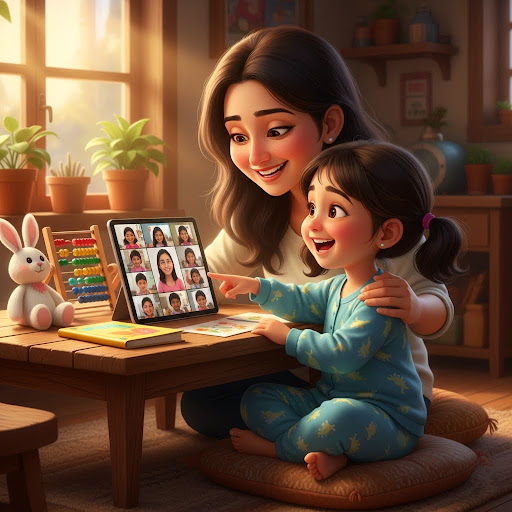
A child who does not feel safe is unable to learn. Yes, no school brochure will let you know, but this is what child psychologists say.
It is not a hypothesis but a hard fact of human biology. The nervous system of a small child under stress due to being separated from attachment figures, experiencing loud noise, strangers and high-performance demands of a traditional classroom for a long time, easily switches to survival mode. The prefrontal cortex, responsible for curiosity, creativity and memory, is the first to get shut down.
You can have the best teachers in the world. The most colourful classrooms. The most expensive curriculum. However, a scared five-year-old won't be able to take in almost anything from them.
Online primary education, when done well, addresses this at the root. A child logging into class from her own room is wearing her favourite pyjamas. Her mother is nearby. Her comfort toy is on the desk. The teacher's face on screen is kind, familiar, and consistent. The class is small. There is no corridor chaos, no cafeteria noise, no bewildering social geometry to decode before she/he's even sat down.
There is just: Good Morning, have a great day learning! Spending time with your child is not enough for learning. Do you know what your child really needs? In what environment do they learn better? Let us tell you.
What Your Child Actually Needs and Rarely Gets?
Ask any parent what they wish for their child between the ages of three and eight, and their answers are unbelievably similar:
- I want her/him to love learning.
- I want him/her to be confident.
- I want her/him to still be herself when she/he gets home.
These desires sound very simple. Actually, they are extraordinarily difficult to maintain in the industrial framework of most traditional schools, where thirty children have to move, sit, and perform together, whether or not any individual is ready.
Small classes radically transform that. When a teacher is dealing with fifteen or twenty children instead of forty, a child of six doesn't have to wait for twenty minutes to ask a question. The question gets an answer. The exact moment of confusion, the very moment where real learning occurs, doesn't go unnoticed.
Besides school work, young learners require an opportunity to be exposed to things that gradually build their confidence and competence, such as reading, basic mathematics, creative outlets, and nowadays also basic digital skills. They need a speed that honours their growth instead of rushing past it. And most importantly, they need to feel... above all, that school is a place that belongs to them. And not only your child, but even you need to come together for their learning. Why? Let us expose the answer.
Parents Don't Just Send Their Children Here. They Come Too
One of the quiet, underappreciated gifts of online primary education is what it gives back to the family. It is not the four-year-old seeing the teacher for the first time in a classroom that you have never seen, but at the dining table, where your little kiddo learns the alphabet, and where you witness it. You become a part of their story through learning. You see the exact moment something clicks. You hear the little gasp of discovery.
Fathers working from home find themselves sitting in on a Class 2 EVS lesson about plants and then walking to the garden together. Grandmothers who never went to school beyond Class 5 sit next to grandchildren and learn the parts of a flower.
Siblings help each other with French vocabulary before dinner. The Online school does not just educate children. It silently educates families. It gets them involved in a shared practice of learning that most traditional schooling, by its very geography, makes impossible.
What else is education for when your child not just learns but finds fun in it and does not want to skip school anymore?
Check Out: Some Easy Ways to Increase Focus in Preschoolers
How is Sunbeam World School Doing This Well?
Sunbeam World School carries the legacy of Dalimms Sunbeam School, an institution with nearly five decades of educational heritage built on the belief that learning should change people, not merely credential them. When the world shut down in 2020, and families scrambled to hold childhood together from kitchen tables, the Sunbeam, one of the best CBSE online schools in India, made a deliberate choice: not a temporary fix, but a genuine commitment to building something better.

Today, Sunbeam World School is a fully accredited online K-12 school recognised by CBSE, NIOS, Cambridge, IAO, and the Northwest Accreditation Commission, with students across more than 130 countries.
For early learners specifically, the school maintains a 20:2 student-to-teacher ratio, with a dedicated assistant focused on doubt resolution and individual observation. Alongside the CBSE-mapped core curriculum, children are introduced to coding, expert reading, and other skills designed to build genuine competence alongside academic knowledge. A parent access portal keeps families transparently connected to their child's progress, grades, assignments, and teacher communications, all visible.
But perhaps what matters most is simpler than any of that. One mother, who had spent four months watching her daughter/son cry through every drop-off at a traditional school, enrolled her child in Sunbeam's Nursery programme. On the first day of class, her daughter giggled.
To learn more about this and other such online schools, explore this list of the best online schools in India.






 as a preferred source on