








Have you ever noticed how children learn faster when they touch, play, and explore rather than just listen? For young learners, education isn’t just about memorizing the alphabet or numbers; it’s about engaging all the senses to make learning meaningful and fun.
GD Goenka International School understands this deeply. Its Pre-Primary Wing is designed to nurture curiosity through a multi-sensory approach, giving children opportunities to learn with their hands, eyes, ears, and imagination.
In this article, we explore why multi-sensory learning is so effective for early childhood education, how it shapes better understanding and confidence, and how GD Goenka International School, one of the best schools in Greater Noida West, brings it to life through innovative activities and specially designed spaces.
Also Read: How Sports & PE Build Character and Resilience in SchoolWhy Multi-Sensory Learning Matters
Children between the ages of 3-6 are naturally curious and learn best by exploring the world with all their senses. Instead of simply memorizing facts, they thrive when learning involves seeing, hearing, touching, moving, and interacting. A multi-sensory approach helps them:
-
Understand concepts better: When children can see, hear, and physically engage with what they are learning, like counting blocks, singing alphabet songs, or matching colors, they form deeper mental connections. This leads to better comprehension and longer retention of concepts.
-
Stay engaged and focused: Young learners often struggle with sitting still for long periods. Activities like puzzles, interactive storytelling, and art keep their attention, turning lessons into enjoyable experiences instead of repetitive drills.
-
Develop fine and gross motor skills: Using clay, stacking blocks, cutting shapes, or jumping in rhythm helps children strengthen hand-eye coordination, build finger dexterity, and improve overall body balance, crucial for later writing and physical development.
-
Boost creativity and imagination: Multi-sensory learning encourages children to think outside the box. They are free to invent stories, role-play scenarios, and express emotions, which enhances their ability to solve problems and come up with new ideas.
-
Build confidence early: When children explore and discover answers on their own, they feel a sense of achievement. This boosts their self-esteem and motivates them to keep learning, creating a positive cycle of curiosity and confidence.
Key Elements of Multi-Sensory Education
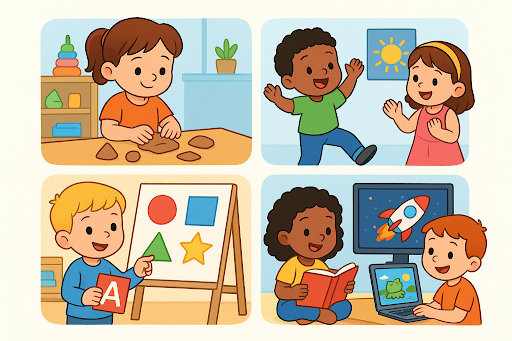
A strong early-years program goes beyond textbooks and worksheets. It combines a variety of interactive, sensory-rich experiences to make learning meaningful, fun, and memorable for every child.
-
Hands-on exploration: Activities like clay modelling, sorting games, and tactile puzzles help children literally “feel” what they are learning. This physical engagement deepens understanding, for example, touching different shapes makes geometry real rather than abstract.
-
Movement-based learning: Songs, dance, and action rhymes keep children active while teaching key ideas like counting, body parts, or days of the week. This kinesthetic learning improves coordination and helps children associate physical movement with concepts, making them easier to recall later.
-
Visual stimulation: Bright charts, flashcards, and colorful classroom displays capture children’s attention and reinforce memory. Visual cues help them link words with pictures, improving vocabulary, reading readiness, and concept recognition.
-
Auditory learning: Storytelling sessions, rhymes, and phonics exercises build strong listening and language skills. Exposure to sounds and rhythm improves pronunciation, communication, comprehension, and early literacy development.
-
Technology integration: Smart classes and multimedia tools bring lessons to life. Animated videos, interactive quizzes, and digital games make abstract concepts, like seasons, space, or basic science, easy to understand and exciting to explore.
GD Goenka International School: Where Learning is an Experience

GD Goenka International School, one of the best CBSE schools in Noida West, redefines early education by taking it far beyond ABCs and numbers. The school’s Pre-Primary Wing is designed to make every day exciting and meaningful for children through a multi-sensory, activity-driven approach that sparks curiosity and love for learning.
Highlights of GD Goenka’s Pre-Primary Approach
-
Interactive concept rooms: Each room is built around a specific theme, turning lessons into real-life experiences. For example, children might explore a “mini market” to learn about money or step into a “nature corner” to understand plants and seasons.
-
Smart Class technology: Age-appropriate digital lessons and animated visuals make abstract ideas easy to grasp. This keeps children engaged and introduces them to technology as a natural part of their learning process.
-
Activity-based curriculum: From group projects to role plays and hands-on puzzles, children are encouraged to actively participate. These experiences build collaboration skills, problem-solving ability, and confidence.
-
Creative art sessions: Clay modelling, painting, and craft activities allow children to express their imagination freely. These sessions also strengthen hand-eye coordination and fine motor development, preparing them for writing tasks.
-
Focus on holistic growth: Beyond academics, the school nurtures communication skills, emotional intelligence, and confidence. Circle time, storytelling, and interactive games teach children how to express themselves and work well with peers.
At GD Goenka International School, learning is not a race, it’s a joyful journey. By the time children graduate from the Pre-Primary Wing, they have built strong foundational skills, a love for exploration, and the courage to ask questions, preparing them to thrive in primary school and beyond.
For more information on this and similar schools in the area, check out this list of the best schools in Noida Extension.












 as a preferred source on