








The Sainik School medical test 2026 is conducted at a government or military hospital after the AISSEE written exam. Students receive a call letter for this stage, and are called in a ratio of 1:3. Doctors check vision (6/6 in one eye, 6/9 in the other), colour vision, hearing (no ear disease or unhealed perforation), and overall health, including heart, lungs, bones, speech, ENT, skin, and kidneys.
Healed minor issues may be allowed. Only those declared fit by the Medical Board can proceed for Sainik School Admission and document verification; candidates who fail the medical test are not admitted, even if their written exam performance was excellent.
Ready to Find the Best Boarding School for Your Child?
Discover Boarding Schools in India 2026-27
Also Read: Documents Required for Sainik School
Sainik School Medical Test Date 2026
Parents and students can check the tentative dates, along with other important details, for the Sainik School medical test below:
|
Particulars |
Details (Tentative) |
|
Sainik School medical test date 1 |
3rd week of March 2026 |
|
Sainik School medical exam - Tentative date 2 |
4th week of March 2026 |
|
Timing for Sainik School Medical Test |
Usually starts from 9 AM |
|
Duration for Sainik School Medical Exam |
3 to 4 days |
Also Read: Sainik School Entrance Exam Syllabus
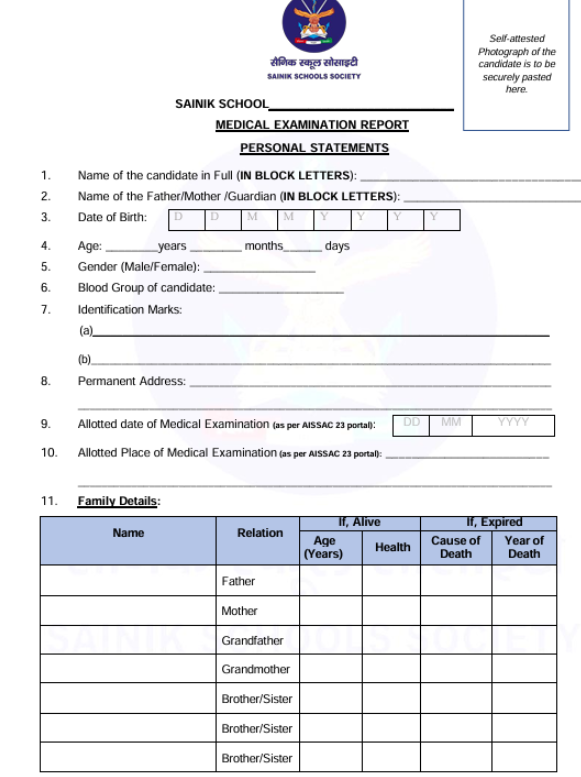
Sainik School Medical Test Form
Students who pass the AISSEE exam and get a provisional seat through Sainik School E-Counselling will receive a medical form online from their chosen Sainik Schools. This form is 15-16 pages long and includes their name and registration details. The form also includes family details along with a family history of certain diseases. They need to download the form and bring it along on the Sainik School medical date.
Sainik School Medical Form - What details are present?
The Sainik School medical form contains the following details:
-
Students’ Personal Details (Name, DOB, Gender, Blood Group, Any identification mark(s), etc.)
-
Medical Exam Centre Venue and Date
-
Family Details
-
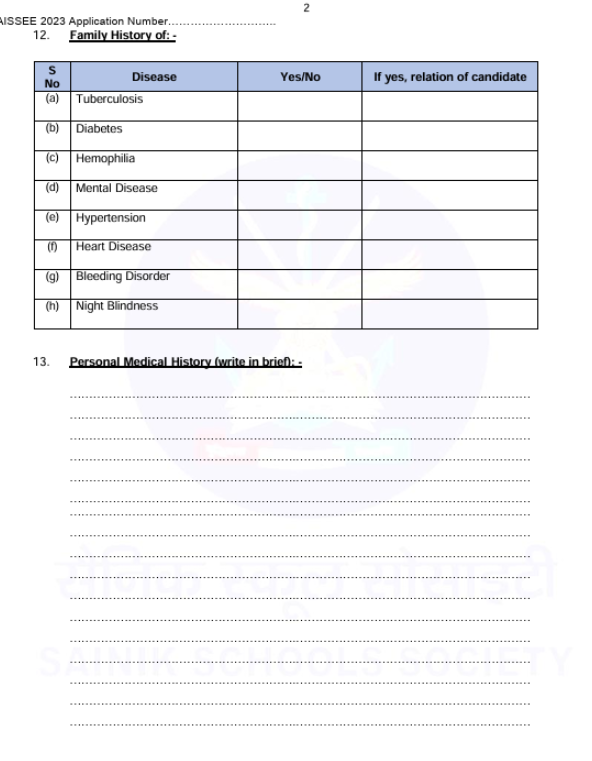
Family History of Diseases like TB, Diabetes, Haemophilia, Mental Disorders, etc.
-
Personal Medical History - this has to be briefly written by candidates or their parents.
-
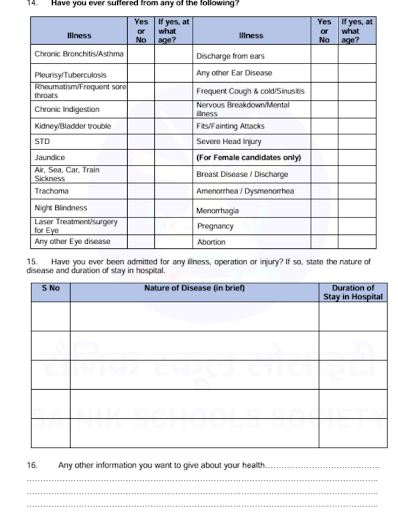
A section of “Have you suffered from any of the following?” - this section has a listed set of diseases, and students must answer in Yes or No. If the answer is Yes, then they have to mention age as well.
-
A section of “Have you ever been admitted for any illness, operation or injury? If so, state the nature of the disease and the duration of stay in hospital.” - In this section, students or parents will need to provide the nature of the disease and the duration of hospitalisation.
-
A section of “Any other information you want to give about your health” - in this section, parents or their wards can briefly mention any relevant health issues.
-
A section of “Vaccination Details” in which students or parents must also attach their vaccination card for reference purposes.
-
Lastly, there’s a self-declaration that must be filled out by parents or their wards, and it includes the following details:
-
Signature of Candidate
-
Name of Candidate
-
AISSEE 2026 Application No
-
Signature of Father/Mother/Guardian
-
Name of Father/Mother/Guardian
-
Date
-
Important Note: After self-declaration, there’s a medical examination form of 10-11 pages that will be filled by the civil/military doctor who’s performing the medical test of students. It includes some of the important details like:
Measurements and Physical Statistics
- Height (without shoes) in cm
- Weight in kilograms
- Chest measurement: normal & expansion (the minimum expansion expected is specified) and how it is to be taken.
Vision and Eyesight
- Uncorrected and corrected vision (right eye, left eye)
- Colour vision status.
- Limits of myopia/ hypermetropia (including astigmatism).
Hearing
- Basic speech test
- Audiometric readings, if needed
Orthopaedic / Musculoskeletal
- Checks for flat feet (rigid or flexible), knock knees, general alignment of limbs, etc.
- Examination of joints, spine, limbs.
Dental Examination
-
Number of sound teeth (“dental points”) required, presence of certain anterior and posterior teeth.
Sainik School Medical Test Form - Sample PDF Link
Parents and/or students can directly click on the link given below to view and download the PDF for the Sainik School medical exam form, for their better understanding and clarity:
Also, parents and students can check some sample images for the Sainik School medical test form below for a quick overview:
Also Read: Sainik School Admission Process
Ready to Find the Best Boarding School for Your Child?
Discover Boarding Schools in India 2026-27
Documents Required for Medical Test for Sainik School
Documents (originals and self-attested photocopies) that are usually required during the Sainik School medical test are as follows:
-
Admit Card/ Call Letter for AISSEE/ Medical Test.
-
Photo ID
-
Medical Fitness Form
-
Proof of Date of Birth
-
Photo ID Proof
-
Domicile Certificate
-
Caste Certificate, if applicable
Note: There may be a difference in the documents required on the day of the medical test. Students must check with their respective Sainik School for these requirements, and can also go through the official website to know the exact list of documents required for the medical date of Sainik School.
Also Read: Sainik School Admission Online Application Form
Sainik School Medical Admit Card 2026
There’s no separate Sainik School medical admit card issued during the medical test. After the Sainik School Entrance Exam results and e-counselling, shortlisted candidates get a call letter or medical form with their name and registration details. They must download and print this form from their profile and show it at the nominated hospital for the medical examination.
Also Read: Sainik School Fees Structure
Sainik School Medical Test Process
Here you can check what step-by-step procedures the medical test for Sainik School includes:
-
A team of qualified doctors and nurses conduct the Sainik School medical test.
-
They first do a physical examination by checking height, weight, and other important body measurements. They also look for any deformities or health problems.
-
They carry out a vision test to make sure the student has clear eyesight, which is important for activities like shooting and navigation.
-
They do a hearing test to confirm that the student can hear well, which is necessary for communication and awareness of dangers.
-
They conduct a dental examination to check the teeth and gums, since good dental health is important for overall health.
-
They ask about the student’s medical history, including past illnesses, surgeries, or allergies. This helps them decide if the student is fit for the tough training at Sainik School.
-
They perform blood and urine tests to find out if the student has any hidden health problems or infections.
Finally, all the medical reports are combined, and candidates are declared any one of the following:
-
Fit – Eligible for admission
-
Unfit (Temporary) – May be given a chance for review/appeal (e.g., wax in ear, dental caries, temporary illness)
-
Unfit (Permanent) – Serious untreatable conditions (heart disease, severe deformity, epilepsy, etc.).
Also Read: Sainik School Eligibility Criteria
Ready to Find the Best Boarding School for Your Child?
Discover Boarding Schools in India 2026-27
Sainik School Medical Result - Review and Appeal Process
Here’s the stepwise process of how parents can review and appeal for their wards who were declared medically unfit for Sainik School admission:
-
If doctors say a candidate is not medically fit, the school sends a written notice to the parents or guardian.
-
This notice clearly tells them what health problem or defect caused the rejection.
-
Parents or guardians have 15 days from the day they receive the letter to appeal to the Principal.
-
The appeal must include a medical report from a Government Specialist Doctor.
-
In the report, the doctor must say:
-
They have read the school’s rejection letter and know the defect mentioned.
-
They have checked the candidate carefully for that defect.
-
They find the candidate fit, even though the earlier decision said they were unfit.
-
-
Parents must also pay a medical review fee when they appeal (example: Rs 100 for General category, Rs 50 for SC/ST).
-
The Principal studies both the appeal and the medical report and decides if a Review Medical Board should check the case again.
-
If the Principal allows it, the school forms the Review Medical Board.
-
The candidate must appear before the Board in person at the given place, and the parents or the candidate must pay all travel and related costs.
-
If the Review Medical Board declares the candidate fit:
-
The school adds the candidate’s name back to the admission list as per merit.
-
The medical review fee is returned.
-
-
If the Review Medical Board again declares the candidate unfit, the rejection stays final. No further appeal is allowed within the school.
-
During the appeal process, the Principal may keep the admission status on HOLD. This means the seat stays reserved for the candidate until the review result is final.
-
Parents or candidates must pay all expenses for travel, stay, or any related costs during the review.
Also Read: Sainik School Class 6
Sainik School Medical Test - Vision Standards
Candidates must follow either Standard I or Standard II for distant vision. In Standard I, both eyes must see clearly at 6/6 without glasses. In Standard II, the better eye must see 6/6, and the weaker eye must see 6/9, but both can use correction to reach these levels.
The rules for eye power are also strict: myopia (short-sight) cannot be more than -1.5 diopters, including astigmatism, and hypermetropia (long-sight) cannot be more than +2.5 diopters. Candidates can check the table below for the general vision guidelines for the medical test for Sainik School:
|
Parameter |
Requirement/ Limit |
Additional Details |
|
Standard I (Uncorrected distant vision) |
6/6 in both eyes |
Without glasses. |
|
Standard II (Distant vision, with correction allowed) |
Better eye: 6/6; Worse eye: 6/9 |
If it needs glasses, but is correctable to these values. |
|
Visual acuity for acceptance if not meeting Standard I |
6/18 in both eyes initially, correctable to Standard II |
The minimum acceptable standard is Standard II. |
|
Refractive Error Limits |
Myopia ≤ –1.5 D (including astigmatism); Hypermetropia ≤ +2.5 D (including astigmatism) |
If beyond, it is usually disqualifying. |
|
Colour Perception |
Must not be severely colour blind; ability to differentiate red, green, and white signals; Ishihara / other tests used. |
Some colour defect (safe level) may be tolerated, but colour blindness is often a rejection. |
|
Fundus / Media Health |
Healthy fundus and media; no degenerative changes from myopia; full visual fields |
The internal structures of the eye should be normal. |
|
Binocular Vision & Stereopsis |
Good binocular vision; normal stereopsis; full field of vision in both eyes |
The ability to see with both eyes together properly; depth perception, etc. |
|
Squint / Eye Lid / Morbid Conditions |
No squint or any morbid condition/lid disorder that may worsen; lids should be healthy |
Squint (strabismus) or lid problems, which may lead to visual problems, are disqualifying. |
|
Trachoma / Corneal Pannus |
Mild trachoma Stage III or IV with regressive corneal pannus ≤ 1-2 mm may be accepted under specialist opinion; active or likely to progress are not acceptable. |
Allowed if the specialist says no risk of worsening. (Only exceptional cases) |
Also Read: Sainik School Reservation
Ready to Find the Best Boarding School for Your Child?
Discover Boarding Schools in India 2026-27
Sainik School Medical Test - Dental Standards
Parents and students can check below the minimum standards set for dental health for Sainik School admission:
-
A candidate must have at least 14 dental points to pass. Points are given for teeth that line up well with the matching teeth in the opposite jaw.
-
The points for each tooth are:
-
Central incisor, lateral incisor, canine, 1st and 2nd premolars, and underdeveloped 3rd molar get 1 point each.
-
1st and 2nd molars and fully grown 3rd molars get 2 points each.
-
If all 32 teeth are healthy, the total points add up to 22.
-
-
The candidate must have:
-
At least 4 out of 6 front teeth are in good contact with the opposite jaw.
-
At least 6 out of 10 back teeth in good contact with the opposite jaw.
-
-
If someone has severe gum disease (pyorrhea), they fail. But if the dental doctor says it can be fixed without removing teeth, they may still pass.
-
The candidate’s teeth must allow easy chewing and should not have serious cavities or pain.
-
Teeth must not be loose. Loose teeth do not get any dental points.
-
Teeth that are tied together (splinted) also do not count.
-
Baby teeth that should have fallen out but haven't been replaced by adult teeth do not count for points.
-
If the bite is misaligned and makes chewing hard or causes speech or hygiene problems, the candidate can be rejected or judged less fit.
-
What really matters is how well the teeth work together for chewing and speaking.
Also Read: Sainik School Class 9
ENT Medical Criteria for Sainik School
Students and parents can check the medical standards for ENT health for admission to Sainik Schools below:
Hearing and Ear Tests
-
The candidate must hear a forced whisper from each ear separately at a distance of 610 cm in a quiet room.
-
Doctors will also do an audiometric test. The hearing loss should not be more than +10 dB in frequencies between 250 Hz and 4,000 Hz (sometimes up to 8,000 Hz).
-
The ears must not have any discharge, acute or chronic disease.
-
Any unhealed hole in the eardrum is not allowed. A healed perforation is fine if hearing and drum movement are normal.
Speech
-
The candidate must not have a speech problem.
-
Doctors will disqualify anyone with a speech issue that makes clear communication difficult.
Nose, Nasal, and Sinus Conditions
-
The nose must be free from bone and cartilage diseases.
-
There must be no nasal polyps or sinus disease.
-
A small, painless hole in the nasal septum caused by injury is sometimes allowed.
Throat, Tonsils, and Neck
-
The throat, tonsils, palate, and gums must be healthy and not affect function.
-
Large tonsils are acceptable if they do not cause repeated infections.
-
The neck must not have swollen glands from diseases like tuberculosis.
-
The thyroid gland must be normal.
-
Old surgical scars (such as from TB gland removal) are fine if there has been no active disease in the past 5 years and the chest is healthy on tests.
Other ENT Rules
-
The candidate must have no hearing problem in either ear except for a very mild loss (up to +10 dB in the given range).
-
Doctors will reject a candidate if there is ear discharge, active or long-term ear disease, unhealed perforation, or signs of major ear surgery (like mastoid surgery).
Also Read: Sainik School Seats
Ready to Find the Best Boarding School for Your Child?
Discover Boarding Schools in India 2026-27
Medical Criteria for Sainik School - Surgery
Parents and students can check the Sainik School medical list for surgery-related criteria below:
-
The body must be strong. It should not show weak growth, deformities, or obesity.
-
The bones and joints must be well-formed and work properly. There should be no problem, like an extra neck bone (cervical rib), found during a normal check-up.
-
If an X-ray shows a small extra cervical rib but the candidate has no pain or problem, the doctor can still declare the student fit. This note will be written in the medical report.
-
The head must look normal. There should be no abnormal shape, no sunken bones, and no major injuries from fractures.
-
The heart and blood vessels must be healthy, with no signs of disease.
-
The lungs must be healthy. There should be no past or present tuberculosis or any other long-lasting lung disease.
-
The digestive system must be normal. The liver and spleen must not show any abnormality.
-
A candidate with an untreated hernia cannot be accepted. If a hernia has been operated on, the candidate can be accepted only if:
-
At least one year has passed since the surgery, and proof is given.
-
Abdominal muscles are strong.
-
The hernia has not returned, and no surgery-related problems exist.
-
-
There must be no hydrocele, no clear varicocele, and no other genital disease. A hydrocele surgery is acceptable if the cord and testicle are normal and there is no filariasis.
-
If one testicle remains inside the abdomen but the other is normal and causes no health or mental issues, the candidate can be accepted. But if the testicle stays stuck in the groin and is not corrected by surgery, the candidate will be rejected.
-
There must be no fistula or tear (fissure) in the anus, and no piles (haemorrhoids).
-
The kidneys must be healthy. If sugar (glycosuria) or protein (albuminuria) is found in urine, the candidate will be rejected.
-
The skin must be free of serious disease. Minor or temporary problems are acceptable. But large scars that affect movement or cause bad disfigurement will cause rejection.
-
The candidate must not have any sexually transmitted disease, whether present, hidden, or from birth.
-
The candidate must be mentally healthy. Epilepsy, bed-wetting (enuresis), or loss of bladder control will lead to rejection.
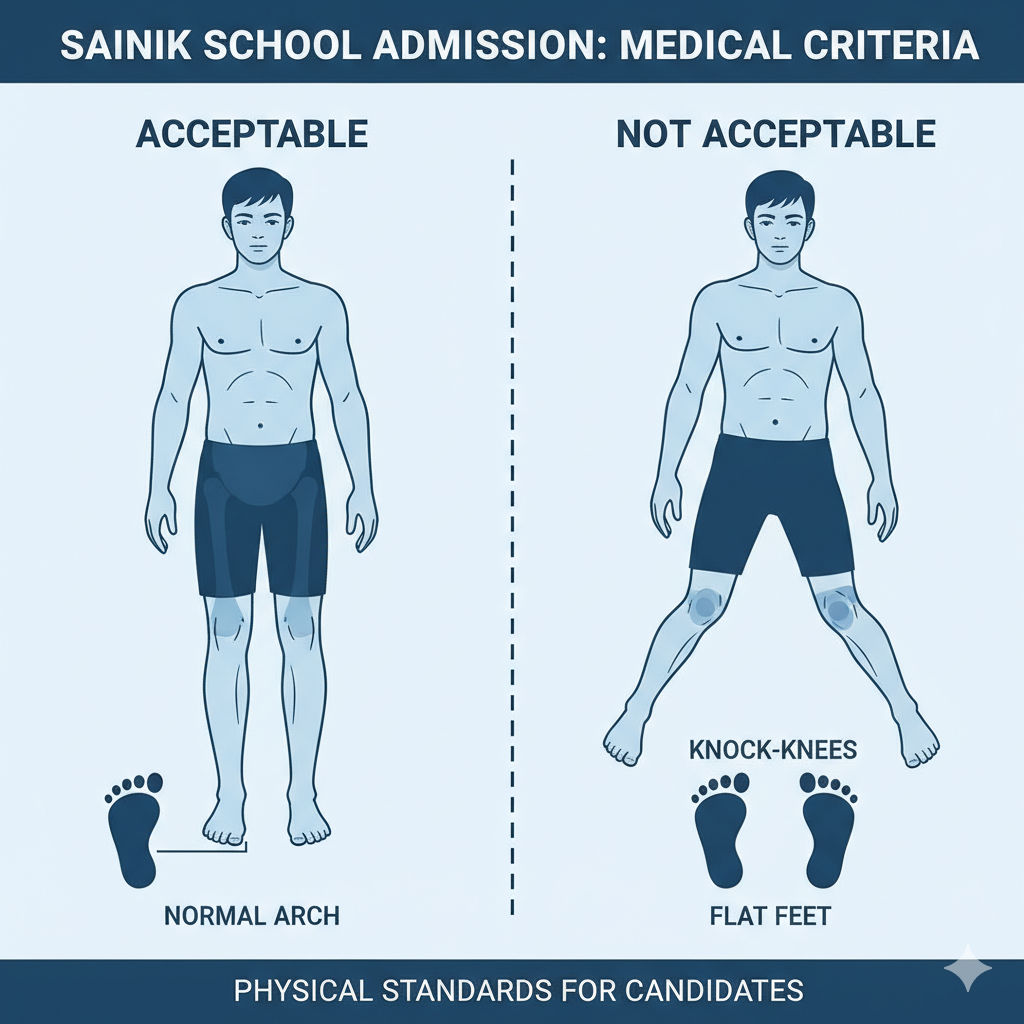
Medical Exam of Sainik School for Flat Foot and Knock Knees
Parents and students can check Sainik School medical test criteria for flat foot and knock knees below:
-
Candidates with severe flat foot (where the full arch of the foot is lost) are declared unfit.
-
Candidates with mild flat feet are accepted only if they feel no pain, can walk and run normally, and their shoes do not wear out unusually.
-
Doctors may ask for a weight-bearing X-ray if they are unsure during the check-up.
-
If a candidate had surgery for flat feet, but the foot arch is still not normal, they will be rejected.
-
Candidates with mild knock-kneed (gap between the ankles up to 5 cm when knees are together) are accepted.
-
If the ankle gap is more than 5 cm, the candidate is rejected.
-
Knock knee affecting only one leg also leads to rejection.
-
If the knock knee disappears when the candidate stands on their toes, the candidate may be accepted.
Also Read: Sainik School Previous Year Papers
Ready to Find the Best Boarding School for Your Child?
Discover Boarding Schools in India 2026-27
FAQs
1. When will the Sainik School medical test 2026 be conducted?
The Sainik School medical test is expected in March 2026, usually in the 3rd or 4th week. It lasts 3 to 4 days and starts at 9 AM. Candidates must report on time with documents. The exact date will be mentioned in the call letter or official notice.
2. What documents should students carry for the Sainik School medical test?
Students must carry their AISSEE admit card, call letter, photo ID, domicile certificate, caste certificate (if applicable), and proof of date of birth. They should also bring the medical form provided online by the chosen Sainik School. Both original and self-attested copies are usually required for verification.
3. What does the Sainik School medical form include?
The Sainik School medical form has 15–16 pages. It covers student details, family history, past illnesses, vaccination records, and self-declaration. Another section (10–11 pages) is filled by doctors after examination, covering eyesight, hearing, height, weight, dental points, bones, and organ health. Students must download, complete, and carry it on test day.
4. What are the eyesight requirements for the Sainik School test?
For Sainik School medical, candidates must have either 6/6 vision in both eyes (Standard I) or 6/6 in one eye and 6/9 in the other (Standard II). Myopia must not exceed -1.5 diopters, and hypermetropia must not exceed +2.5 diopters. Severe colour blindness, squint, or eye diseases generally lead to rejection.




 as a preferred source on