









The Sainik School syllabus is set by the NTA on behalf of Sainik Schools Society (SSS), and it checks students' subject knowledge and reasoning skills for admission. For Class 6, the exam covers Mathematics, Intelligence, Language, and General Knowledge, testing topics like arithmetic, reasoning, vocabulary, and current events. For Sainik School Class 9, the Sainik School entrance exam syllabus includes advanced Mathematics, Science, English, and Social Science, covering subjects like algebra, biology, grammar, and history.
Understanding the Sainik School syllabus helps students know what to study and prepares them to score better in the AISSEE exam. This blog explains each subject in detail so candidates can prepare well for the entrance exam.
Ready to Find the Best Boarding School for Your Child?
Discover Boarding Schools in India 2026-27
Sainik School Entrance Exam Syllabus
In this section, we will discuss in detail the Sainik School syllabus for class 6 and class 9. The syllabus for the Sainik School Entrance Exam is provided by the NTA. Each year, the syllabus hardly changes, and it’s described in detail in the information bulletin that’s available on the official website, exams.nta.nic.in/sainik-school-society/.
Sainik School 6th Class Syllabus
There are 4 subjects covered in the syllabus of Sainik School for class 6, and they are as follows:
- Mathematics
- Intelligence
- Languages (English / Hindi / Regional Languages)
- General Knowledge
Now, let’s check out the detailed syllabus covered in each of the above subjects:
Sainik School Class 6 Syllabus for Mathematics
Mathematics syllabus of Sainik School Class 6 includes important topics like fractions, types of angles, LCM and HCF, ratio and proportion, circle, and more. Check out the detailed syllabus below:
|
Topics Covered in Mathematics |
|
|
Natural Numbers |
Conversion of Units |
|
LCM and HCF |
Roman Numerals |
|
Unitary Method |
Types of Angles |
|
Fractions |
Circle |
|
Ratio and Proportion |
Volume of Cube and Cuboids |
|
Profit and Loss |
Prime and Composite Numbers |
|
Simplification |
Plane Figures |
|
Average |
Decimal Numbers |
|
Percentage |
Speed and Time |
|
Area and Perimeter |
Operation on Numbers |
|
Simple Interest |
Temperature |
|
Lines and Angles |
Arranging Fractions |
|
Complementary & Supplementary Angles |
- |
Sainik School Class 6 Syllabus for Intelligence
Intelligence syllabus for Sainik School Class 6 covers topics like puzzles, brain teasers, mathematical analogies, visual reasoning, logical reasoning, and more. Check the detailed syllabus below:
|
Topics Covered in Intelligence |
|
|
Analogies (mathematical & verbal) |
Pattern (spatial and mathematical) |
|
Classification |
Visual Reasoning |
|
Logical Reasoning |
- |
Sainik School Class 6 Syllabus for Languages (English / Hindi / Regional Languages)
Sainik School class 6th syllabus for the languages section includes important topics like articles, sentence formation, vocabulary, antonyms & synonyms, subject-verb agreement, etc. Check out the detailed syllabus below:
|
Topics Covered in Languages |
|
|
Comprehension Passage |
Sentence Formation |
|
Preposition |
Antonyms |
|
Article |
Synonyms |
|
Vocabulary |
Adjectives |
|
Verbs and Types |
Interjection |
|
Confusing Words |
Idioms and Phrases |
|
Question Tags |
Collective Nouns |
|
Types of Sentence |
Number |
|
Tense Forms |
Gender |
|
Kinds of Nouns |
Adverbs |
|
Kinds of Pronouns |
Rhyming Words |
|
Correct Spelling |
Singular/Plural |
|
Ordering of Words in a Sentence |
- |
Note: The questions in the language section will cover topics studied up to Class 5.
Sainik School Class 6 Syllabus for General Knowledge
General Knowledge Sainik School syllabus for Class 6 involves important topics like icons and symbols of India, historical monuments, shape of Earth and gravitation, international organisations, sports and games (India and International), etc. Discover the detailed syllabus below:
|
Topics Covered in General Knowledge |
|
|
Different Types of Scientific Devices Used in Daily Life |
Concepts on Mountain Terrain and Lifestyle |
|
Icons and Symbols of India: National Insignia, Emblem, Sports, Animal, etc. (Elementary awareness) |
Historical Monuments |
|
Major Religions of India (Founder, Place of Origin, Religious Books, Important Ideas) |
Shape of Earth and Gravitation (Basic Concepts) |
|
Art and Culture: Music, Dance (Classical & Folk), Renowned Personalities, Instruments |
Non-Renewable Energy Sources (Fossil Fuels) |
|
Defence: Equivalent Ranks in Services, Weapons, Aircraft, Missiles, Warships (Elementary awareness) |
Food, Culture, Habitat, Languages of Various Regions (Basic Concepts) |
|
Sports and Games (India & World): Personalities, Competitions, Trophies |
Names of Young Ones of Different Animals |
|
Super Senses: How Plants and Animals Sense Their Surroundings |
Functions of Body Parts of Plants and Animals |
|
Relationship between Animals and Human Beings |
International Organisations: United Nations, World Bank (Structure, Functioning, Objectives) |
|
Taste and Digestion (Basic Concepts) |
Indian Literary and Cultural Personalities: Names and Achievements |
|
Cooking and Preserving Techniques |
Indian Literary and Cultural Awards: Names and Recent Recipients |
|
Germination and Seed Dispersal |
Natural Calamities: Flood and Earthquake |
|
Traditional Water Harvesting Techniques |
Evaporation, Condensation and Water Cycle (Basic Concepts) |
|
Experiment with Water in Everyday Life |
Life of Farmers: Farming Techniques |
|
Water Pollution and Microbial Diseases |
Tribal Communities and Forest Produce |
Ready to Find the Best Boarding School for Your Child?
Discover Boarding Schools in India 2026-27
Sainik School 9th Class Syllabus
There are 5 subjects covered in the Sainik School entrance exam syllabus for class 9, and they are as follows:
- Mathematics
- Intelligence
- English
- General Science
- Social Science
Now, let’s check out the detailed syllabus covered in each of the above subjects:
Sainik School Class 9 Syllabus for Mathematics
Sainik School class 9 syllabus for Mathematics include topics like playing with numbers, quadrilaterals, squares and square roots, triangles, linear equations in one variable, etc. For the detailed syllabus, check below:
|
Topics Covered in Mathematics |
|
|
Rational Numbers |
Exponents and Powers |
|
Linear Equations in One Variable |
Playing with Numbers |
|
Understanding Quadrilaterals |
Visualising Solid Shapes |
|
Data Handling (Bar Graph and Line Graph) |
Triangles (Pythagoras' Theorem) |
|
Squares and Square Roots |
Euler’s Formula |
|
Cubes and Cube Roots |
Average, Median, Mode |
|
Comparing Quantities (Percentage, Profit and Loss) |
Probability |
|
Algebraic Expressions and Identities |
Pie Chart |
|
Area and Perimeters |
Direct & Inverse Proportions |
|
Volumes and Surface Areas |
Factorisations |
|
Introduction to Graph |
Unitary Method |
|
Divisibility Exam |
Triangles (Angle Sum Property) |
|
Parallel Lines |
Simple Interest and Compound Interest |
|
Time and Work |
Area and Perimeter of Circles |
|
Algebraic Expression (Addition, Subtraction, Multiplication, Division) |
- |
Sainik School Class 9 Syllabus for Intelligence
Sainik School syllabus class 9 for the Intelligence section involves crucial topics like visual reasoning, logical reasoning, spatial and mathematical patterns, etc. Check out the detailed syllabus below:
|
Topics Covered in Intelligence |
|
|
Analogies (mathematical & verbal) |
Pattern (spatial and mathematical) |
|
Classification |
Visual Reasoning |
|
Logical Reasoning |
- |
Sainik School Class 9 Syllabus for English
English syllabus of Sainik School class 9th covers various important topics like confusing words, modals, order of words in sentences, spelling corrections, tense forms, verb types, etc. Check the full syllabus below:
|
Topics Covered in English |
|
|
Spotting Errors |
Modals |
|
Comprehension Passage |
Confusing Words |
|
Antonyms |
Subject-Verb Agreement |
|
Synonyms |
Correct Spellings |
|
Prepositions |
Order of Words in a Sentence |
|
Articles |
Idioms and Phrases |
|
Types of Verbs |
Sentence Improvement |
|
Tense Form |
Change of Sentence as Directed |
|
Narration |
Sentence Formation |
|
Phrase and Clauses |
Voices |
|
Kinds of Noun |
Types of Sentences |
|
Adjectives |
Personal Pronoun |
|
Interjection |
Change of Gender |
|
Question Tags |
Change of Number |
|
Adverbs |
Conjunctions |
|
Conditions |
Comparison of Adjectives |
Sainik School Class 9 Syllabus for General Science
General Science syllabus for Sainik School entrance exam class 9 includes important topics like cell structure and function, global warming, chemical effects of electric current, metals and non-metals, etc. Check out the complete syllabus below:
|
Topics Covered in General Science |
|
|
Fossil Fuel: Coal and Petroleum |
Chemical Effects of Electric Current |
|
Combustion and Flame |
Stars and Solar Systems |
|
Cell Structure and Function |
Pollution of Air and Water |
|
Reproduction in Plants and Animals |
Global Warming |
|
Force, Friction and Pressure |
Micro-Organisms |
|
Sound and Its Basics |
Some Natural Phenomena |
|
Reflection and Dispersion of Light |
How to Find Calorific Value of Fuel |
|
Metals and Non-Metals |
Electroplating and Artificial Jewellery |
|
Synthetic Fibres and Plastics |
Relation Between Types of Friction |
|
Cropping Seasons |
Agricultural Practices |
|
Conservation of Plants and Animals |
Biosphere Reserves, National Parks and Sanctuaries |
|
Reaching the Age of Adolescence |
Changes During Puberty |
|
Endocrine Glands and Hormones |
|
Sainik School Class 9 Syllabus for Social Science
Sainik School class 9 syllabus for the Social Science subject involves topics like Important Freedom Movements, Types of Agriculture, Social and Caste Reforms, Land, Soil and Water Resources, etc. Discover the full syllabus below:
|
Topics Covered in Social Science |
|
|
Revolt of 1857 |
Importance of Parliament |
|
Freedom Fighters |
Types of Agriculture |
|
Important Freedom Movements |
Types of Government and Different Tiers of Government |
|
Social and Caste Reforms |
Understanding Markets |
|
Resources and Sustainable Development |
Elections |
|
Rock Cycle and Water Cycle |
Role of Government in Health |
|
Pressure and Wind System |
Delhi Sultanate |
|
Land, Soil and Water Resources |
Mughals |
|
Minerals and Power Resources |
Bhakti and Sufi Movement |
|
Indian Constitution and Secularism |
Interior of Earth |
|
Climate Change |
Law and Social Justice |
|
Earthquakes and Major Landforms |
Judiciary and Criminal Justice System |
|
Types of Rainfall |
Marginalisation |
|
Major Grasslands |
Public Facilities |
|
Types of Forests |
Natural Vegetation and Wildlife |
|
Means of Transport |
Industries |
|
Communication |
Human Resources |
|
Life in Deserts |
Changes in the Arts |
|
Panchayat System |
Local Self-Government |
Tips to Get Good Scores in Sainik School Entrance Exam
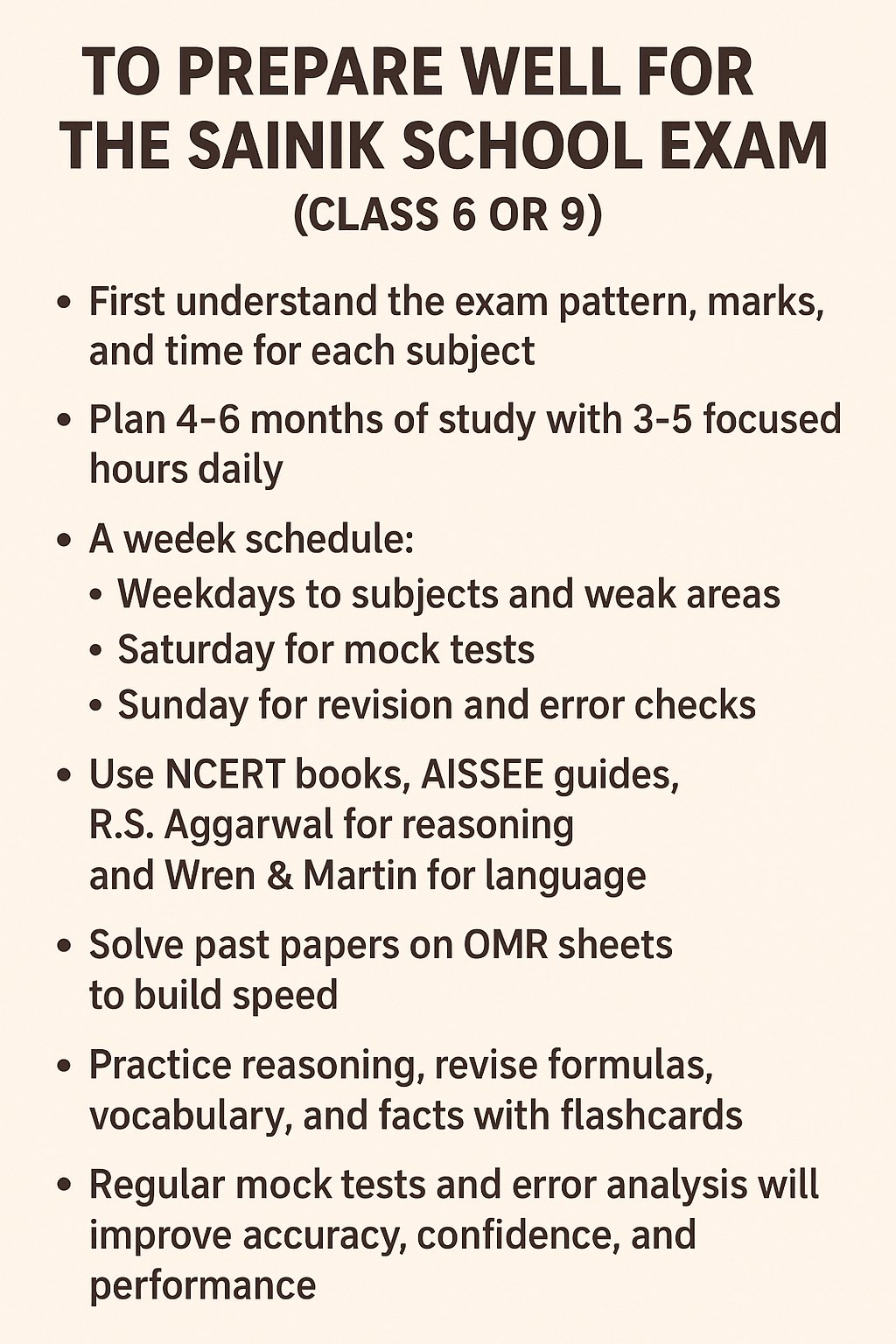
Candidates should follow specific strategies like 3-5 hours of daily study, starting preparation at least 4 months before the exam date, solving Sainik School Mock Test and previous year question papers for good memory and better practice. Creating flashcards to remember Math formulas, Vocabulary, GK/ historical facts, etc. is also a good technique.
Check the table below for some tips and tricks to ace the AISSEE 2026 exam for Sainik School Admission:
|
Focus Area |
Preparation Tip |
|
Exam structure awareness |
Know subject marks and durations for each section (depending on your Class level (i.e. Class 6 or 9). This will help you allocate time to important sections that carry the highest weightage in the exam. |
|
Time management |
Dedicate 4–6 months upfront, with 3–5 hours daily of focused study. Prioritise the study schedule as mentioned below:
Your weekly schedule should look like this:
|
|
Study materials |
|
|
Practice methodology |
|
|
Mock test feedback loop |
|
|
Improving Intelligence Section |
|
|
Revision tools |
|
Ready to Find the Best Boarding School for Your Child?
Discover Boarding Schools in India 2026-27
FAQs
1. What subjects are covered in the AISSEE Class 6 exam?
The Sainik School Class 6 exam includes Mathematics, Intelligence, Language, and General Knowledge. Students are tested on arithmetic, reasoning, grammar, and awareness of science, history, geography, and current affairs to assess their overall academic and mental ability.
2. How much daily study time is recommended for AISSEE preparation?
Students should dedicate 3–5 hours of focused study daily. Time should be divided between mathematics, reasoning, language, and general knowledge or science/social science, depending on the class level, ensuring balanced preparation for all sections. However, in the last few days of Sainik School entrance exam preparation, the focus must be on high-weightage topics like Mathematics, for both classes 6 and 9.
3. Which subject carries the highest weightage in AISSEE?
Mathematics holds the highest weightage in both Class 6 and Class 9 AISSEE exams. Students are advised to spend 45–60 minutes daily on maths practice, focusing on problem-solving speed, conceptual clarity, and formula revision.
4. Which books are best for AISSEE exam preparation?
The most effective resources include NCERT textbooks for basics, Arihant or Oswal AISSEE guides for practice, R.S. Aggarwal for reasoning, and Wren & Martin for English grammar.
5. What subjects are included in the Class 9 Sainik School entrance exam?
The Class 9 Sainik School entrance exam covers subjects like Mathematics, General Science, English, Social Science, and Intelligence. Students face advanced topics like algebra, geometry, physics, biology, history, civics, and reasoning to assess higher-level knowledge and critical thinking.





 as a preferred source on