









Traditional lecture-based teaching does not work well for primary students. The human brain forgets 95% of what it only hears. Children end up memorizing facts without really understanding them. This creates weak academic foundations and poor critical thinking skills. Experiential learning offers the best solution because it means learning by doing. This method helps children retain 75% of the information.
Some of the best schools in Noida are moving away from standard textbooks toward scientifically developed curriculums. These curriculums focus on active participation instead of just listening. Parents should choose schools that emphasize doing over listening to help their children truly learn. This article explains why scientific curriculums matter so much for young minds.
Also Read: Values That Last a Lifetime: The Virtues Behind True Education
The Flaw in Chalk and Talk Teaching-Learning Method
Schools used a simple method for a long time where teachers talked and students just listened. This approach works fine for adults but fails for primary school children. Studies prove that young kids have very short attention spans. When teachers lecture for 30 minutes most children tune out after the first 10 minutes. They may sit quietly yet their brains stop taking in the lesson.
This causes a big issue for learning. Children begin to mug up answers only to pass exams. They memorize definitions without grasping their real meaning. For instance a child might repeat that evaporation turns liquid into vapor. However they do not know why rain puddles vanish on hot days. This difference between memorizing facts and truly understanding them grows bigger over time. As a result higher-level science and math become much harder later on.
The Science of Learning: Why Doing Beats Listening?
For decades, educators used the standard model of education called the Chalk and Talk method. Teachers stood at the front of the class, delivered information, and students wrote down every word. Modern educational science now proves that this method helps the human brain retain information the least effectively.
Rewiring the Young Brain
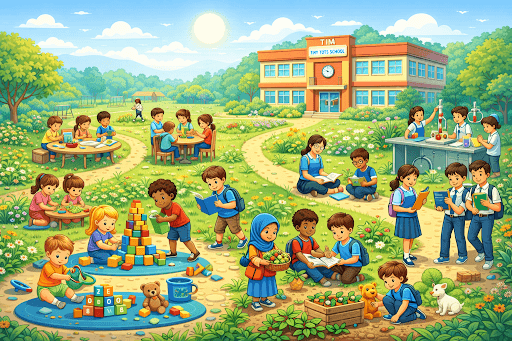
Primary school children enter a developmental stage called the Concrete Operational Stage. During this stage, their brains physically wire themselves according to their daily experiences. Neuroscientists refer to this process as neuroplasticity. When a child actively engages in a task, such as constructing a model to grasp geometry or planting a seed to learn photosynthesis, multiple sensory pathways in the brain light up at the same time. Children see, touch, smell, and manipulate objects during this process. Such multi-sensory engagement creates stronger and more complex neural connections than simply listening to a lecture ever achieves.
The Learning Pyramid: Data That Demands Attention
The most compelling argument for experiential learning comes from the Learning Pyramid model. Experts at the National Training Laboratories developed this model. The data stands out sharply, and no educator or caring parent can ignore it if they want real results.
Lecture: Students retain only 5% of what they hear.
Reading: Retention rises slightly to 10%.
Audio-Visual: Retention hits 20%.
Demonstration: Retention reaches 30%.
Discussion: Engagement pushes retention to 50%.
Practice by Doing (Experiential Learning): Retention jumps dramatically to 75%.
This data strongly argues for experiential learning over traditional schooling. It highlights how lectures waste most of a child's time since kids forget 95% of the information quickly. On the other hand, a science-based curriculum with practice helps three-quarters of the learning stay with them forever. For primary students, this means they grasp ideas that last a lifetime instead of losing them by the weekend.
Moving Past Rote Memorization
Traditional schools make kids memorize facts, and that passes as learning. A student recites the definition of gravity and seems smart. Yet that child probably does not grasp how gravity pulls the tides or keeps us on the ground.
Experiential learning pushes critical thinking and problem solving instead of just recall. A science-designed curriculum gives kids problems to solve, not plain facts. Teachers do not simply tell students that plants need sunlight. Instead, they let children put one plant in the sun and another in a dark box, then predict what happens.
Kids see the leaves turn yellow on the plant without light, so they analyze real results. They do not just remember facts; they question, guess, and check their ideas. This builds a scientific mindset that matters more today than a sharp memory.
Growing Emotional Strength
Experiential learning also creates a safe place for kids to fail and learn from it. In lecture classes with exams, a wrong answer feels like a harsh judgment on their brains. But in hands-on activities, failure turns into useful information. When a student constructs a bridge from popsicle sticks and it falls apart under weight, that teaches them to strengthen their design next time.
They see mistakes as normal steps in discovery. Primary kids gain resilience and determination through this process. Such emotional strength is a key life skill that no textbook can provide.
Also Read: Grow Talent with Starmakers platform
Why the Primary Years are the Critical Window?
Timing matters a lot in child development. Psychologists confirm that children form habits and attitudes between ages 6 and 12, and these often stay with them into adulthood.
Forming Habits That Last a Lifetime
Children who see learning as a dull task where they just sit quietly will resist education all through high school and college. On the other hand, kids who explore, ask questions, and join in during these years will love learning as a fun search for answers.
A curriculum based on science makes sure this love for learning happens in an organized way. Teachers plan every activity, game, and project to teach a clear skill or idea. This stops fun activities from turning into plain playtime without purpose. Instead, it turns them into focused learning moments. Young children need this kind of help to link what they do with their hands to bigger ideas.
How ASPAM Scottish School Leads with the XSEED Advantage?
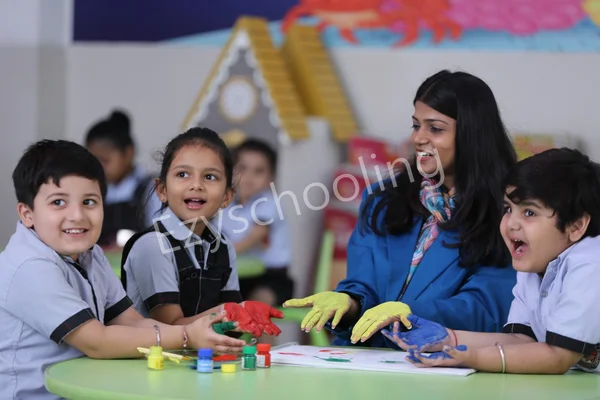
Many schools talk about activity-based learning. Yet, very few use a standard system backed by scientific research to make it happen in every class each day. ASPAM Scottish School stands out from others in this way.
ASPAM Uses a Scientific Plan for Every Lesson
ASPAM Scottish School, one of the best CBSE schools in Noida, no longer depends on one teacher's skill or random textbook choices. The school adopts the XSEED Curriculum for primary classes to deliver every lesson through a proven framework based on data.
XSEED offers more than just books. It provides a teaching method that replaces lectures with a learning cycle. At ASPAM, teachers do not simply read from books while students lose focus. Instead, they apply the 5-Step XSEED Method every time. This method matches how the human brain naturally gains new skills.
How the 5-Step XSEED Method Works?

ASPAM creates brilliant consistency with this program. Every concept in Mathematics, Science, or English follows this clear scientific process:
Aim: Teachers start class with a specific goal that students can measure. Students know exactly what they will achieve by the end (for example, they learn to predict if an object floats or sinks, not just study Chapter 4).
Action: Students dive into hands-on activities before teachers explain theory. They mix liquids, measure the playground, or act out stories. These steps develop interest and give real experiences to remember.
Analysis: Teachers lead discussions where students think about the activity. They answer questions such as what happened, why it happened, and if everyone saw the same result. This turns play into true understanding.
Application: Students now use the idea in real-life problems with their workbooks. They connect the lesson to the world outside class. This strengthens the connections their brains formed earlier.
Assessment: Teachers check learning with questions that test skills, not just memory. Students must apply what they learned in new ways. This confirms they reached the goal from the start.
Real Changes Students See at ASPAM
ASPAM Scottish School changes how classrooms work with this method. Students participate actively instead of just listening. A student who finds reading hard might shine during Action and gain confidence for other subjects. The Analysis step helps shy students share their thoughts.
ASPAM makes the 75% retention fact real for students through XSEED. Students discover joy in learning, not just finish the syllabus. The school uses this curriculum to create a strong base of clear concepts for primary students. This avoids weak facts based only on memory. ASPAM shows its deep duty to prepare children for exams and a world full of problems to solve.
Conclusion
Data shows that students remember 75% of what they experience, but only 5% of what they hear. ASPAM Scottish School closes this gap well by using the XSEED Curriculum. Every primary student there takes part in a clear five-step process called Aim, Action, Analysis, Application, and Assessment. This method helps develop strong critical thinking, resilience, and a deep understanding of concepts.
Parents should always choose schools that follow these proven learning methods instead of old rote learning ways. When we pick experiential learning for our children, we make sure they gain real skills. These skills prepare them not just for tests, but for handling life's challenges in the actual world.
To learn more about this and other schools nearby, see this list of the top schools in Noida.








 as a preferred source on