






Your child spends nearly an hour solving a mathematics problem, yet the answer remains incorrect. You explain the steps again, but they still seem confused. After a few attempts, they close the notebook and say, "I just can't do it."
As a parent, you may wonder whether your child needs more practice or additional support. While occasional learning struggles are normal, repeated difficulties deserve attention. At Sapphire International School (SIS), Sector 70, Noida, the importance of communication between parents and teachers is reflected in its parent partnership approach.
Understanding when to speak with teachers can help parents address learning concerns before frustration begins affecting a child's confidence.
What Are the Signs That Your Child Is Struggling With Learning?
Every child learns at a different pace. Some understand mathematical concepts quickly but need more time with reading. Others remember information well but struggle to express their thoughts in writing.
However, certain patterns may suggest that your child needs additional guidance.
- Difficulty understanding familiar concepts: Your child repeatedly struggles with topics despite receiving explanations and practice.
- Problems with reading or writing: They frequently skip words, struggle to form sentences, or find age-appropriate reading unusually challenging.
- Avoiding schoolwork: Homework regularly leads to frustration, tears, or excuses to avoid studying.
- Changes in academic performance: A noticeable decline in marks or classroom participation continues over time.
For example, a Class 3 student might understand a story when someone reads it aloud but struggle to read the same story independently.
According to the American Academy of Pediatrics, persistent difficulties with reading, writing, mathematics, or following instructions may require further attention.
These signs do not automatically indicate a learning disability. However, recognising patterns can help parents understand where support may be needed.
When Is the Right Time to Speak With Your Child's Teacher?
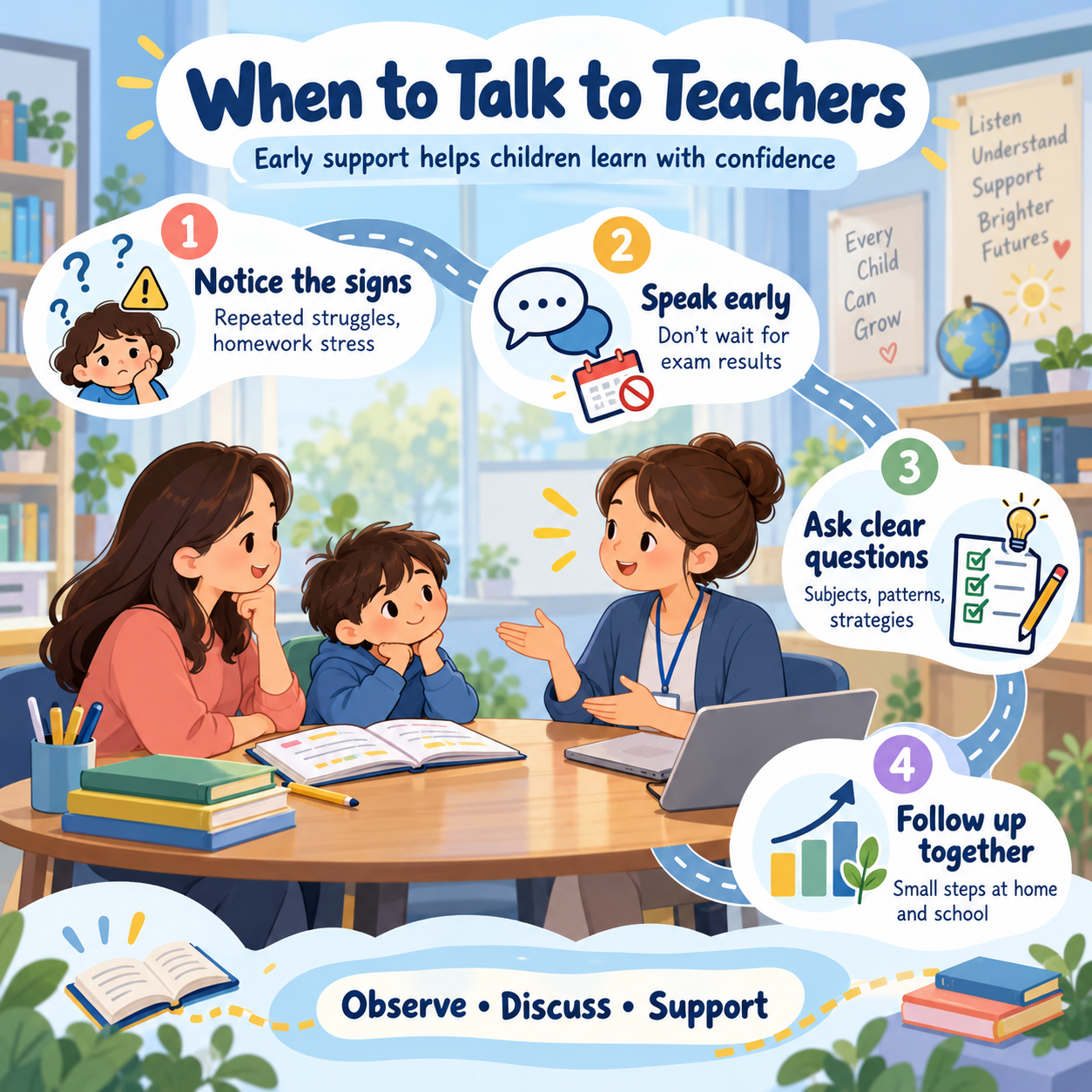
Many parents wait until examination results show a significant decline before discussing learning concerns. However, difficulties often become noticeable much earlier.
Consider speaking with your child's teacher when:
- The same learning difficulty appears repeatedly despite regular practice.
- Your child becomes unusually anxious or upset about particular subjects.
- Homework takes considerably longer than expected on most days.
- Your child starts avoiding school or expresses negative feelings about their abilities.
Imagine your child consistently struggles with multiplication, even after several explanations at home. Rather than immediately arranging extra tuition, speaking with the mathematics teacher may help identify the specific concept causing confusion.
Teachers observe children in different learning situations. They may notice whether a child struggles with understanding instructions, completing written tasks, or participating in classroom activities.
Parents should also remember that learning challenges can sometimes be connected to emotional stress, sleep difficulties, or changes in routine.
The important thing is not to wait for a major academic setback before seeking guidance. If concerns are significant or involve developmental milestones, parents can also consult a qualified healthcare professional without waiting for the next school meeting.
How Can Parents Make Teacher Meetings More Helpful?
A parent-teacher meeting becomes more productive when both sides focus on understanding the child's needs rather than discussing marks alone.
Before the meeting, observe your child's study habits and note specific examples. Bringing a few schoolwork samples can make the discussion clearer.
Consider asking these questions:
- Which subjects or classroom activities does my child find most challenging?
- Have you noticed similar difficulties during lessons?
- What learning strategies could we try at home?
- How can we measure improvement over the coming weeks?
- When should we discuss progress again?
For example, instead of saying, "My child is weak in English," explain that your child understands spoken English but struggles to write complete sentences.
This gives teachers a clearer starting point for suggesting suitable activities.
Research reviewed by the Education Endowment Foundation highlights the importance of meaningful parental involvement and communication focused on children's learning.
Parents should also listen carefully to the teacher's observations. A difficulty that appears serious at home may look different in the classroom, and understanding both perspectives helps create a more useful support plan.
What Should Parents Do After Talking to the Teacher?
A productive conversation should lead to manageable next steps.
Parents and teachers can begin by identifying one or two areas requiring attention. For instance, if reading fluency is a concern, the teacher might recommend suitable reading material and a short daily reading routine.
At home, parents can support this process through simple actions:
- Set aside a quiet, consistent time for learning.
- Divide difficult assignments into smaller tasks.
- Appreciate effort and improvement rather than focusing only on marks.
- Maintain communication with teachers about progress and challenges.
Avoid comparing your child's performance with classmates or siblings. Such comparisons may increase frustration instead of encouraging learning.
India's National Curriculum Framework emphasises cooperation between families and educators when supporting children's development.
If difficulties continue despite appropriate support, parents can discuss whether a professional assessment would be helpful. Teachers can identify learning concerns, but a formal diagnosis requires appropriately qualified professionals.
Supporting Parent-Teacher Communication at Sapphire International School
For parents exploring a Top School in Noida or searching for the Best School in Noida, opportunities for meaningful parent-teacher communication are worth considering. Sapphire International School (SIS), Sector 70, Noida, describes parents as partners in children's education.

According to its official website, the school conducts Parent-Facilitator Meetings after term assessments to discuss students' academic progress, strengths, areas for improvement, and overall development. It also provides structured communication guidelines through which parents can raise concerns. Such opportunities can help families discuss learning difficulties and identify possible next steps with teachers.
Conclusion
Learning difficulties do not define a child's intelligence or potential. Sometimes, children simply need a different explanation, additional practice, or more individualised support.
When parents and teachers communicate early, they can better understand a child's challenges and work towards practical solutions. The goal is not perfect marks, but helping children learn with confidence.
To know more about other schools in Noida, click on the link below








 as a preferred source on