








A child can memorise a chapter, score well in a test, and still struggle when asked to use the same knowledge somewhere else, apart from exams. Maybe at a shop, counting money quickly while buying something. Most parents have probably seen some version of this. A student may remember the formula taught in mathematics but feel lost when the numbers in the question are changed. They can get totally confused just by swapping some numbers and functions. They may be able to reproduce a science definition perfectly but find it difficult to explain how the concept works in everyday life.
This is where an important question about education comes in: Are schools only preparing children to know things, or are they also teaching them how to learn?
The distinction matters more today because children are growing up in a world where information is everywhere. A search engine can find an answer in seconds, videos can explain complicated concepts visually, and AI tools can generate summaries, examples, and explanations almost instantly. In such an environment, education cannot stop at transferring information from a textbook to a child's notebook. Children also need to understand how to find reliable information, make sense of it, question it, connect it, and use it.
Today, we will discuss how schools in Bangalore are offering cutting-edge, technology-driven quality education by taking the example of one of the schools, Treamis School.
Also Read: Where Every Child Matters: Inside the Inclusive Education Model of Bangalore
What Does “Learning How to Learn” Actually Mean?
Learning how to learn does not mean leaving children alone with a textbook and asking them to figure everything out. It means helping them become increasingly aware of their own learning process.
For instance, imagine a student who keeps reading the same history chapter but cannot remember it during a test. Instead of simply telling the child to study harder, a teacher can help them ask what is actually going wrong. Are they only rereading? Are they able to explain the chapter without looking at the book? Would making a timeline help them understand the sequence of events? Would discussing the topic with a classmate make the connections clearer?
These questions introduce children to metacognition, or the ability to think about their own thinking and learning. Over time, students can become better at recognising what they understand, where they are struggling and which learning strategies work for them.
That is a skill they can carry from one subject to another.
Why Understanding Matters More Than Simply Memorising
Memorisation is not the enemy of good education. Children need foundational knowledge. It is difficult to write well without vocabulary, solve advanced mathematics without basic concepts, or understand a scientific debate without knowing some science.
The problem begins when remembering becomes the end point of learning.
A child learning about water conservation, for example, could memorise definitions of rainwater harvesting and groundwater depletion. But imagine taking the lesson further. What if the student had to observe water usage around the school, collect information, identify wastage and suggest ways to reduce it?
Now the child has to use the information rather than simply repeat it.
This is where meaningful learning happens. Knowledge becomes something children can apply, question and build upon, rather than something that exists only for the next examination.
Inquiry-Based Learning Can Make Children Better Learners
Children are naturally curious. A five-year-old can ask an astonishing number of questions about something as ordinary as rain, insects or a broken toy. As they grow older, however, classroom learning can sometimes become more focused on finding the “correct” answer than asking an interesting question.
Inquiry-based learning approaches this differently. Instead of always beginning with an explanation, teachers can sometimes begin with a question, observation, problem, or situation.
A class studying plants, for example, might wonder why two plants kept in different conditions grow differently. Students can make observations, suggest possibilities, collect evidence, and discuss what they find. The teacher remains an important guide, but the student is not merely receiving information.
They are learning how knowledge is developed. That difference can shape the way children approach unfamiliar problems later in life.
Learning How to Learn Builds Independent Learners
There is a point in every child's education when the teacher cannot be standing beside them to explain every difficult question. Higher education, competitive examinations, university projects and eventually professional life all require some degree of independence.
This is why schools need to gradually give students ownership of their learning.
That could involve encouraging students to:
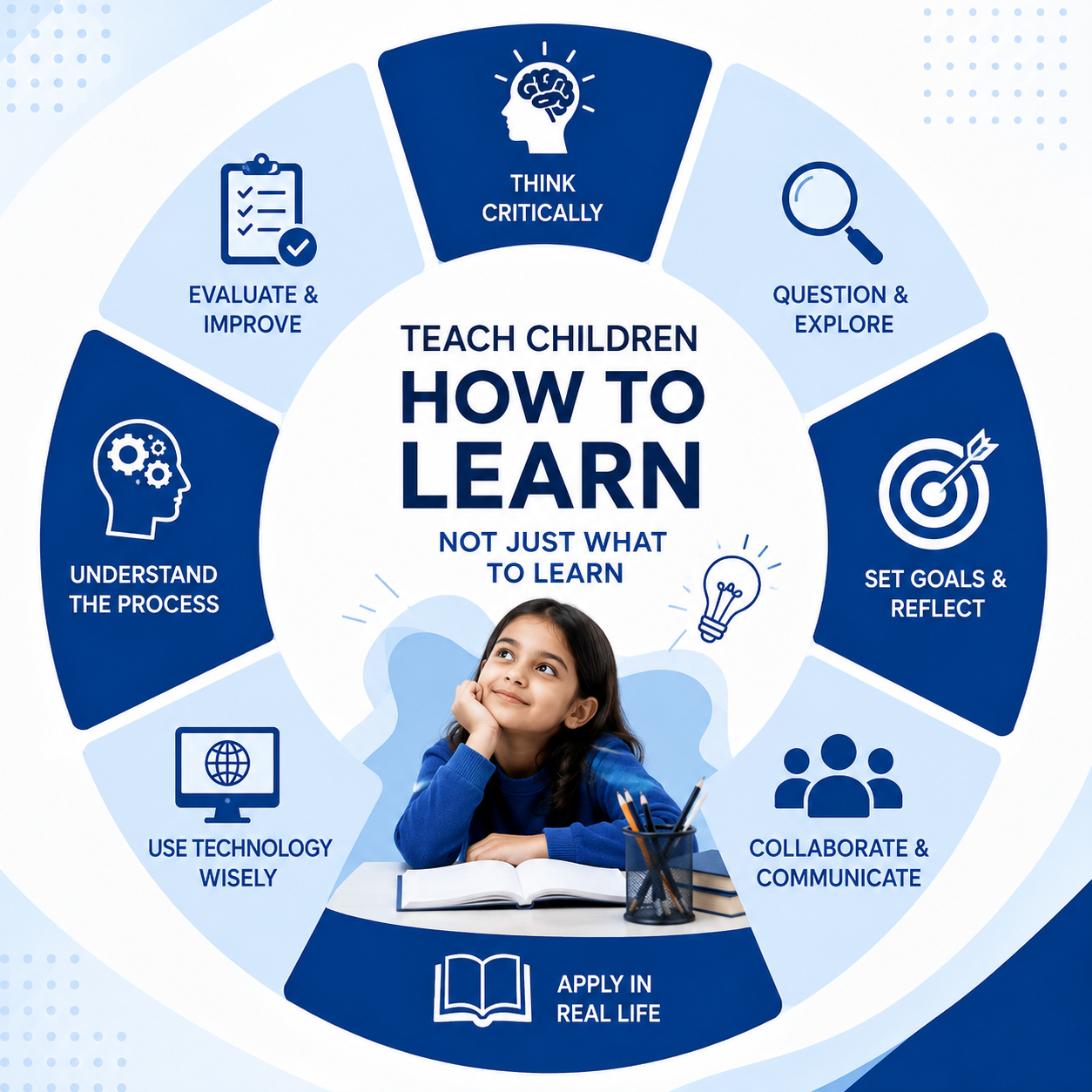
- set realistic learning goals and review their progress;
- try different ways of understanding a difficult concept;
- ask questions when they do not understand something;
- reflect on mistakes instead of simply correcting them;
- research information and evaluate whether it is reliable;
- work with others while taking responsibility for their own contribution;
- explain their reasoning rather than only giving an answer.
These habits may seem small when a child is in school, but they become increasingly valuable as the level of learning becomes more complex.
What Role Does Technology Play in Learning?
Technology can make learning more accessible, but it can also make passive learning easier. A child can watch ten explanations of a topic without actually understanding it. They can copy an answer without knowing why it is correct. They can ask an AI tool to solve a problem without developing the ability to solve a similar problem independently.
So the goal should not be to keep technology away from learning. Instead, children need to understand how to use technology as a learning tool.
A student researching a topic online should learn to question the source. A child using AI should be able to check whether its response is accurate. Someone watching an educational video should still be able to explain the idea afterwards in their own words.
The technology can provide support. The thinking still needs to come from the learner.
Also Read| What a classroom looks like in 2026 in Bangalore
How Treamis School Is Helping Children Become Better Learners
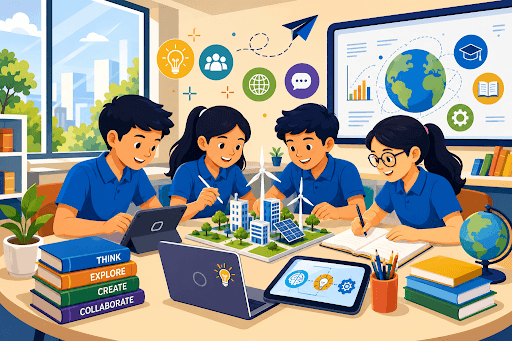
For parents looking for an international school in Bangalore, Treamis School, one of the renowned schools in Bangalore, is worth exploring. At Treamis School in Electronic City, Bangalore, this idea of learning beyond simply acquiring information is built into its teaching philosophy. The school describes its approach as student-centred and constructivist, where knowledge is not merely acquired but constructed through active learning, real-life involvement and exploration. Its stated focus is on developing self-regulated learners who can set goals, inquire, explore, self-question, reflect on their performance and try different ways of solving problems.
The approach also extends beyond conventional classroom learning. Treamis incorporates life skills into lessons and activities, including team-based projects, communication, interpersonal skills and simulations of real-life situations. The aim is to give students opportunities to experience situations where they have to think, respond and make sense of what they are learning.
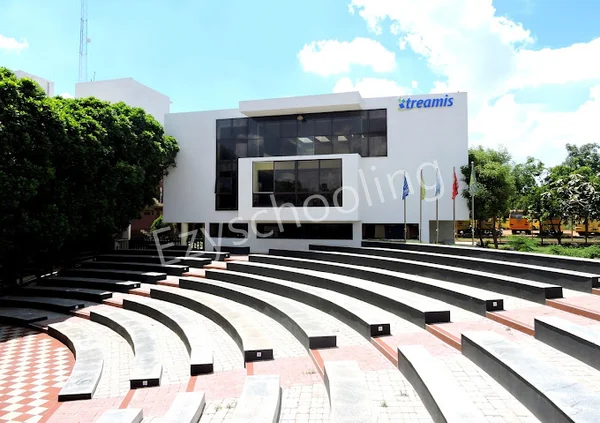
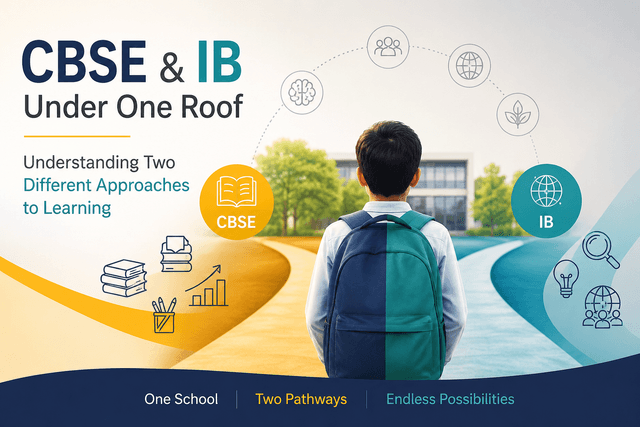
For families looking at an international school in Electronic City, this becomes an interesting aspect to consider. Treamis offers IB and Cambridge pathways through Treamis International School, while Treamis World School follows the CBSE curriculum. Across its programmes, the school emphasises inquiry, independent thinking, project-based learning and real-world application.
Its curriculum also gives students opportunities to connect academic learning with practical experiences. At the CBSE level, for example, the curriculum is enhanced for real-world application, while assessment includes projects, assignments and activities alongside conventional examinations.
The Real Goal of Education Is to Create Lifelong Learners
Children will eventually forget some of the dates, definitions and formulas they learn at school. That is normal. What should stay with them is the ability to approach something unfamiliar without immediately giving up.
A child who knows how to learn can look at a difficult problem and break it down. They can ask for help, try another approach, check their understanding and learn from what did not work the first time.
That is why the question schools need to ask is not simply, “What should children know?” It is also, “What should children be able to do when they encounter something they do not know?”
In a world where information is becoming easier to access, the ability to learn independently may become one of the most valuable things education can give a child. Knowledge gives them a foundation, but knowing how to learn gives them a way forward.
Want to know more about this school and other schools in Bangalore
 as a preferred source on