







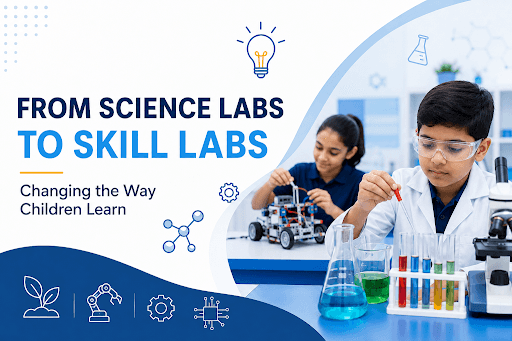

For many children, the word lab immediately brings to mind a white coat, test tubes, beakers, and a science experiment. But school laboratories today are becoming much more than spaces where students perform experiments for their practical exams.
Think about how a child learns that plants need sunlight for photosynthesis. Reading the definition from a textbook is one way of learning it. But what happens when the child actually places a plant in sunlight, keeps another part covered, observes the changes, and discusses why they happened? Suddenly, photosynthesis is no longer just a definition to remember. It becomes something the child has seen and experienced.
This is the bigger shift happening in school education: from learning about something to learning through it. And the growing importance of hands-on learning is also reflected in recent educational initiatives. CBSE has been actively promoting skill education and has mandated the establishment of Composite Skill Labs in affiliated schools. Today, we will understand how one of the schools in Greater Noida West, St. Teresa School, is using the labs to enhance the knowledge of the children and how it closely resonates with the new notice by the CBSE.
Also Read| Where Curiosity Meets Discovery: Well-Equipped Laboratories
Why Do Children Learn Better When They Can See and Do?
Let's take a simple example: digestion. A child can read that food travels from the mouth to the stomach and then through the intestines, where nutrients are absorbed. The child may be able to reproduce the entire process in an examination.
But imagine a classroom activity where the teacher uses simple materials to demonstrate how food is broken down and how different parts of the digestive system perform different functions. The learning experience changes.
|
Learning only from a book |
Learning through an activity |
|
"Food is broken down into simpler substances." |
The child actually observes a model of the process. |
|
The child memorises the names of organs. |
The child understands what each organ does. |
|
The lesson may feel abstract. |
The process becomes visual and relatable. |
|
The focus is often on remembering. |
The child asks questions and investigates. |
|
The information may be forgotten after the test. |
The experience can make the concept easier to recall. |
This is why laboratories matter. They give children an opportunity to observe, experiment, make mistakes, ask questions and find answers.
A simple science experiment can therefore teach more than science. It can develop curiosity, patience, observation and problem-solving at the same time.
From Photosynthesis to Rainwater Harvesting: Everyday Concepts Come Alive
Some of the best lab activities don't require complicated machinery. In fact, the simplest demonstrations can sometimes leave the strongest impression.
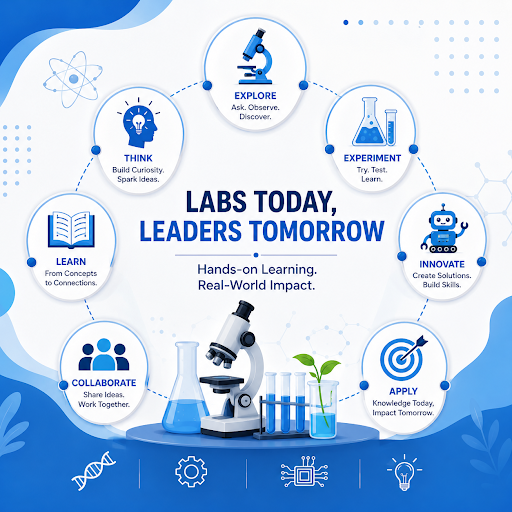
Take photosynthesis. Instead of simply telling students that plants use sunlight to prepare food, a teacher can demonstrate how light affects the process and discuss what happens when a plant does not receive adequate sunlight.
Similarly, rainwater harvesting can be taught through a small working model. Imagine students creating a miniature house with a sloping roof, connecting it to a pipe and directing collected water into a storage container. When water is poured over the roof, students can actually watch the journey of rainwater—from the roof to the collection system.
Suddenly, a chapter about water conservation becomes something tangible.
Other simple activities can include:
- Building a basic water filtration model.
- Demonstrating how shadows change with the position of a light source.
- Creating a simple electrical circuit.
- Observing seed germination under different conditions.
- Making a model to understand the water cycle.
- Using simple materials to demonstrate air pressure.
- Creating models that explain waste segregation and recycling.
The important thing isn't how expensive or sophisticated the activity is. It is whether the child gets an opportunity to connect a concept with the real world.
School Labs Are Becoming Spaces for Skills, Not Just Experiments
This is where the idea of skill-based learning becomes particularly important.
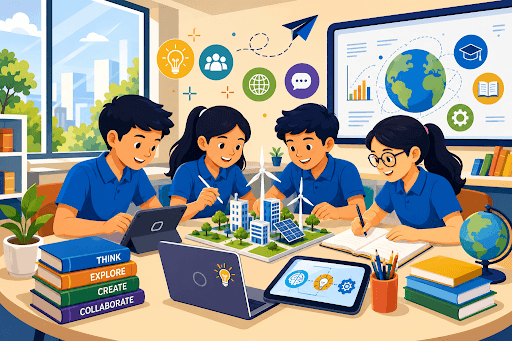
The laboratory of the future may not be limited to traditional science experiments. Children are increasingly expected to develop skills such as creativity, critical thinking, collaboration, communication, digital literacy and problem-solving.
A robotics activity, for example, may look like a technology lesson on the surface. But when students work together to build a robot that has to perform a particular task, they are also learning to:
- Understand the problem.
- Think of a possible solution.
- Build and test it.
- Identify what went wrong.
- Modify their approach.
- Work with other students.
- Present the final outcome.
That is much closer to how problem-solving works in real life.
This broader understanding of skill education is also why CBSE has been pushing schools towards Composite Skill Labs. The Board's guidelines are intended to strengthen practical and skill-oriented learning rather than keeping vocational exposure separate from mainstream schooling.
CBSE's Composite Skill Lab Mandate: A Sign of Changing School Education
The recent CBSE mandate is an important development in this direction.
Under its guidelines, CBSE has required affiliated schools to establish Composite Skill Labs equipped with the necessary equipment and machinery. For existing affiliated schools, the latest March 2026 circular provides a timeline extending to August 22, 2027, for establishing the required lab.
Why does this matter?
Because it sends a larger message: skill education is no longer something that schools can treat as an optional extra.
The education system is increasingly recognising that children need opportunities to understand how things work, create things, solve practical problems and develop skills alongside academic knowledge.
Government and educational bodies taking such initiatives also show that laboratory-based and experiential learning is becoming an important part of the larger vision for school education.
For parents, this means that when they evaluate a school, they may want to look beyond the question of “Does the school have a lab?”
A better question could be: “What does my child actually get to do in that lab?”
Also Read| From Space Labs to Student-Led Learning
How St. Teresa School Brings Practical Learning Into the School Environment
A school can have an impressive-looking laboratory, but what matters ultimately is how that infrastructure is used to support children's learning.

At St. Teresa School, Sector 10, Greater Noida West, the emphasis on learning beyond conventional classroom instruction is reflected in the school's infrastructure and teaching approach. The school lists an AI & Robotics Lab, Science Activities Area, smart classes and interactive boards, alongside sports and other activity spaces.
These facilities create opportunities for students to experience learning in different ways. A science concept can be supported through practical activities, while technology-based learning can introduce students to areas such as robotics and emerging technologies.
The school's stated approach also emphasises innovative teaching practices, critical thinking, creativity, active participation and practical knowledge.
This puts the focus where it should be, not simply on having laboratories, but on creating an environment where children can explore, question, experiment and apply what they learn.
Conclusion
Education becomes much more meaningful when a child can connect a classroom lesson with something they can see and experience.
A student who watches water move through a rainwater-harvesting model may understand water conservation differently. A child who observes a plant experiment may remember photosynthesis differently. A student who builds and tests a simple robotic model may begin to see failure not as a mistake, but as part of finding a solution.
That is the real value of school laboratories.
As CBSE and the broader education system place increasing emphasis on skill education and hands-on learning, laboratories are evolving from examination-oriented spaces into centres of curiosity, creativity and real-world learning.
And perhaps that is what modern education should ultimately aim for: not just children who know the answer, but children who are curious enough to find out how and why.
Want to know more about this and other schools in the nearby area






 as a preferred source on