








Parents often feel relieved when a child gets an answer quickly. But what if quick answers are not always the same as deep learning? A child who struggles to solve a puzzle, find a word, fix a failed experiment, or understand a maths problem may actually be doing some of the most important learning. This idea gives parents another way to think about choosing among the Top Schools in Haralur, Bangalore, including The Cambridge International School, Haralur. Instead of asking only, “How quickly does my child get the answer?”, it can be useful to ask, “What does my child do when the answer does not come easily?”
This is known in learning research as productive struggle or, in some contexts, a desirable difficulty. The key is that the difficulty must be useful, not overwhelming.
Also Read: Is Your Child Learning for Exams or Learning for Life?
What Happens When a Child Is Allowed to Struggle a Little?
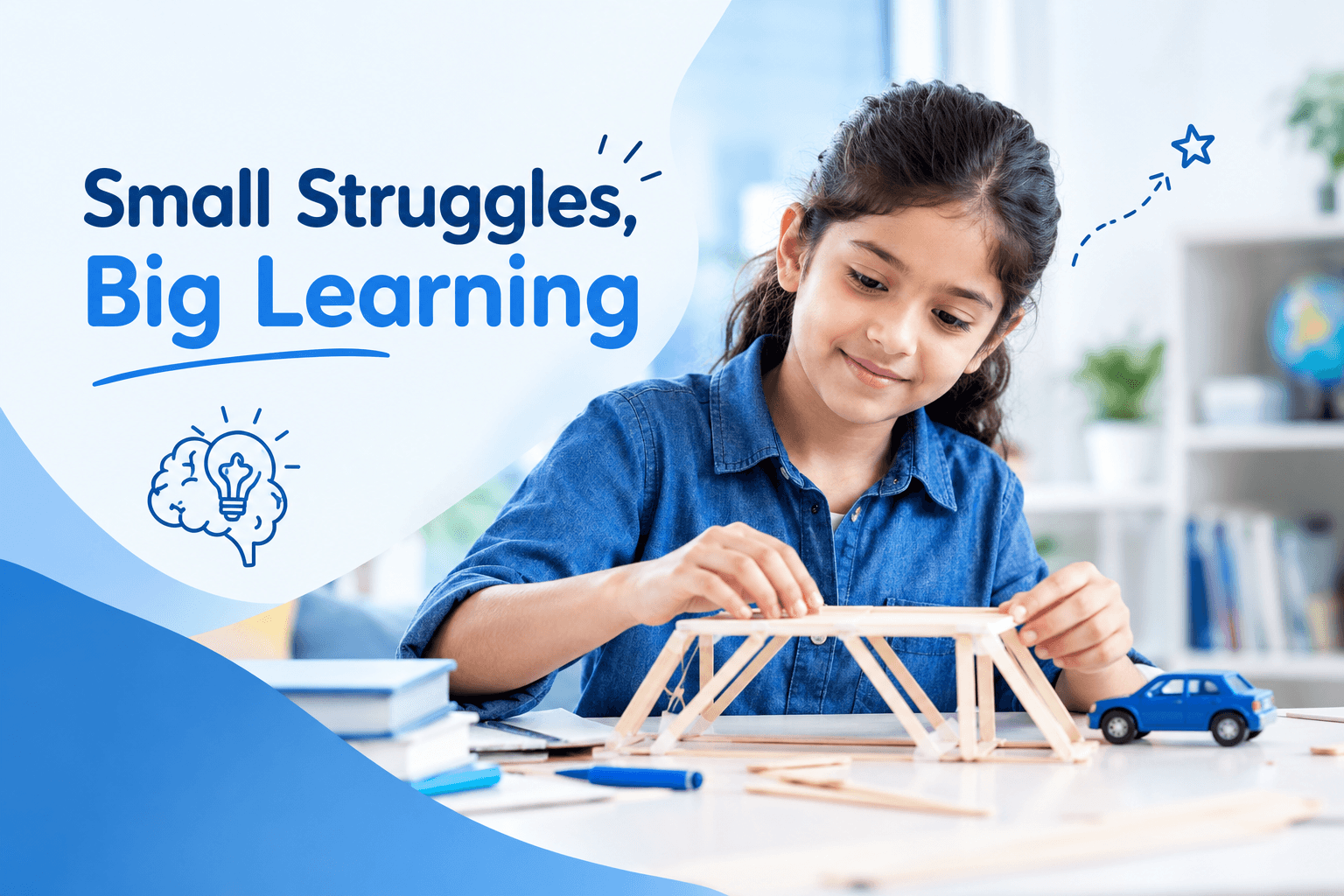
Imagine a child trying to build a paper bridge. The first bridge bends under a toy car. An adult can immediately show the correct design. The child gets a successful bridge, but misses the chance to ask, “Why did mine bend?”
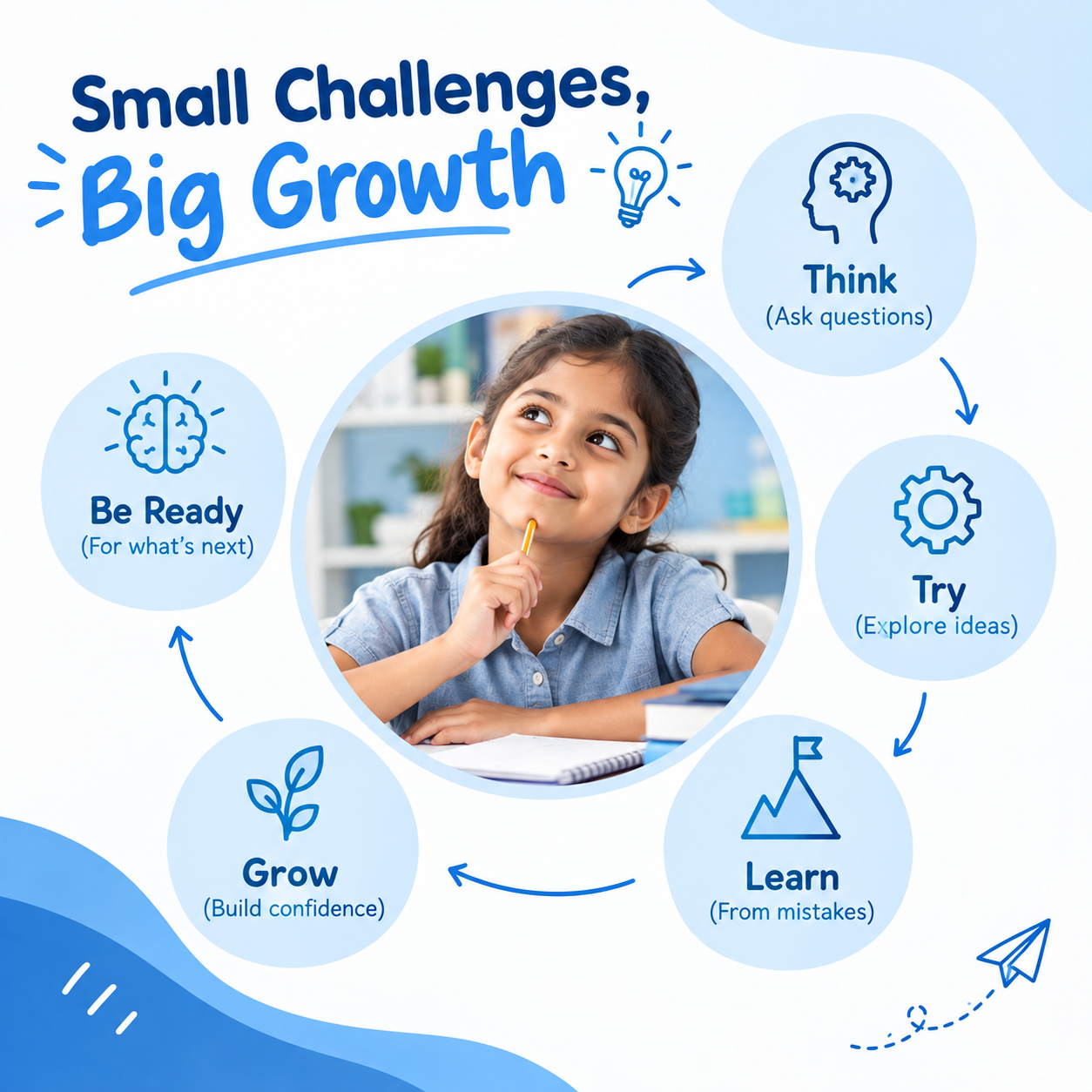
Now imagine the adult asks, “What do you think made it fall?” The child tries thicker paper, changes the shape, and tests it again. The child may fail twice before discovering something that works.
That second experience contains several layers of learning:
- The child notices a problem instead of waiting for an answer.
- They form a possible explanation.
- They test an idea.
- They learn from an unsuccessful attempt.
- They become more comfortable changing their approach.
Research on mathematics problem-solving has found that students can turn errors into productive struggle when they return to examine and analyse what went wrong.
This does not mean children should simply be left alone with difficult work. Productive struggle needs guidance.
|
Instead of immediately saying… |
An adult can ask… |
|
“Here is the answer.” |
“What have you tried so far?” |
|
“You are doing it wrong.” |
“Where do you think it changed?” |
|
“Let me fix it.” |
“What could you change and test?” |
|
“This is easy.” |
“Which part is confusing?” |
The aim is not to make learning harder for the sake of it. The aim is to give children enough space to think before someone else thinks for them.
Why Easy Learning Can Sometimes Be Misleading
There is an interesting idea in cognitive psychology called “desirable difficulties,” associated with psychologist Robert Bjork and his research. It describes learning conditions that may make practice feel harder but can support better long-term retention and transfer. Spacing, retrieving information from memory, and mixing different types of problems are examples.
Consider a child learning multiplication tables. Reading “7 × 8 = 56” ten times may feel smooth. But closing the book and trying to remember the answer tomorrow requires more effort. That small effort is actually useful because the child has to retrieve the information.
The same principle appears in everyday life.
- A child packs their schoolbag and forgets a notebook once.
- A child tries to tie their shoelaces instead of having an adult do it.
- A child reads a recipe and works out which ingredient should come first.
- A child tries to explain why ice melts faster in one place than another.
Each situation gives the brain a chance to connect information with action.
However, research also makes an important distinction: not every difficulty is beneficial. A task that is far beyond a child's current understanding can produce frustration rather than learning. Recent research on productive struggle similarly stresses that useful challenge should be within reach, while excessive difficulty can become unproductive.
The “Help Ladder” Parents Can Try at Home
Parents do not have to choose between helping and not helping. There is a middle path: help gradually. A simple four-step approach can work:
- Wait: Give the child some quiet time to think before stepping in.
- Ask: Use a question rather than giving the solution. “What have you tried?”
- Hint: Offer one small clue if the child is genuinely stuck.
- Explain: Give a fuller explanation only when the child needs it, and then ask them to try again.
For example, suppose a child cannot understand why 24 ÷ 6 equals 4. Instead of immediately explaining division, a parent could ask the child to divide 24 pencils equally among six people. The child can physically distribute them and discover the relationship.
This is also where metacognition becomes important. Children gradually learn to think about their own thinking: What do I know? What do I not know? What could I try next? That habit can become useful far beyond examinations.
Also Read: Is CBSE Alone Enough to Prepare Kids for a Global Future?
How The Cambridge International School, Haralur Connects With This Idea
The Top Schools In Bangalore conversation increasingly includes questions about how children learn, not simply what they learn. The Cambridge International School, Haralur describes its approach as play-based, activity-based and inquiry-based during the foundational years, with an emphasis on skills such as logical thinking, cooperation, creativity, self-discipline and communication.

Its academic approach also describes inquiry-led learning in the preparatory years, multidisciplinary learning in the middle years and career orientation, innovation and leadership in the senior years. The school states that STEM learning develops from early hands-on activities towards areas such as coding, 3D printing, AI, drones, robotics and design in higher grades.
This creates a natural connection with the idea that learning can involve questioning, testing and revising rather than simply receiving answers. The school's reported activities also include technology, sports, arts and inter-school events, giving children different settings in which to practise persistence and problem-solving.
The Bigger Lesson: Let Children Meet Small Problems
Childhood does not need to be free from every small difficulty. In fact, small, manageable problems can become practice for larger ones. A child who learns to ask “What can I try next?” when a tower falls may eventually use the same habit when a science experiment fails, a difficult maths question appears or a group project does not go as planned.
The goal is not to make children struggle more. It is to help them become comfortable with the process of thinking, trying, failing, changing and trying again. Sometimes, the most valuable moment in learning is not when a child gets the answer. It is the moment just before they do.
For more information regarding this school and other schools in this area










 as a preferred source on