







Walk into any Indian school today, and you'll notice something peculiar. Either it's all about board exam rankings with no cultural basis, or it's heavy on tradition but light on academic rigour. Rarely do you find both coexisting seamlessly.
This occurrence isn't just an observation—it's a crisis. UNESCO's 2022 report underscores that cultural education fosters critical thinking and social cohesion, yet most schools tend to overlook it. Annual day performances and sporadic cultural events don't count as integration.
In this article, we explore how structured pillar-based frameworks are reshaping education by making culture compulsory. We will examine Kesar The International School (KTIS) in Bagalur, Bangalore, a CBSE institution that has successfully implemented a five-pillar approach, where every child receives a keyboard, and every house embodies the philosophy of a river.
Also Read | How Robots Teach more than Books
Why Traditional Education Models Are Failing Today's Students
The world has moved on, but many classrooms haven't. Today's workplaces demand more than memorised formulas—they want creative problem-solvers who can collaborate across cultures. Yet education remains stuck in the rote-learning era.
The Skills Gap Nobody Talks About
Research from the World Economic Forum reveals that emotional intelligence and creativity rank among the top five skills for 2025. But how many schools actively teach these? Mathematics and science labs exist everywhere, but where are the mandatory music rooms or cultural immersion spaces?
Students graduate with stellar grades but struggle with basic teamwork. They do well on tests, but they can't confidently share their ideas. The issue isn't intelligence—it's the absence of holistic development that only comes from arts, culture, and experiential learning woven into daily academics.
When "Extra-Curricular" Means "Extra-Ordinary"
Most schools label music, dance, and cultural activities as "extra-curricular"—a polite way of saying optional. These programmes run during lunch breaks or after school hours, accessible only to students whose parents can afford additional fees or time commitments.
This approach sends a clear message: culture and arts are bonuses, not necessities. Compare this with mathematics or English—no school calls those optional. Until cultural education receives the same priority, we're producing academically literate but culturally hollow graduates.
The Five-Pillar Framework: Beyond Token Cultural Programs
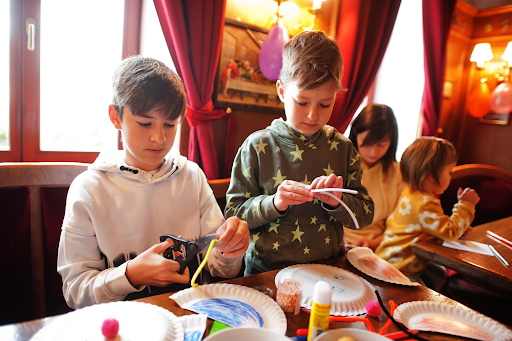
Progressive institutions are rejecting the dichotomous approach. They're building structured frameworks where academics and culture don't compete—they complement each other. Let's understand what genuine integration looks like through systematic pillars.
KALA: When Arts Become Non-Negotiable
What if every student learnt an instrument? Instead of being an elective, music education could become an integral part of their regular curriculum, much like science or history. This endeavour isn't about creating concert performers. Music education develops pattern recognition, enhances memory, and teaches discipline through daily practice.
When schools make arts mandatory, something shifts. Students discover hidden talents. Introverted children discover their voice through rhythm. Academic pressure finds a healthy outlet. The cognitive benefits are documented—students with music training show stronger mathematical abilities and improved language processing.
SANSKRITI: Culture as Core, Not Costume
Ethnic day celebrations are lovely, but they're not cultural education. Real integration means students understand the philosophy behind traditions, not just wear them once a year. It involves regular exposure through storytelling, festivals celebrated meaningfully, and discussions about India's diverse heritage.
Schools that adopt this philosophy organise traditional art workshops, classical music appreciation sessions, and heritage walks. Students learn about their culture as well as other cultures, which helps them build respect and a sense of identity simultaneously. The goal isn't nostalgia—it's equipping children with cultural confidence in a globalised world.
ANUBHAVA: Experiential Learning That Sticks
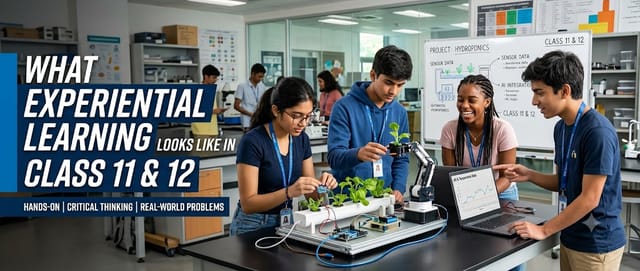
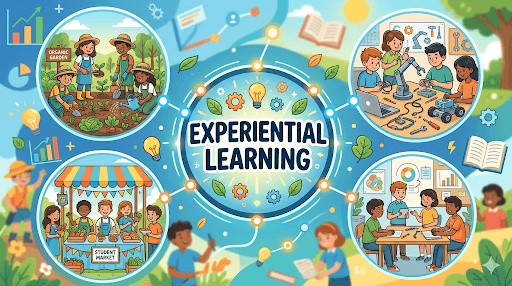
Reading about photosynthesis is one thing. Growing plants from seeds and observing the process is entirely different. The ANUBHAVA (experience) pillar recognises that children learn best by doing, not just hearing.
Progressive schools create:
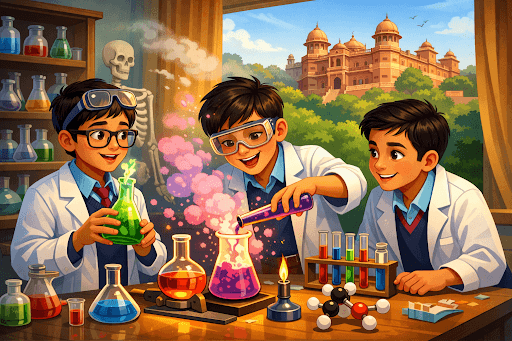
- Science labs with hands-on experiments using actual chemicals and equipment
- Math labs where abstract concepts become tangible through models
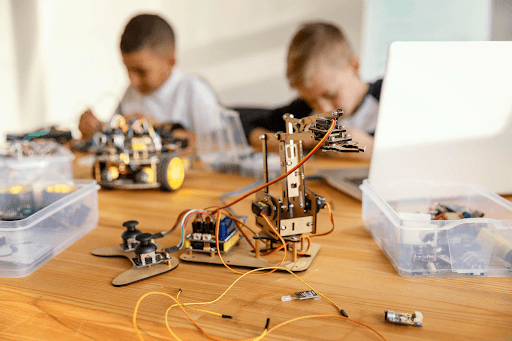
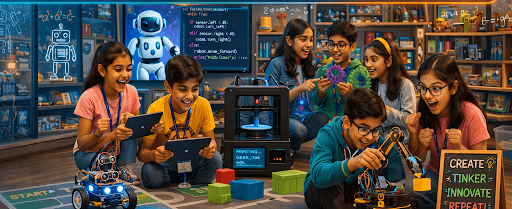
- Robotics spaces where coding meets construction
- Gardens where biology lessons unfold naturally
- Life skills workshops teaching sewing, cooking, and conflict resolution
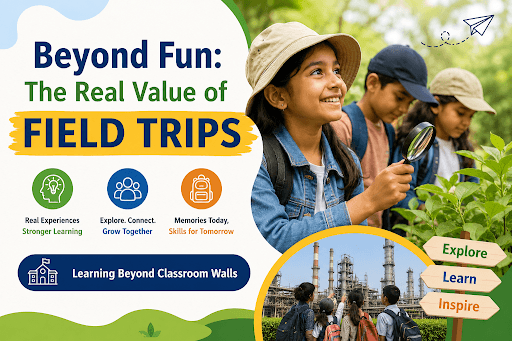
These aren't field trips or annual events. They're integrated into weekly schedules, ensuring every student gets consistent experiential exposure across subjects.
When Houses Aren't Just for Sports: The Ekta Model

Most schoolhouse systems exist for one purpose: sports day. Students wear coloured T-shirts, cheer for their teams, collect points, and forget about them until next year. But what if houses represented something deeper?
Philosophical Foundations Beyond Competition
Imagine houses named after India's sacred rivers, each carrying distinct mottos and symbolism. Ganga House's yellow represents fire and passion with the motto "I Am Eternal." Kaveri House's Blue embodies serenity in "Braving the Rocky Terrain". Suddenly, houses aren't just about winning—they're about embodying values.
This transforms student councils from organising committees to leadership laboratories. Students don't just plan events; they represent their house's philosophy, debate its relevance, and demonstrate its principles. The EKTA (unity) pillar fosters belonging that transcends academic competition.
Leadership Through Collaboration
When houses have meaningful identities, student participation changes. A debate competition becomes Sindhu's "Strength Galore", challenging Yamuna's "In Union is Strength". Group projects reflect house philosophies. Community service initiatives carry thematic depth.
Students learn that leadership isn't about individual glory but collective progress. They discover their strengths, support teammates, and understand that every role matters—lessons far more valuable than any trophy.
Safety as Pedagogy: The Often-Ignored Fifth Pillar
Schools install CCTV cameras and hire security guards, then call themselves safe. But what about the anxious child struggling silently? Is the student being subtly bullied? Is the parent unable to communicate concerns effectively?
Physical and Emotional Safety Combined
The RAKSHA (protection) pillar recognises that safety isn't just about locking gates. It's comprehensive: nurse bays for immediate medical attention and counsellors for mental health. This plan includes support, parent immersion programs for transparent communication, transportation systems that incorporate speed governors, and teacher supervision.
When schools treat emotional safety as seriously as physical security, attendance improves, anxiety reduces, and learning flourishes. Students focus better when they know support systems exist. Parents engage more confidently. Teachers spot issues earlier. Safety becomes culture, not just infrastructure.
Check Out | Child Safety in Schools: The Satya School, Gurgaon Approach
Kesar The International School: Where Ancient Rivers Meet Modern Innovation
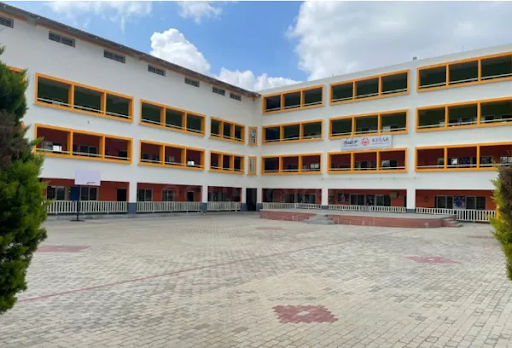
Kesar The International School (KTIS) in Bagalur, Bangalore, operates under the MVM Group of Institutions as a CBSE-affiliated school. Its Sanskrit motto "तेजस्वी नवधिथमस्तु" translates to "Study and be enlightened"—setting the philosophical tone from day one.
Here's where KTIS gets specific: mandatory keyboard lessons for every student up to grade 5, guitar for grades 5 and above. Each child receives an individual instrument—no sharing, no waiting turns. Such an arrangement isn't aspirational; it's an operational reality. Add to this a dedicated space for art, dance, and drama integrated into weekly timetables.
KTIS backs its ANUBHAVA pillar with substantial infrastructure: a library housing over 6,000 books, science labs with actual chemicals and glassware for hands-on practicals, a mathematics lab with manipulatives and models, a fully equipped robotics lab, and computer facilities with the latest software. Students don't watch demonstrations—they conduct experiments, build robots, and solve problems physically.
KTIS's four houses—Ganga, Sindhu, Yamuna, and Kaveri—each carry distinct colour symbols and mottos. Ganga's yellow fire represents eternal passion. Sindhu's red energy embodies strength in unity. Yamuna's green harmony symbolises prosperity through togetherness. Kaveri's blue serenity teaches resilience through rocky terrains. Student councils operate year-round, not just during sports week.
Safety manifests through multiple layers: a full-time nurse with a dedicated bay, including beds for sick students; an in-house counsellor available for emotional support; GPS-enabled school buses with speed governors capped at 40 km/h; teacher supervision on every bus; regular parent-teacher meetings; and parent immersion programs that ensure transparent communication.
The school's framework hasn't gone unnoticed. KTIS holds recognition from the Asia Book of Records and Guinness World Records and has received Best School Awards. More importantly, it's producing students who excel academically while demonstrating cultural awareness, emotional intelligence, and social responsibility—the true markers of holistic education.
Kesar The International School demonstrates that ancient wisdom and modern pedagogy aren't opposing philosophies. When keyboard lessons coexist with robotics labs, when river philosophies complement scientific thinking, and when cultural immersion enhances rather than interrupts academic rigour—that's when education becomes truly transformative.
If you're searching for an institution that doesn't compromise between cultural roots and global readiness, Kesar The International School in Bagalur, Bangalore, offers a proven framework. Explore their admission process, visit the campus, and see how the five pillars create well-rounded learners prepared for tomorrow's challenges.
For more information on this and other such schools in the area, check out this list of the best schools in Bangalore.

 as a preferred source on