









Choosing a Cambridge school is simply not about finding a school that offers IGCSE. For parents in Gurgaon, the bigger question is: what kind of learning experience will my child actually get after choosing a Cambridge school?
Two schools may follow the same curriculum but offer very different experiences. One may focus mainly on completing the syllabus, while another may give students more opportunities to question, research, communicate and apply what they learn.
So, before choosing one of the best Cambridge schools in Gurgaon, it is worth looking beyond the curriculum name and checking how the school brings that curriculum to life.
Also Read| Why Multi‑Sensory Learning Matters in Schools?
1. Start With the Curriculum, But Look Beyond the Board Name
Cambridge education is often associated with independent thinking, subject depth, and analytical skills. But simply having “Cambridge” on the school website does not tell you how students are taught every day. You need to ask-
- Which Cambridge stages does the school offer?
- What subjects are available?
- How does the school approach assessments?
- Is learning focused only on examinations or also on understanding?
- Are students encouraged to research, question and form their own opinions?
For example, in a history lesson, there is a difference between memorising the causes of an event and examining different sources before reaching a conclusion.
That difference in teaching approach matters. Queen Elizabeth’s School, Gurugram follows a Cambridge-led academic pathway, with its programme extending from the Early Years through the Senior School and eventually to Sixth Form. The school says its approach focuses on academic rigour alongside curiosity, independent learning and critical thinking.
2. Check Whether Learning Goes Beyond Textbooks
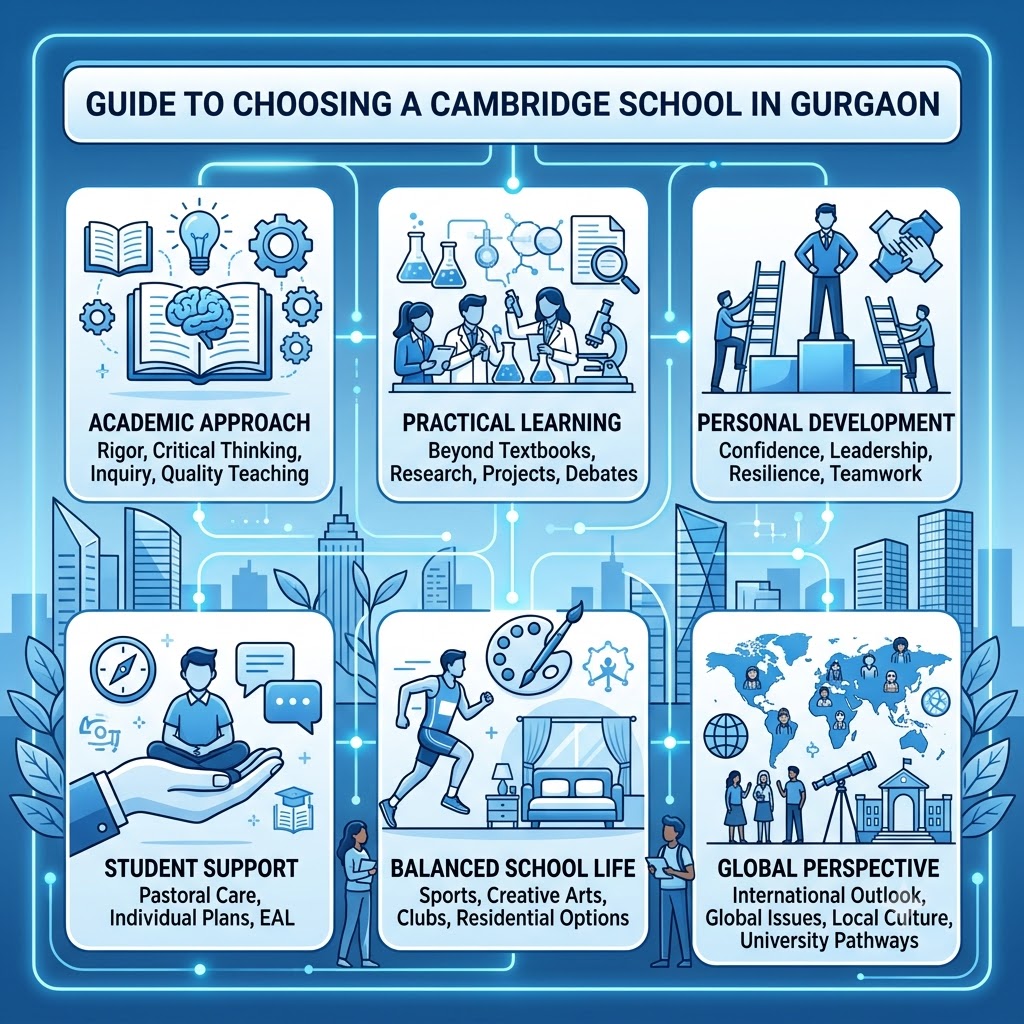
A good Cambridge school should leave room for students to explore ideas beyond what is written in a textbook. This could happen through:
- Research projects
- Debates and discussions
- Practical experiments
- Academic competitions
- Independent reading
- Presentations
- Subject-specific enrichment
Think about a science class discussing climate change. Students could simply learn definitions and diagrams for an examination. Or they could examine real data, discuss different viewpoints and think about possible solutions.
The second approach develops something much more valuable: the ability to use knowledge. Queen Elizabeth’s School highlights what it calls free-thinking scholarship, encouraging students to ask questions, think critically and develop independent study habits. Its academic programme also includes research projects, debates, masterclasses and academic extension opportunities.
3. Look at the School's Approach to Personal Development
Cambridge education is not only about academic performance. Parents should also ask how the school helps students develop confidence, resilience, communication and leadership.
A student might know the answer in class but hesitate to speak. Another may be comfortable presenting an idea but struggle to work with a team. School life should provide opportunities for both students to grow.
|
What to check |
Why it matters |
|
Leadership opportunities |
Helps students take responsibility |
|
Communication |
Builds confidence in expressing ideas |
|
Teamwork |
Teaches students to collaborate |
|
Independence |
Prepares children to make decisions |
|
Resilience |
Helps them handle setbacks |
|
Creativity |
Encourages new ways of thinking |
Queen Elizabeth’s School places personal development alongside academic achievement, with programmes such as QE House focusing on belonging, leadership and teamwork, and QE Futures focusing on independence, aspiration and preparation for life beyond school.
4. Don't Ignore Student Support from School
This is particularly important in an international or boarding school. Academic pressure, changing friendships, new environments and the expectations of a demanding curriculum can affect students differently.
So, ask what happens when a student needs help and whether there:
- Learning support?
- Support for English as an Additional Language?
- Individualised learning plans?
- Regular communication with parents?
- A system for identifying students who may need additional help?
At Queen Elizabeth’s School, student support includes learning support, EAL and pastoral care, with options such as classroom, small-group and individual support. That matters because a strong school should know its students, not just their grades.
5. If It Is a Boarding School, Look at Life Beyond Classes
This is where choosing a Cambridge boarding school becomes slightly different from choosing a regular day school. Students spend much more of their time within the school community. So, parents should look at:
- Residential arrangements
- Pastoral care
- Evening routines
- Sports and activities
- Study support
- Student supervision
- Opportunities for social interaction
- How independence is developed
The aim should not be to keep students busy from morning to night. It should be to create a balanced environment where academic learning, rest, friendships, activities and personal development have their own space.
Queen Elizabeth’s School, Gurugram offers day boarding, weekly boarding and full boarding, giving families different residential options. Its boarding model is built around academic learning, pastoral care and co-curricular opportunities.
6. Check the School's International Exposure
A Cambridge curriculum is naturally international, but students also benefit from understanding the world around them. Look for opportunities involving:
- Different cultures and perspectives
- Global issues
- Languages
- International university pathways
- Research and collaboration
- Exposure to people and ideas beyond the immediate community
At the same time, international education should not mean losing touch with the local context. Queen Elizabeth’s School says its curriculum is designed with an international outlook while also incorporating the cultural and linguistic strengths of India. That balance can be particularly useful for students who may eventually study or work in different parts of the world.
7. Finally, Look at the People Behind the Curriculum
A curriculum is only as good as the way it is taught. Parents should look at the teachers, school leadership, and the overall academic culture. You need to ask yourself-
- Do teachers encourage questions?
- Are students expected to think independently?
- Does the school value curiosity as much as marks?
These details can tell you far more about a child's everyday experience than a curriculum logo can.
Also Read| Why do Children want a better learning approach?
Why Queen Elizabeth’s School, Gurugram Can Be Worth Considering
For families specifically searching for a Cambridge school in Gurgaon, Queen Elizabeth’s School, Gurugram brings together several of the factors that are worth examining: a Cambridge-led academic pathway, British educational heritage, emphasis on independent thinking, student support, leadership opportunities and a day-and-boarding model.

The school is inspired by Queen Elizabeth’s School, Barnet, which was founded in 1573. Its Gurugram campus is scheduled to open in August 2026 and is located on Bilaspur, Tauru Road.
What makes the proposition interesting is that the school isn't positioning Cambridge education as simply an examination pathway. Its stated approach connects academic rigour with curiosity, independent learning, character development, leadership and pastoral care. So, if you are searching for one of the Cambridge schools in Gurgaon, don't stop at the question, “Does this school offer Cambridge?”
Ask the more useful question: “What kind of learner will my child become here?” That is ultimately what separates one Cambridge school from another—and it is also why Queen Elizabeth’s School, Gurugram, Bilaspur Kalan, can be a compelling choice for families looking for a Cambridge education combined with a broader, internationally oriented school experience.
Want to know more about this school and other schools in Gurgaon







 as a preferred source on