









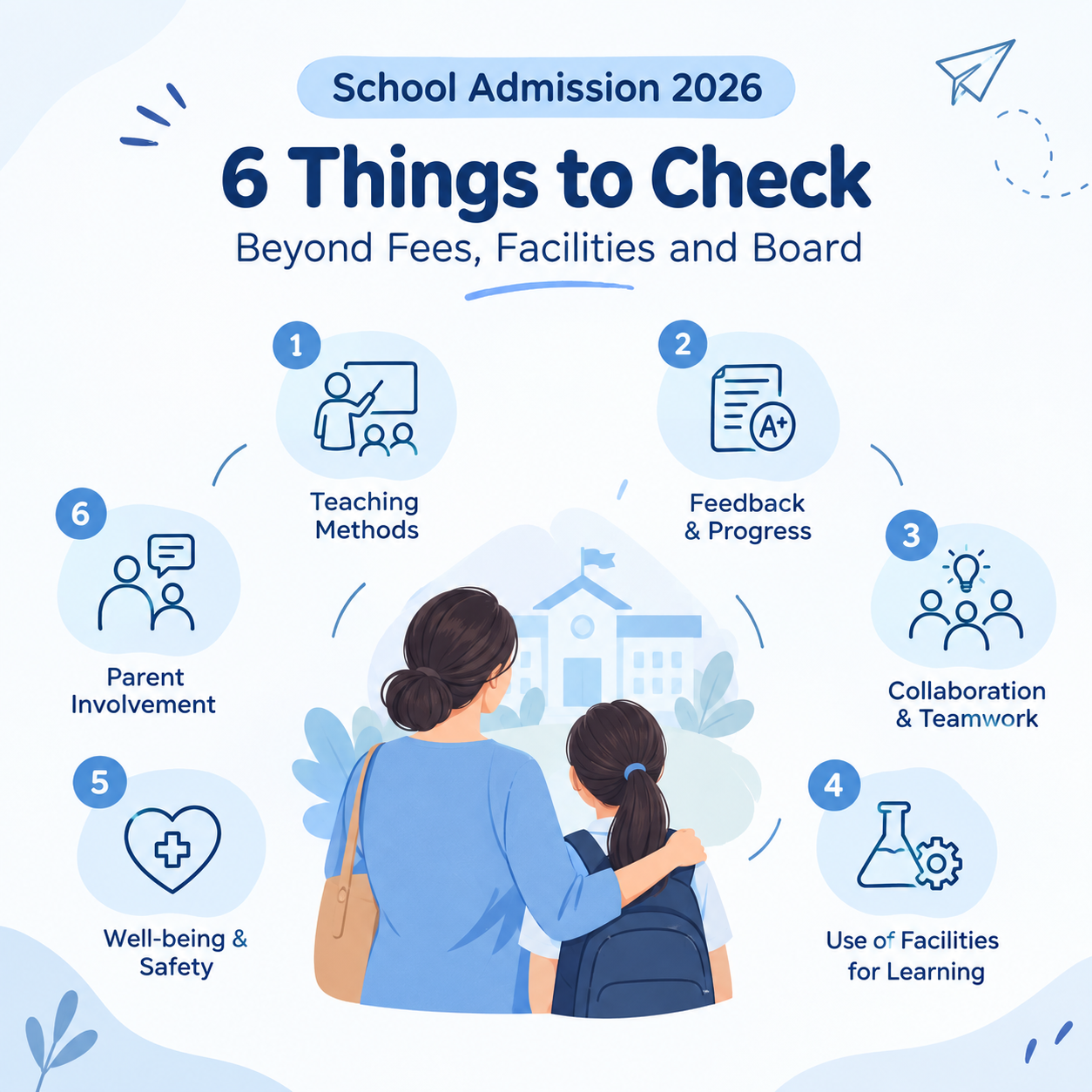
Choosing a school can feel a little like buying a house. Parents look at the location, facilities, fees, board and reputation, and then try to imagine whether their child will be happy there. While these are important, families comparing the Top Schools in Gurgaon, including Presidium School, Sector 57, Gurgaon, should also look at what happens inside those classrooms every day. A smart board does not automatically make a lesson engaging, just as a large playground does not tell you whether children actually get enough opportunities to use it. For school admission 2026, here are six things worth checking before making a decision.
Also Read: The Importance of Life Skills Education in Today's Schools
1. Ask How Children Are Actually Taught
Two schools can follow the same board and still offer very different classroom experiences. One classroom may focus mainly on completing chapters and preparing for tests, while another may ask students to explain their reasoning, discuss an idea, solve a problem together or apply a concept to everyday life.
This matters because learning is not simply about remembering an answer. Metacognition, the process of thinking about how we learn, helps children plan, monitor and evaluate their own learning. The Education Endowment Foundation's research review found that metacognitive and self-regulation approaches have a high average impact on learning, with its current toolkit estimating around eight months of additional progress.
During a school visit, parents can therefore ask:
- Are students encouraged to ask questions?
- Do teachers explain mistakes instead of only marking them wrong?
- Are children given opportunities to explain how they reached an answer?
- Does classroom learning include practical activities and discussion?
For example, if a child gets a maths problem wrong, the useful question is not only, “What is the correct answer?” but also, “Where did your method go off track?”
2. Look at the Quality of Feedback, Not Just Marks
A report card can tell parents what a child scored, but good feedback can explain what the child should do next. This distinction becomes especially important as children move into higher classes.
Imagine two comments on an English assignment. “Improve grammar” gives very little direction. “Your argument is clear; now support the second point with an example” tells the child exactly what to work on.
Research by the Education Endowment Foundation identifies feedback as a well-evidenced approach, with an average impact equivalent to around six additional months of progress in its Teaching and Learning Toolkit. It also notes that effective feedback should give pupils specific information about how to improve.
Parents can ask how the school handles:
|
What to check |
Why it matters |
|
Written feedback |
Helps children understand areas for improvement |
|
Verbal feedback |
Allows misconceptions to be addressed quickly |
|
Assessments |
Shows progress rather than just one test score |
|
Parent communication |
Keeps families aware of learning needs |
3. Check Whether Students Get to Work With Others
Group projects are sometimes dismissed as “fun activities,” but structured collaboration can have a serious learning purpose. When children work together on a science investigation, for instance, one may record observations while another explains the result and a third checks whether the evidence supports their conclusion.
The Education Endowment Foundation reports that well-designed collaborative learning approaches can have a positive impact, with an average of around five months of additional progress in its current toolkit. However, the research also makes an important point: simply putting children into groups is not enough. The task needs clear roles, shared goals and meaningful participation.
Parents should therefore look beyond the phrase “group activities” and ask whether students actually get opportunities to:
- discuss and defend ideas;
- divide responsibilities;
- listen to different viewpoints;
- present a shared project; and
- learn from their peers.
4. Find Out Whether Facilities Are Actually Used for Learning
A school brochure can list a long collection of facilities. The more useful question is: What does my child actually do with them?
A science lab is more meaningful when students conduct experiments instead of only reading about them. A mathematics lab becomes useful when abstract ideas are explored through models, puzzles or activities. Similarly, a robotics lab matters more when children are solving design problems than when the equipment simply sits in a room.
This is where parents should connect infrastructure with classroom practice. Ask to see examples of student projects, lab activities, exhibitions or presentations. A child learning about forces in science, for example, may understand the concept differently after building and testing a simple model than after memorising a definition for a test.
5. Look at Support for Health, Safety and Emotional Well-Being
Academic performance is only one part of a child's school experience. A child who is constantly anxious, uncomfortable or unable to ask for help may struggle to make the most of even a strong academic programme.
The World Health Organization notes that safe and supportive school environments are linked with better health outcomes, educational performance and attainment. Its latest guidance for teachers also highlights the importance of positive relationships, safe and inclusive classrooms, social-emotional skills and appropriate support systems.
Parents can ask practical questions rather than relying on broad claims about “well-being.” Is there a counsellor? How are health concerns handled? Who does a child approach when something goes wrong? How does the school communicate with parents during an important concern?
These details may seem small during admission, but they can become very important during a child's school years.
6. Understand How the School Involves Parents
Parents do not need to become teachers at home, but they should know what their child is learning and where support may be needed. Good school-parent communication can make this partnership easier.
The Education Endowment Foundation's research on parental engagement estimates an average impact of around four additional months of progress in its Teaching and Learning Toolkit, while also noting that parent-school partnerships can support attendance, behaviour and well-being.
Before admission, ask how often parents receive meaningful updates, how teachers communicate concerns and whether meetings are only about marks or also about learning habits, participation and progress.
Also Read: Beyond Fun: The Real Value of Field Trips
How Presidium School, Sector 57, Gurgaon Fits Into These Considerations
For parents exploring the Best Schools in Gurgaon, Presidium School, Sector 57, Gurgaon offers several features that connect with these admission considerations. Its official website describes digital classrooms, science and mathematics labs, a computer lab and a robotics lab designed around practical, interactive learning.

The school also describes its robotics programme as involving experimentation, creativity, cooperation and problem-solving, while its mathematics lab uses activities and puzzles to connect abstract ideas with practice. The campus also includes a library, outdoor play areas, sports facilities, activity rooms and an amphitheatre for competitions, house and club activities. Its public disclosure records two counsellors/wellness teachers and two special educators, alongside 84 teaching staff.
School admission should not be reduced to a comparison of fees, buildings and board names. Those details matter, but they do not tell the complete story of a child's daily experience. Before choosing a school in 2026, parents should try to understand how children learn, how teachers give feedback, how students collaborate, how facilities are used, what support systems exist and how families are kept involved. A school becomes a good fit when these everyday experiences match what a child needs to learn confidently and grow more independent over time.
For more information regarding this and the other schools in this area







 as a preferred source on