








While visiting your child's school for parent-teacher meetings, have you ever wondered how your child's teacher has most probably been teaching the same syllabus for the last several years? They are capable, yes, and they definitely do care for the kids. But after so many years, doesn't a change seem much needed for them?
What that teacher may be missing is exposure; not a refresher course or a certification, but an actual, disorienting, perspective-shifting exposure to how education works somewhere else entirely. According to UNESCO, teacher quality remains one of the strongest factors affecting student learning and classroom engagement.
Schools that understand this have been quietly investing in Faculty Exchange Programmes for years. One such school is The Scindia School, one of the best boarding schools in India.
But how do faculty exchange programmes work? Read on to find out!
Also Read | Using Teachers’ Training to Redefine the Education System
The Problem with Professional Isolation
Teaching is one of the very few professions where someone can spend decades being excellent at their job without ever having to fundamentally question their method. A teacher who explains something one way, year after year, rarely gets told that there are four other ways to explain the same thing, two of which might work better for a certain kind of learner.
This is not a criticism. It is the natural result of working in a closed system.
And students feel the effects. This does not happen in a dramatic way but more in the quiet accumulation of hours that feel slightly flat. For example, a chapter that should spark curiosity, but just gets covered, or a concept that should connect to something real but stays abstract.
By the time a student sits for board exams, the texture of their education, the richness of it, has been shaped largely by whether the adults teaching them were still learning themselves. That is perhaps a much harder question for schools to answer than "what is our pass percentage."
How Faculty Exchange Programmes Actually Work
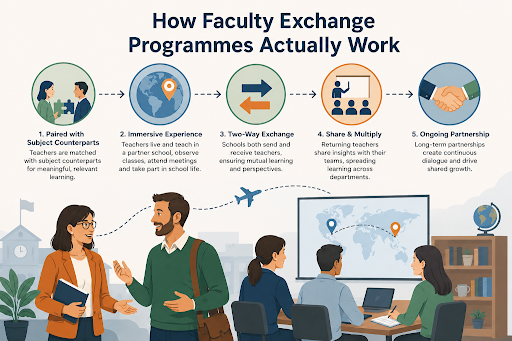
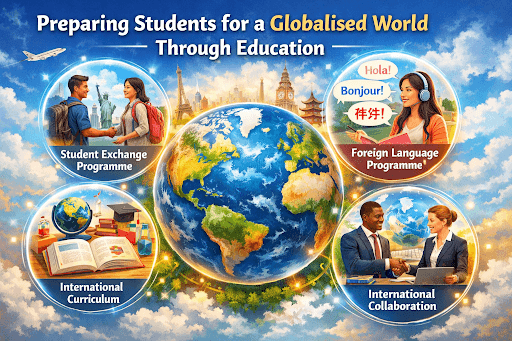
The basic mechanics are straightforward: a teacher from one school is placed in a partner school, sometimes in another city, often in another country, for a defined period. They teach actual classes. They sit in on lessons run by their counterparts. They participate in department meetings, attend school events, and navigate a professional environment that works differently from the one they are used to.
There are a few things the best faculty exchange programmes tend to do consistently:
- Teachers are paired with subject counterparts, not just placed in any available classroom, so the learning is directly applicable to their department.
- Schools run the exchange in both directions. The institution both sends teachers and receives them. One-way programmes miss half the value.
- Returning teachers are given structured time to share what they learned. Otherwise, the insight stays with one person instead of spreading through a department.
- The partnership is ongoing. Single exchanges between schools generate some benefit. Exchanges that run year after year, with the same partner institutions, generate real educational dialogue. Both schools begin to evolve together.
How Faculty Exchange Programs Benefit Students
Children today already grow up under constant academic comparison. Many quietly struggle with confidence issues because classrooms sometimes reward only one type of learner.
Teachers who interact with educators from different cities or countries often become more open-minded in their teaching style. They understand that students learn differently. Some respond to visual learning. Others understand better through discussion, practical activities, or storytelling.
In many schools, faculty exchange programmes also expose teachers to cultural diversity. They interact with people from different backgrounds, traditions, and educational systems. Those experiences eventually enter classrooms as well.
Most importantly, a classroom discussion becomes richer when teachers bring wider perspectives into everyday lessons. Students can benefit from this in the following ways:
- Communication skills improve
- Confidence during presentations grows
- Curiosity increases
- Students become more adaptable
- Teamwork improves during collaborative activities
And then there is the visiting teacher, the one who arrives at your child's school from another country. For a student sitting in a classroom in central India, being taught Physics by someone from the United States, or working through a text in English class with a teacher from South Africa, the subject quietly stops feeling local and bounded. It becomes something people across the world care about. That shift, from subject as syllabus to subject as living discipline, is not something you can engineer any other way.
Check Out | Why Every Student Should Experience an Exchange Programme
The Scindia School: Facilitating Foreign Exchange Programs
Founded in 1879 as The Sardar School by HH Maharaja Madhavrao Scindia, The Scindia School was initially established as The Sardar School, making it one of the oldest boarding schools in India. The school is located atop the historic Gwalior Fort and has built its identity around character-building, discipline, leadership and holistic education.
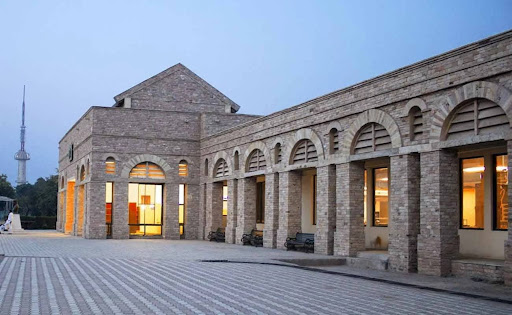
The Scindia School has a very concrete stance on faculty exchange. The school runs annual exchanges of one month each with the Woodbridge School and Ellesmere College, both in the United Kingdom. For two consecutive years, Scindia has sent its teachers to Germany as part of a structured partnership programme with a German school. Scindia teachers have also received the prestigious Fulbright Award, enabling them to work and collaborate with institutions in the United States.
One of the best boys’ boarding schools in India, The Scindia School, also places equal emphasis on the teachers it receives. Ms Roslyn McCarthy from Ellesmere College, UK, helped Scindia set up its Special Education Needs Department, a contribution that directly improved the support structure for students who learn differently. Similarly, Ms Daria from Ukraine made a substantive contribution to the school's theatre program.
In addition to this, the school's house system, community service programme, adventure activities, and the unique meditative space of the Astachal together form an environment designed to shape character alongside intellect. For parents considering a boarding education for their son, The Scindia School represents a place where the thinking about faculty development, and by extension student learning, goes considerably deeper than most.
For more information on this and other boarding schools, check out this list of the best boarding schools in India.









 as a preferred source on