







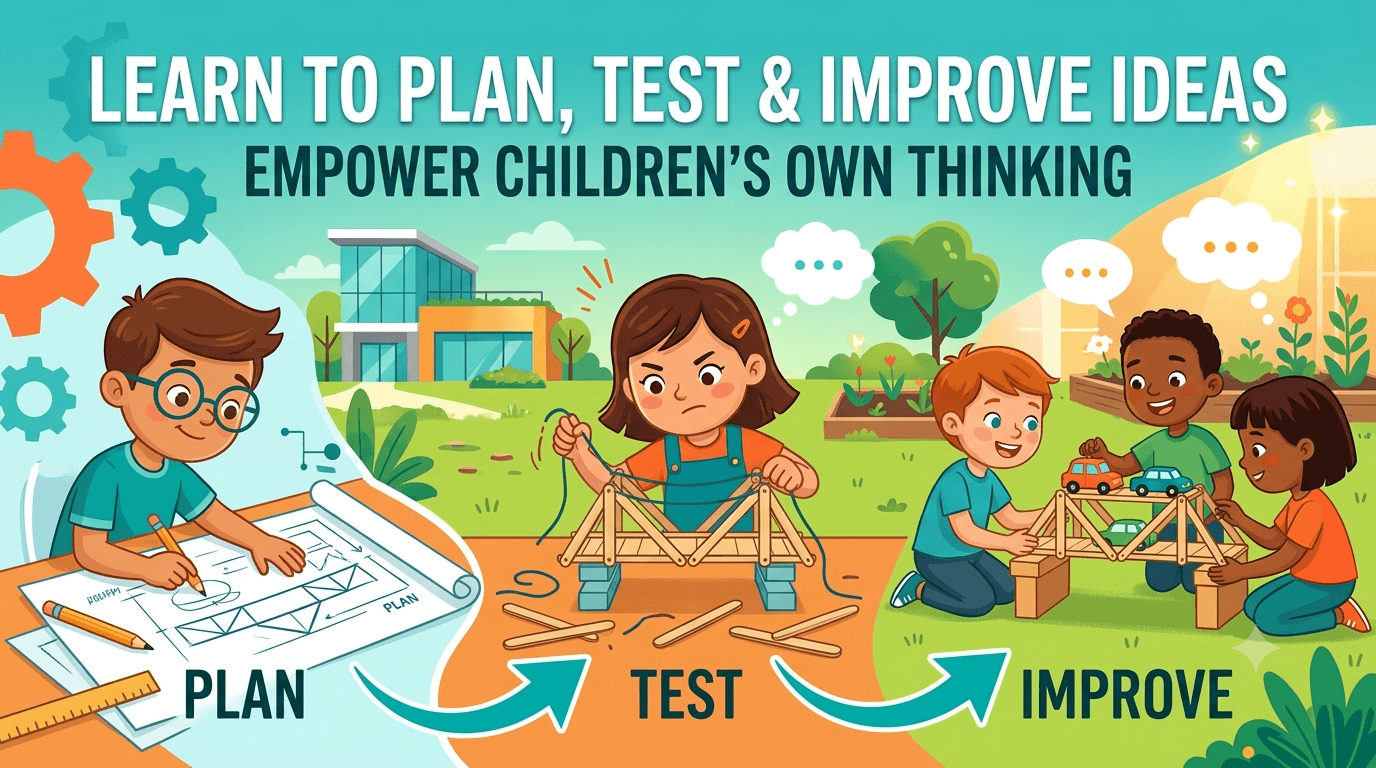

Imagine a child building a paper tower that keeps falling. An adult could quickly show them how to make it stand. But what if the child had a chance to try a different design, test it, and discover what works? That small experience could teach more than simply copying the correct method.
When looking for the Best School in Bangalore, parents can look beyond marks and textbooks to consider whether children get opportunities to think independently, explore ideas, and learn through experience. These skills help children approach unfamiliar situations with greater understanding and confidence.
Learning to plan, test, and improve an idea is not limited to science experiments or school projects. It is a useful process that children can practise in everyday life, from solving a maths problem to organising an assignment.
Also Read| How School Culture Shapes Student Confidence and Success
Why Children Need More Than the Right Answer
Children often learn to focus on getting the correct answer. While accuracy matters, understanding how to reach an answer is equally important. A child who memorises a method may struggle when a question is presented differently. A child who understands the process has a better chance of finding another way forward.
Planning is the first step. It encourages children to pause, understand the task, and decide what they need to do. For example, before starting a school project, a child can list the materials required, break the work into smaller steps, and decide how much time each step might take.
The next step is testing the idea. Children try their approach and observe the result. If it does not work, they can consider what needs to change.
This process is connected to metacognition, which means thinking about one's own learning. Educational guidance from the Education Endowment Foundation highlights the value of helping children plan, monitor, and evaluate their work.
Instead of asking only, “Did you get the answer right?”, parents can also ask, “How did you work it out?” This helps children pay attention to their thinking, not just the final result.
What Children Learn When Their First Attempt Fails
A failed attempt can be frustrating, especially when a child has spent time trying to solve a problem. However, an unsuccessful attempt can provide useful information when children know how to learn from it.
Suppose a child builds a bridge using paper and finds that it cannot hold a few small objects. Rather than immediately rebuilding it for them, a parent can ask what might have caused the problem. Was the paper too thin? Was the bridge too long? Would folding the paper make it stronger?
The child can then change one part of the design and test it again.
Through experiences like these, children practise observing results, comparing possibilities, and making decisions. They also begin to understand that a mistake does not always mean they lack ability. Sometimes, it means their first approach needs adjustment.
However, children should not be left to struggle endlessly. If they are confused or becoming upset, they may need a hint, a demonstration, or a simpler starting point. The aim is not to make learning difficult but to help them take part in finding a solution.
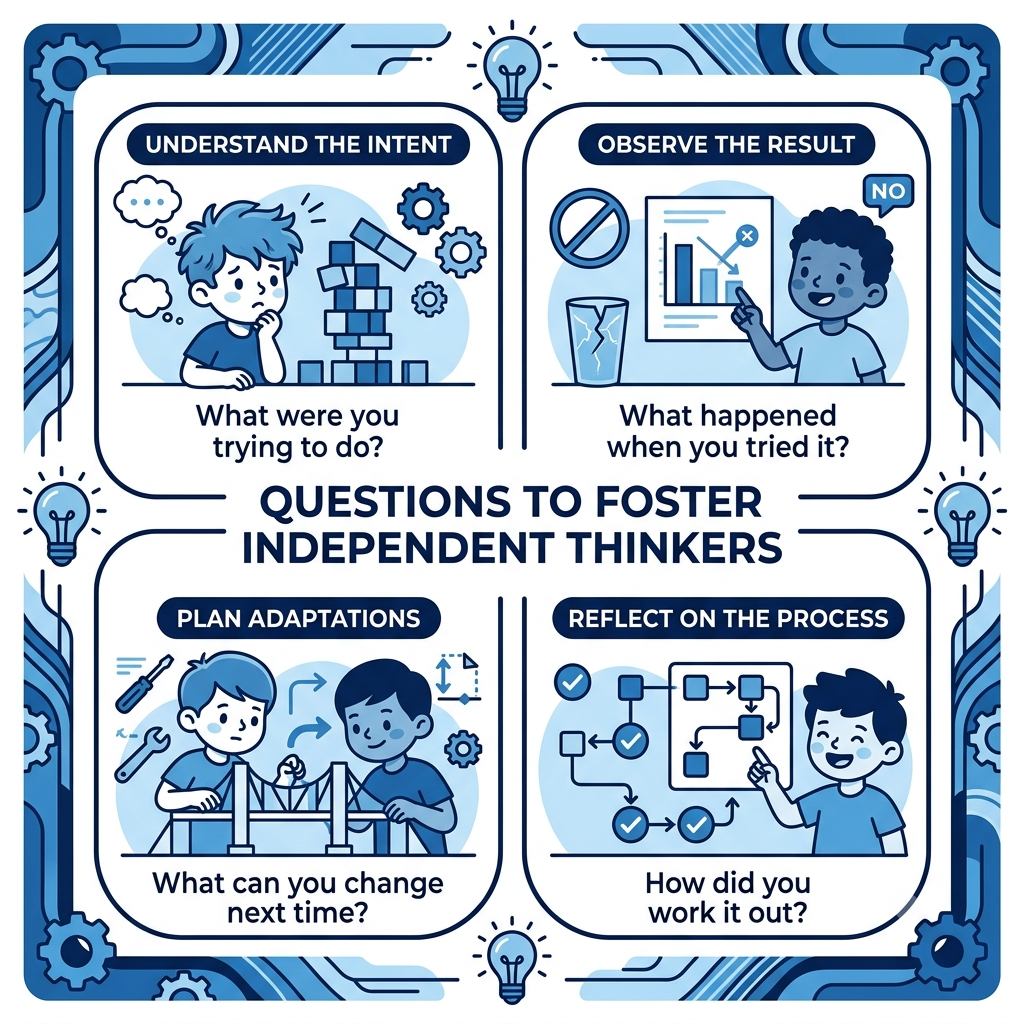
Parents can encourage reflection with three simple questions:
- What were you trying to do?
- What happened when you tried it?
- What could you change next time?
These questions help children turn an experience into a useful lesson.
How Parents Can Encourage Children to Think for Themselves
Children do not need expensive equipment or complicated activities to develop these skills. Everyday situations can provide plenty of opportunities to plan, experiment, and improve.
1. Ask questions before giving answers
When a child gets stuck on homework or a puzzle, resist the urge to solve it immediately. Ask, “What have you tried so far?” or “Can you think of another way?” If necessary, offer a small hint rather than the complete answer.
2. Let children plan manageable tasks
Invite children to plan a simple activity, such as preparing materials for a craft project, organising their school bag, or dividing an assignment into smaller tasks. Younger children may need a few choices, while older children can gradually take greater responsibility.
3. Encourage safe experimentation
Cooking with adult supervision, making a paper aeroplane, or growing a plant can help children observe how changes affect results. Ask them to make a prediction before trying something and compare it with what actually happens.
4. Focus on the process, not only the outcome
Instead of praising only a perfect result, notice the child's effort to find a solution. You might say, “You noticed what went wrong and changed your approach. What did you learn from that?”
This does not mean every attempt deserves the same result or that effort replaces accuracy. It means helping children recognise the decisions and strategies that contribute to improvement.
5. Give children time to revise their work
When a child finishes a story, drawing, model, or written assignment, encourage them to review it before calling it complete. They might find a sentence that needs clarification or a step that could be better organised.
The goal is to make reviewing work a normal part of learning rather than a punishment for making mistakes.
How Schools Can Create Opportunities for Independent Thinking
Schools can support this process by giving children meaningful opportunities to investigate questions, explore different approaches, and explain their reasoning. Practical activities, classroom discussions, and suitable projects can help students connect what they learn with situations they can observe and understand.
Teachers also play an important role in deciding when to step in. A helpful question or a small clue can guide a child forward while allowing them to remain involved in solving the problem. Over time, children can take more responsibility for planning and reviewing their work.
When evaluating a Top School in Bangalore, parents can ask how students are encouraged to think through challenges, whether they get opportunities to learn from feedback, and how teachers support children when their first attempts do not work. These questions can reveal more about everyday learning than the presence of activities alone.
Also Read| Why School Spaces Matter in a Child’s Early Educational Journey
A Relevant School Connection: New Oxford School, Sarjapur
New Oxford School (NOS), Sarjapur, Bangalore, describes its educational approach through exploration, experimentation, problem-solving, learning by doing, and inquiry-based activities. These stated priorities connect with the idea that children benefit from opportunities to investigate questions and work through challenges rather than simply memorise answers.

For parents researching the Best School in Bangalore or a Top School in Bangalore, a useful consideration is how such educational priorities translate into students' everyday classroom experiences. Asking about opportunities to plan, test, reflect, and improve can help families understand how a school's approach supports active learning. These priorities provide a relevant connection to the topic, though they should not be treated as proof of guaranteed outcomes for every child.
Help Children Learn How to Try Again
Children do not need to get everything right on the first attempt. They need opportunities to think, make decisions, observe results, and adjust their approach with appropriate guidance.
Parents can support this development by asking thoughtful questions, allowing safe experimentation, and giving children time to review their work. Schools can contribute by making exploration and reflection part of meaningful learning experiences.
When children learn not only to find answers but also to understand how they arrived at them, they develop a useful approach to challenges that extends beyond the classroom. The most important lesson is simple: sometimes, the value of an activity lies not in getting it right immediately, but in learning what to do next.
For more information on this and similar schools, check out this list of the best schools in Bangalore.


 as a preferred source on