







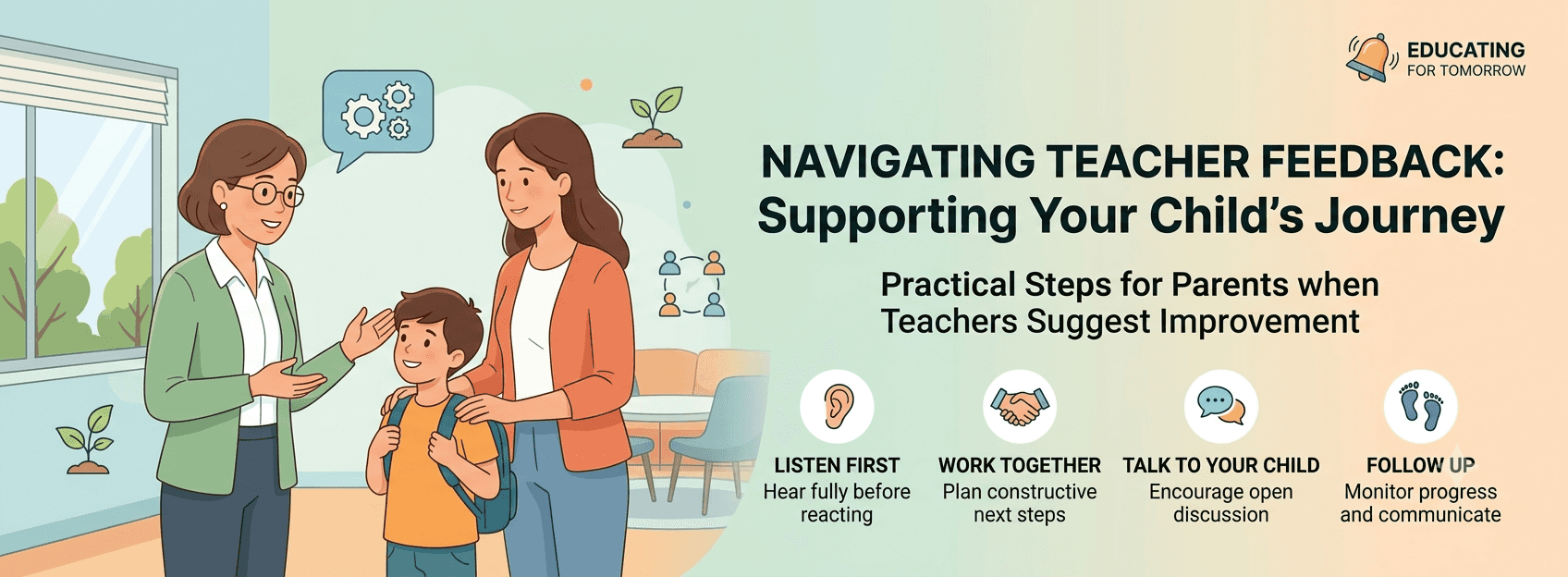

Hearing a teacher say that your child needs to improve can be difficult. You may feel worried, surprised, or even wonder whether you have missed something important. Whether the concern is about homework, classroom behaviour, academic performance, or participation, it is natural to want to defend your child.
However, the most helpful response is to understand what the teacher has noticed and work out what your child needs next. Feedback does not mean a child is incapable of doing better. It can be an opportunity to identify a difficulty before it becomes a bigger problem.
When evaluating what makes the Best School in Bangalore a suitable choice for their child, parents can also consider how well the school and family communicate about learning and development. A constructive conversation between parents and teachers can help turn a concern into a practical plan.
1. Listen to the Teacher Before Jumping to Conclusions
When a teacher raises a concern, try to listen to the full explanation before responding. It is easy to become defensive, especially when the feedback involves behaviour or academic performance. But reacting immediately may prevent you from understanding what is actually happening.
Start by asking for specific examples. If a teacher says your child is not paying attention, find out what that means in practice. Does your child miss instructions, get distracted during independent work, or struggle to follow a lesson? Each situation may need a different response.
Similarly, if the concern is about poor academic performance, ask whether your child struggles to understand concepts, complete assignments, or explain answers independently.
It is also important to understand whether the problem happened once or has become a pattern. One unfinished assignment does not necessarily indicate a serious issue. Repeated difficulties across several weeks may need more attention.
Try asking these questions:
- Could you share a recent example of what you have noticed?
- How often does this happen?
- Does my child experience this difficulty in other subjects or activities?
- Have you noticed anything that helps my child do better?
Listening calmly does not mean agreeing with every observation. It means gathering enough information to respond fairly and thoughtfully.
2. Ask Questions That Turn Feedback Into a Plan
Once you understand the concern, the next step is to decide what can be done about it. A conversation that ends with “Your child needs to work harder” may leave everyone unsure about what to do next.
Instead, ask the teacher what improvement would look like and which steps are likely to help.
For example, imagine that a teacher says your child rarely completes written work in class. Asking your child to study for an extra hour every evening may not solve the problem. The difficulty could involve writing speed, understanding instructions, organising ideas, or feeling unsure about the answers.
A more useful conversation might establish whether the child needs clearer instructions, regular writing practice, help with planning tasks, or additional support with the subject.
Parents and teachers can then agree on a few realistic actions.
- Identify one clear goal: For example, completing a short written task independently.
- Agree on responsibilities: The teacher can monitor classroom progress while the parent provides a suitable routine at home.
- Set a review date: Decide when to discuss whether the approach is helping.
The Education Endowment Foundation's guidance on feedback emphasises that feedback should help learners understand gaps in their work and improve. The same principle is useful for parent–teacher conversations: identifying a problem is only the beginning; the next step should be clear and manageable.
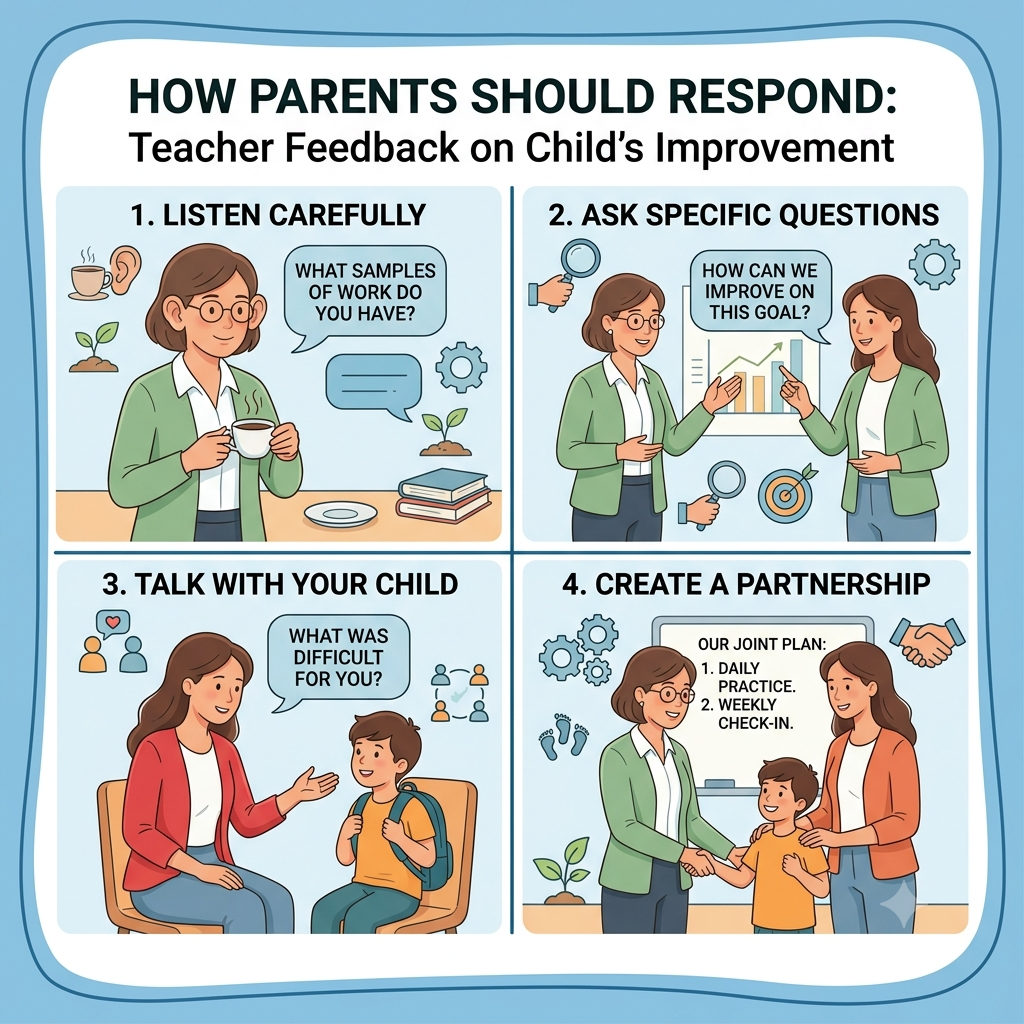
3. Talk to Your Child Without Making Them Feel Like a Failure
After a parent–teacher meeting, your child may be the person most affected by the feedback. How you share it can influence whether they feel supported or become afraid of making mistakes.
Avoid starting the conversation with statements such as, “Your teacher complained about you again,” or “Why can't you do better?” Such comments can make children feel that they are the problem rather than that they have a problem to solve.
Instead, choose a calm moment when both of you have time to talk. Explain the teacher's concern in simple language and invite your child to share their side.
For example, you could say, “Your teacher mentioned that you sometimes miss instructions in class. Have you noticed that happening? Is there anything that makes it difficult to follow along?”
Your child might explain that the classroom feels distracting, the instructions are confusing, or they feel nervous about asking questions. Their explanation may reveal something you did not know.
Here are a few ways to keep the conversation constructive:
- Focus on the behaviour, not the child's identity. Say, “Let's work on completing homework on time,” rather than, “You are lazy.”
- Listen before offering solutions. Children are more likely to share their concerns when they feel heard.
- Agree on small, achievable steps. A short daily revision session may be more useful than suddenly imposing a strict study schedule.
- Recognise progress. Appreciate when your child asks for help, completes a task independently, or makes a genuine effort to improve.
The goal is not to protect children from every uncomfortable conversation. It is to help them understand that mistakes and difficulties can be addressed without defining their worth.
4. Follow Up and Speak Up When Something Does Not Add Up
One conversation rarely solves every problem. After agreeing on a plan, give your child time to practise the new approach and stay in touch with the teacher.
Look for specific changes rather than expecting immediate perfection. A child who struggles with reading may begin attempting unfamiliar words more confidently before becoming a fluent reader. Another child may need several weeks of practice to manage assignments more independently.
If the concern continues, arrange another conversation. Share what you have observed at home and ask whether the teacher has noticed any changes.
It is equally important to speak up if you disagree with the feedback. You might have seen your child complete work independently at home, for example, while the teacher observes difficulties in class. Both observations can be valid because children may behave differently in different settings.
Ask for further examples, explain what you have noticed, and work together to understand the difference.
If difficulties persist despite reasonable support, consider whether the child needs additional help. Depending on the concern, this might involve extra practice, support from the school, or advice from an appropriate professional. Persistent difficulties should be explored thoughtfully rather than dismissed as a lack of effort.
A simple record can help parents stay organised:
- The concern raised by the teacher
- The steps agreed upon at home and school
- The progress observed over time
- The date for the next discussion
This keeps the focus on helping the child rather than repeatedly revisiting the original criticism.
How Podar Global School Connects With Parent–Teacher Partnership
For families considering what a Best School in Bangalore or a Top School in Bangalore should offer, communication between home and school is worth considering alongside academic and developmental priorities. Podar Global School (PGS), Yelahanka, Bangalore, states in its official principal's message that it aims to build strong relationships between students, teachers, and parents.

Its stated approach also highlights academic development, curiosity, critical thinking, and a supportive, inclusive environment. These priorities provide a relevant context for constructive parent–teacher conversations, although they do not establish a specific feedback procedure at the campus. Parents can use school meetings to understand their child's needs, discuss practical support, and work towards shared goals.
Conclusion
When a teacher says your child needs to improve, try to see the conversation as a starting point rather than a verdict. Listen carefully, ask specific questions, involve your child, and agree on manageable next steps.
Remember that progress looks different for every child. Some children need more practice, while others need clearer instructions, encouragement, or help understanding what is expected of them.
The aim is not to prove that the teacher is right or wrong. It is to understand your child's needs and help them move forward. When parents and teachers communicate respectfully and follow up consistently, children have a better chance of receiving the support they need to learn and grow.
For more information on this and similar schools, check out this list of the best schools in Bangalore.





 as a preferred source on