








What happens when a child is given responsibility for something instead of being told exactly what to do?
They may hesitate. They may make a mistake. They may even choose an approach that does not work.
But they are also learning something important: how to take ownership.
Leadership is often associated with adults managing teams, making important decisions or speaking confidently in front of others. For children, however, leadership can begin with much smaller experiences. Organising a group activity, helping a teammate, making a decision or taking responsibility for a task can all become opportunities to practise leadership.
For schools such as BVM Global School (BVMG), creating opportunities for students to develop these abilities can be an important part of preparing children for life beyond the classroom.
Also Read| When Should JEE & NEET Preparation Really Begin?
What Does Leadership Mean for a Child?
Leadership does not always mean being the loudest person in the room or standing on a stage.
For a child, it can simply mean taking responsibility and contributing to a shared goal.
A student who helps organise a group project, listens to different opinions before making a decision, or supports a classmate who is struggling is already practising leadership.
This is why parents should look beyond titles such as class representative or school captain. A child does not need a formal position to develop leadership qualities.
The more important question is whether children are given opportunities to make decisions, solve small problems, and take responsibility for what they do.
Why Children Need to Practise Decision-Making
Children cannot become independent decision-makers if adults always make decisions on their behalf.
This does not mean allowing children to make every choice. Parents and teachers still need to provide appropriate boundaries. Within those boundaries, however, children can be given choices that have real meaning.
For example, a student working on a group project could help decide how different tasks should be divided. A child planning a small activity could decide what materials are needed. Even choosing the best way to organise a task can encourage children to think about consequences.
When children make decisions, they also learn that decisions have outcomes.
If something works, they understand what helped. If it does not, they have an opportunity to reconsider their approach.
That experience can be far more meaningful than simply being told what the correct choice should have been.
What Can Children Learn When They Lead?
Leadership opportunities can help children develop several abilities that are useful both in school and everyday life.
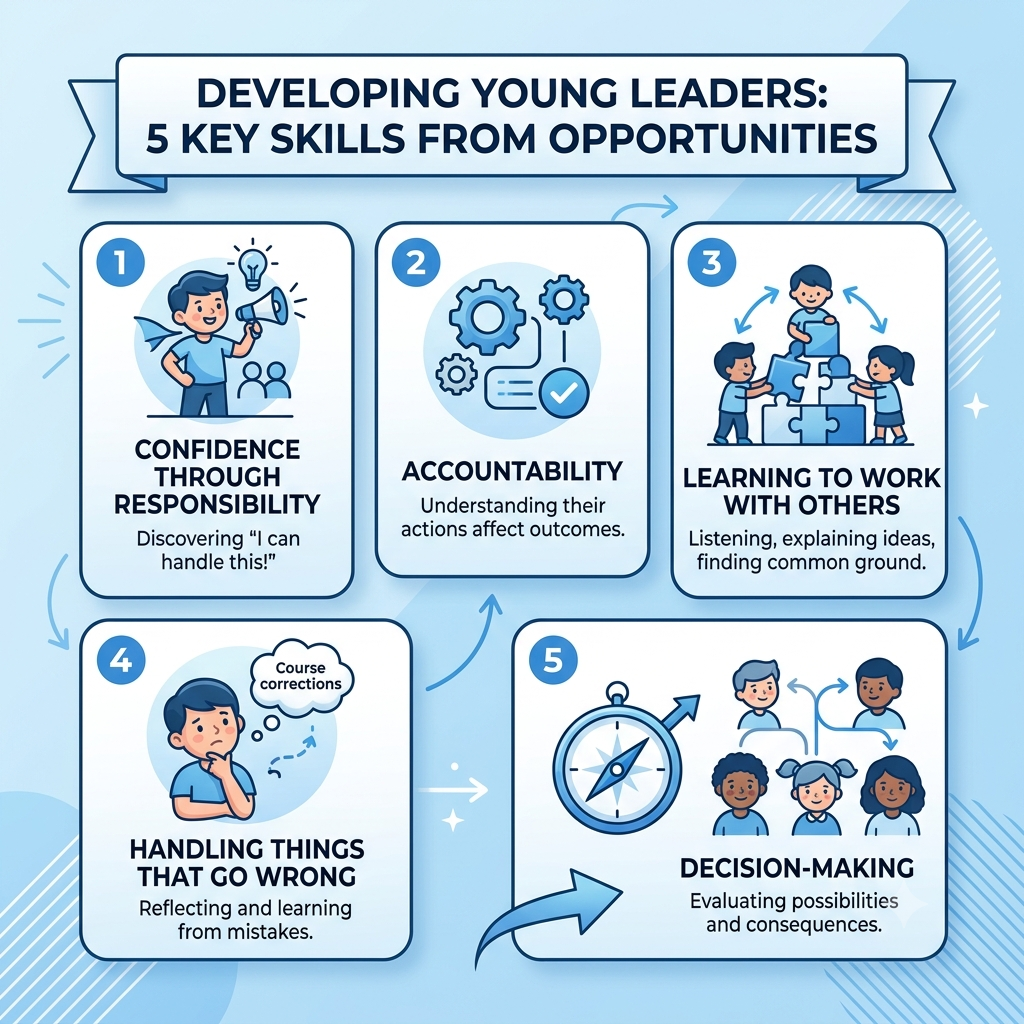
Confidence Through Responsibility
Confidence does not always come from praise. Sometimes, it comes from discovering that “I can handle this.”
When children are trusted with an age-appropriate responsibility, they get an opportunity to experience that feeling for themselves.
A child who successfully organises a small task may become more willing to take responsibility the next time.
Accountability
Responsibility also comes with accountability.
If a child is given ownership of a task, they learn that their actions affect the outcome. This can gradually help them understand the importance of preparation, follow-through,h and keeping commitments.
Learning to Work With Others
Good leadership is not about giving orders.
Children working in groups quickly discover that people have different ideas, working styles and opinions. They need to listen, explain their thinking,g and sometimes find a middle ground.
These experiences can help children understand that achieving a shared goal often requires cooperation.
Handling Things That Go Wrong
Not every leadership experience will go smoothly.
A group may disagree. A plan may fail. A task may take longer than expected.
These situations can become valuable learning experiences when children are encouraged to reflect rather than simply being rescued from the problem.
They can ask themselves: What happened? What could I have done differently? What should we try next?
Leadership Should Not Become Pressure
There is an important difference between giving children opportunities to lead and expecting every child to become a leader in the same way.
Some children naturally enjoy speaking in front of groups. Others may prefer planning, listening or working quietly behind the scenes.
A quieter child can show leadership by helping a teammate, organising materials, contributing an idea or making sure everyone gets a chance to participate.
Schools and parents should therefore avoid treating confidence and leadership as synonyms.
The goal is not to make every child outspoken. It is to help each child discover ways in which they can take responsibility, contribute, and make thoughtful decisions.
How Parents Can Encourage Leadership at Home
Leadership development does not have to stop when school ends. Everyday family situations can provide useful opportunities.
Give Children Real Responsibilities
Instead of treating every task as an instruction, occasionally give your child ownership of something appropriate for their age.
It could be organising their study materials, helping plan a family activity,y or taking responsibility for part of a shared task.
Let Them Make Small Decisions
Offer choices where both options are acceptable.
This allows children to practise thinking about what they prefer and why.
Let Them Plan Something
A simple family game, outing or weekend activity can become a small leadership exercise. Ask your child to think about what needs to be done and what might go wrong.
Do Not Step In Too Quickly
When children face a problem, parents often have a natural urge to fix it.
Instead, try asking:
“What do you think we should do next?”
The question gives the child space to think before an adult provides the solution.
Talk About What Happened
After an activity, discuss what worked and what did not.
Questions such as “What would you change next time?” can encourage reflection and help children understand that leadership also involves learning from experience.
What Should Parents Look for in a School?
When comparing schools, parents may look for student councils, leadership programmes or positions such as house captains. These can be useful, but they are only one part of the picture.
It is worth asking whether students get meaningful opportunities to take responsibility in everyday school life.
Parents can look for learning environments where children are encouraged to:
- Make age-appropriate decisions
- Work collaboratively
- Take ownership of activities
- Listen to different viewpoints
- Solve problems independently
- Reflect on their experiences
- Learn from mistakes
The strongest leadership opportunities are not necessarily the ones with the biggest titles. Sometimes, they are the ones where a child is trusted to take ownership of something and learn from the experience.
Also Read| Why "One Pace Fits All" Doesn't Work in Modern Classrooms Anymore
How BVM Global School Encourages Student Leadership
BVM Global School (BVMG) provides a relevant example through its Young Leadership Programme (YLP), which focuses on developing qualities such as confidence, responsibility, teamwork and decision-making.

For parents considering a Top school in Bangalore, looking at how a school creates structured opportunities for students to practise these skills can be as useful as examining its academic approach. Families searching for the Best school in Bangalore can similarly consider whether students are given opportunities to participate, take responsibility, and develop leadership in ways suited to their age and abilities.
Children Do Not Have to Wait Until Adulthood to Lead
Leadership is not a skill that suddenly appears when a child becomes an adult.
It develops through repeated experiences of making choices, taking responsibility, working with others, and learning from what happens next.
A child does not need to lead a large group or hold an important title to begin. Sometimes, leadership starts with something as simple as being trusted with a task and hearing:
“You take care of this. What do you think we should do?”
Those small moments can help children gradually become more responsible, thoughtful, and confident in taking ownership of their choices.
For more information on this and similar schools, check out this list of the best schools in Bangalore.




 as a preferred source on