








A child may recite a textbook answer perfectly but struggle when asked to explain the same idea in different words. This can leave parents wondering whether their child has truly understood the lesson or simply remembered what was written on the page.
The difference matters because learning is not only about remembering information for a test. Children also need to explain ideas, connect them to what they already know, and use them to solve new problems. When exploring what makes the Best School in Bangalore, parents can look beyond marks and ask how a school encourages children to think, question, and understand.
The good news is that parents do not need to become teachers at home to recognise meaningful learning. A few simple questions and everyday activities can reveal a lot about how a child is learning.
Memorising and Understanding Are Both Part of Learning
Memorisation helps children remember facts, spellings, formulas, dates, and definitions. It is an important part of education. A child cannot use every concept effectively without remembering some basic information.
Understanding goes a step further. It means knowing what information means, why something happens, or how to use an idea in a different situation.
For example, a child may memorise that a quarter is one-fourth. However, understanding fractions means recognising that one of four equal pieces of a roti represents one-fourth of the whole.
Both skills work together. Memorisation gives children useful knowledge, while understanding helps them use that knowledge beyond the textbook.
The aim is not to stop children from memorising. It is to help them move from remembering answers to understanding the ideas behind them.
Five Signs Your Child May Understand a Lesson
Parents can look for a few simple signs during homework, revision, or everyday conversations. No single sign proves complete understanding, but together they can offer useful clues.
1. They Can Explain the Idea in Their Own Words
Ask your child to explain a lesson without looking at the textbook. They do not need to use perfect academic language. What matters is whether they can communicate the main idea clearly.
For instance, after a lesson on evaporation, a child might explain that water changes into water vapour, even without remembering the exact textbook definition.
If your child struggles, give them time to think. Sometimes children understand an idea but need help finding the right words.
2. They Can Apply It to a New Situation
A child who understands a concept should be able to use it in at least some unfamiliar examples appropriate to their age and learning level.
If your child has learnt multiplication, ask how many apples there would be in four bags containing three apples each. This is different from simply asking them to recite a multiplication table.
For older children, you could ask them to apply a science concept to an everyday observation or use a mathematical formula in a slightly different problem.
They may not solve every new question correctly. What matters is whether they can connect what they learnt to the new situation.
3. They Can Explain How They Found the Answer
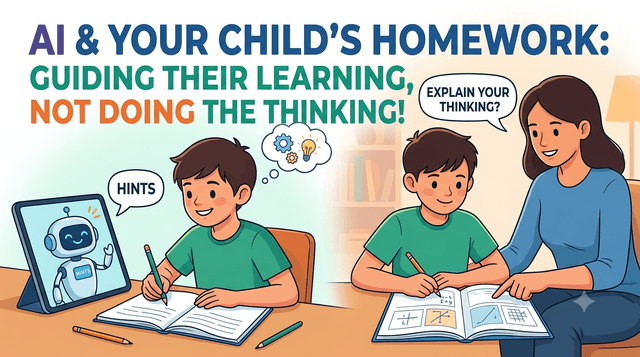
Instead of asking only, “What is the answer?”, try asking, “How did you work that out?”
A child who can describe their steps is giving you a glimpse into their thinking. They may explain why they chose a particular formula, how they compared two ideas, or what helped them reach a conclusion.
This also helps parents notice where confusion begins. If a child gets the final answer wrong, their explanation may reveal that they understood the concept but made a calculation error.
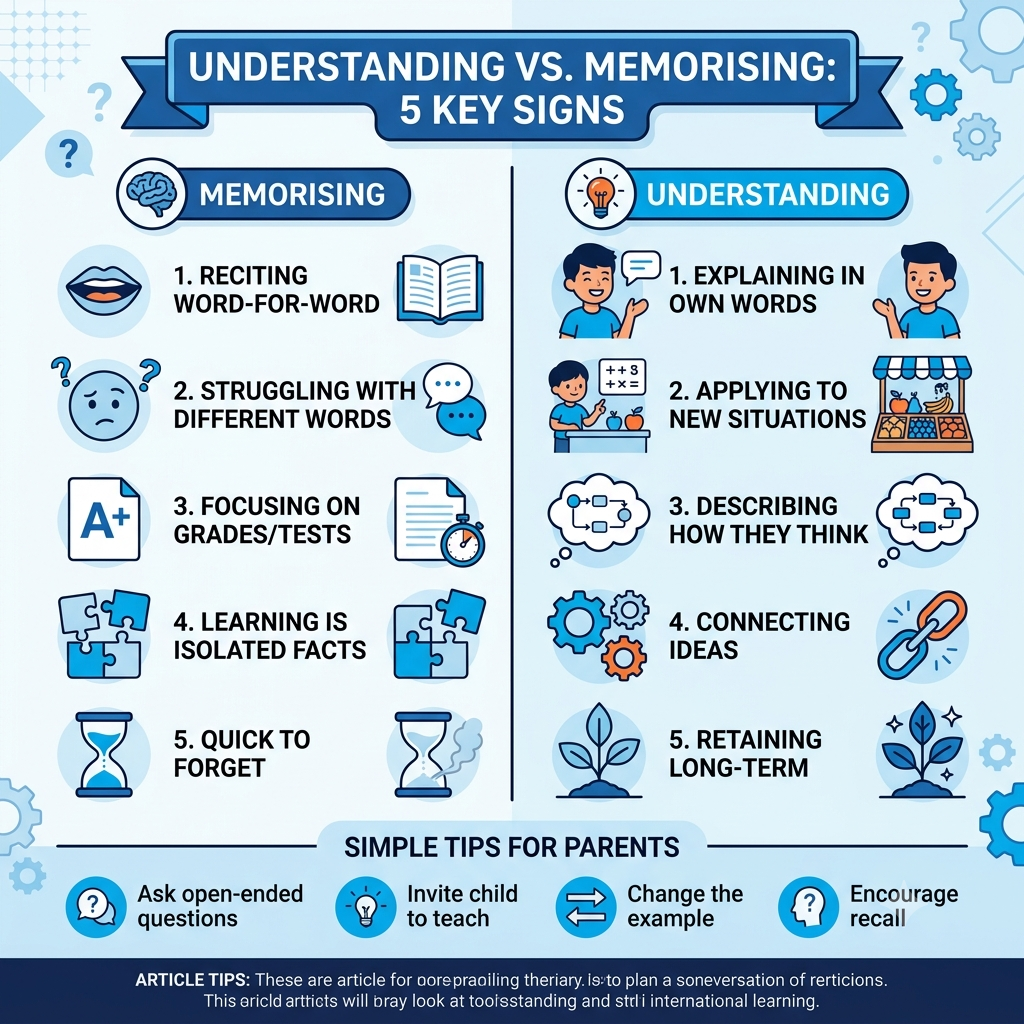
4. They Can Connect New Ideas to What They Already Know
Learning becomes more meaningful when children connect new information to familiar experiences.
After a lesson about plants, for example, ask your child how sunlight and water affect a plant at home. After learning about money, discuss how addition and subtraction help when buying groceries.
These conversations help children see that school subjects are not isolated facts. They can explain and use them in everyday life.
5. They Can Remember the Concept After Some Time
A child might understand a lesson immediately after studying it but struggle to recall it a few days later. This is normal because learning develops through practice and revision.
Try revisiting the topic after a day or two. Ask your child to explain the main idea or answer two or three questions without opening the book.
Research on learning techniques has found that practice testing and revisiting information over time can support long-term retention. Short revision sessions spread across several days may be more useful than relying entirely on one long study session before an exam.
Simple Ways Parents Can Check Understanding at Home
You do not need to test your child after every lesson. Instead, make conversations about learning a natural part of the day.
Here are four simple techniques to try:
- Ask open-ended questions. Questions such as “Why do you think that happened?” or “Can you explain it another way?” encourage children to think beyond textbook answers.
- Invite your child to teach you. Let them explain a topic as though you are learning it for the first time. Teaching can help children organise their thoughts and identify gaps in their understanding.
- Change the example. If your child has solved a maths problem, give them a similar problem with different numbers. For a language lesson, ask them to use a newly learnt word in their own sentence.
- Encourage closed-book recall. After studying, ask your child to share three things they remember. Then let them reopen the book and check what they missed.
These techniques are consistent with educational research on self-explanation, reflection, and active recall. They also help parents understand what their child knows without making every study session feel like another examination.
What If Your Child Cannot Explain the Answer?
A child who struggles to explain a lesson has not necessarily failed to understand it. They may need more time, a simpler example, or another way of exploring the concept.
For example, a child who finds fractions confusing on paper might understand them more easily when sharing a pizza into equal pieces. Another child may understand the answer but feel nervous about explaining it aloud.
Rather than immediately correcting them, try these steps:
- Give them time to think. Avoid jumping in with the answer as soon as they hesitate.
- Break the concept into smaller parts. Return to the basic idea before moving to a more difficult question.
- Use a different example. Draw a picture, use everyday objects, or relate the topic to something familiar.
- Notice the progress. Recognise when your child explains one part correctly, even if the whole concept is not clear yet.
- Speak to the teacher if the difficulty continues. Share specific examples and ask which concepts need further practice.
The goal is not to catch children making mistakes. It is to discover what they need help understanding. A supportive response can make it easier for them to admit confusion and ask questions.
The same principle is useful when comparing schools. Parents considering a Top School in Bangalore should look beyond how much content children cover and explore how teachers encourage questions, explanations, and thoughtful problem-solving.
How New Oxford International School Connects to Meaningful Learning
New Oxford International School (NOIS), Anekal, Bangalore, describes an academic approach that includes enquiry, discussion, experimentation, and student-centred learning. These elements are relevant to helping children explore ideas rather than simply repeat information.

For parents researching the Best School in Bangalore, the school's published approach offers a useful starting point for asking how classroom activities encourage children to explain their thinking, apply concepts, and learn from mistakes. Its stated approach is a point of consideration for families, rather than proof of any guaranteed learning outcome.
The Real Measure of Learning
A child does not need to explain every lesson perfectly to show that learning is taking place. Some concepts take time, and children develop understanding at different rates.
Instead of asking only whether homework is complete or an answer is correct, ask your child to explain what they learnt, show how they reached an answer, or use the idea in a new example.
These small conversations can help you recognise both strengths and learning gaps. More importantly, they remind children that education is not just about remembering the right words. It is about making sense of ideas and learning how to use them.
For more information on this and similar schools, check out this list of the best schools in Bangalore.


 as a preferred source on