







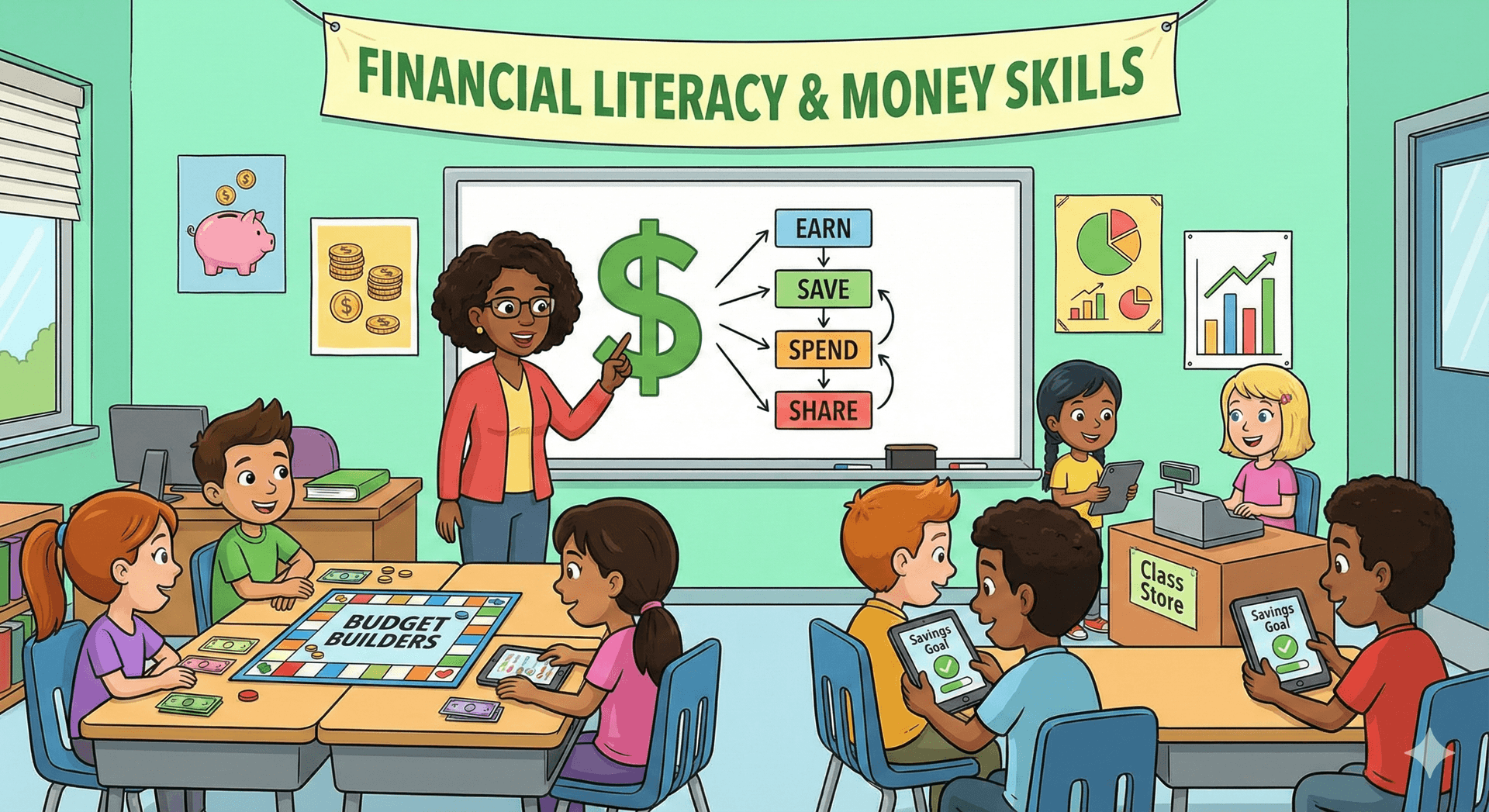

India has a big problem with financial literacy. Only 27% of adults understand basic money skills, which is much less than the 42% global average. This problem affects young people too, as only 58% of 18 to 30-year-olds do well on money related finance tests. We teach students how to calculate compound interest in math class, but we rarely teach them how to open a bank account or why saving money early can change their lives.
In a country where a teenager can spend money with a single tap on a smartphone, waiting until college to teach financial skills is too late. Some of the best schools in Hyderabad have already started teaching financial lessons in primary school. Teaching financial lessons in primary school can solve this. Kids can learn how to save, spend, and budget money early. Programs like NCFE's Money Smart School help bring real change.
Also Read: From Concept to Creation: The Big Idea Factory
Why Indian Schools Must Start Early?
Research shows that most of our money habits form by age seven. By the time students reach high school, their ideas about spending and saving are usually fixed. If schools start teaching money skills early, they can help students build good money habits that last their whole life.
The Problem: High General Literacy, Low Financial Literacy
India has a high general literacy rate of over 77%. But many people, even smart engineers and doctors, still make poor money choices. The Reserve Bank of India (RBI) made a "Financial Inclusion Index" that reached 67 in 2025. This number shows we are improving, but we still have a lot to do.
Schools usually teach students how to earn money by getting good jobs. But they do not teach how to manage money. Because of this, many young people get into debt problems. For example, "Buy Now, Pay Later" targets young Indians. Without knowing about interest rates, students can easily harm their financial future.
The "UPI Generation" Needs New Skills
Today, Grade 7 students live in a mostly cashless world. They see their parents pay by scanning QR codes. They do not often handle physical cash. This "invisible money" can be risky. It makes spending money feel less real.
The Problem: When you give someone a Rs 500 note, you feel like you lost something. But when you scan a QR code to pay, you do not feel the same "pain of paying."
The Danger: Without using physical cash, children find it hard to understand that money is limited.
The Solution: Schools should teach "Digital Hygiene." This means students must learn about protecting OTPs, making strong passwords, and knowing that digital money is real money earned by hard work.
Also Read: Learn Farming & Life Skills
Major Concepts That Must Be Taught
We cannot just give students a textbook on economics. The curriculum must be practical and age-appropriate.
1. Needs vs. Wants (Grade 1-3)
This is the most basic lesson. A "need" is something you must have to survive (food, school uniform, water). A "want" is something nice to have (a new video game, expensive branded shoes).
Activity: Teachers can give students a fake budget of Rs 500 and a list of items. Students must prioritize the needs before they buy the wants.
2. The Magic of Compounding (Grade 4-6)
Albert Einstein reportedly called compound interest the "eighth wonder of the world." Schools usually teach this as a boring formula in Grade 8. But the concept should be taught earlier.
- The Lesson: If you save Rs 100 today, it earns interest. Next year, you earn interest on your original Rs 100 plus the interest you already earned.
- Real World Example: If a student saves just Rs 500 a month starting at age 10, they will have a huge sum by age 25. If they wait until age 20 to start, they lose out on ten years of this money growth.
3. Budgeting and Tracking (Grade 6-8)
A budget is simply a plan for your money. Most adults in India do not have a written budget.
- The 50-30-20 Rule: This is a simple rule that even students can understand.
- 50% of your money goes to Needs.
- 30% goes to Wants.
- 20% must be Saved. Schools can ask students to track their pocket money or festival gifts using this rule for one month.
4. Good Debt vs. Bad Debt (Grade 6-8)
Debt is not always bad. Taking a loan to study (Education Loan) or buy a house (Home Loan) can be good because it builds value. But using a credit card to buy a phone that you cannot afford is "bad debt." In India, credit card usage is exploding. Schools must teach students that a credit card is not free money; it is a high-interest loan that must be paid back.
The Role of Government and Boards
The government is starting to understand the importance of financial education. The Central Board of Secondary Education (CBSE) and the National Institute of Securities Markets (NISM) have launched programs to teach financial literacy.
The RBI created a new plan called the "Panch-Jyoti" Strategy for 2025-2030. This plan focuses on teaching people about money and finance.
Some of the best CBSE schools in Hyderabad made 12-hour skill courses to teach financial literacy to middle school students. These courses are helpful, but students can choose whether to take them or not. To make a real difference, financial literacy should be a regular subject like Math or Science.
The Premia Academy's Financial Literacy Module

Many schools are still waiting for government rules, but some smart schools have already started including financial literacy in their curriculum. The Premia Academy in Attapur, Hyderabad, is a great example. They don’t just follow textbooks; they teach financial literacy as part of their Life Readiness program.
Financial Literacy as a Core Subject
At The Premia Academy, financial literacy is not an extra class. They include it in the main curriculum from the early grades. They know that if students don’t understand money, they can’t truly be "Life Ready," which is the school's motto. Instead of regular math teachers, experts from Metamorphosis Edu teach entrepreneurship and money skills to the students.
Linking Money and Values with "Swadhyay"
The Premia Academy connects money with values through a program called "Swadhyay," which focuses on self-reflection and ethics. They teach students the right way to earn and spend money.
- Earning Ethically: Students learn that how you earn money matters just as much as how much you earn.
- Spending with Care: Students think about how their spending affects others and the environment. For example, they ask if buying a cheap toy can harm nature.
This whole approach helps students become not only wealthy but also responsible citizens.
Conclusion
The economy is changing from saving money as cash to spending money digitally. Our schools need to change too. Schools like The Premia Academy are leading by teaching kids how to manage money well. They teach important ideas like making budgets, how money grows, and spending carefully from a young age. This helps the next generation of Indians become not only educated but also smart with money.
To learn more about this and other schools nearby, see this list of the top schools in Hyderabad.











 as a preferred source on