







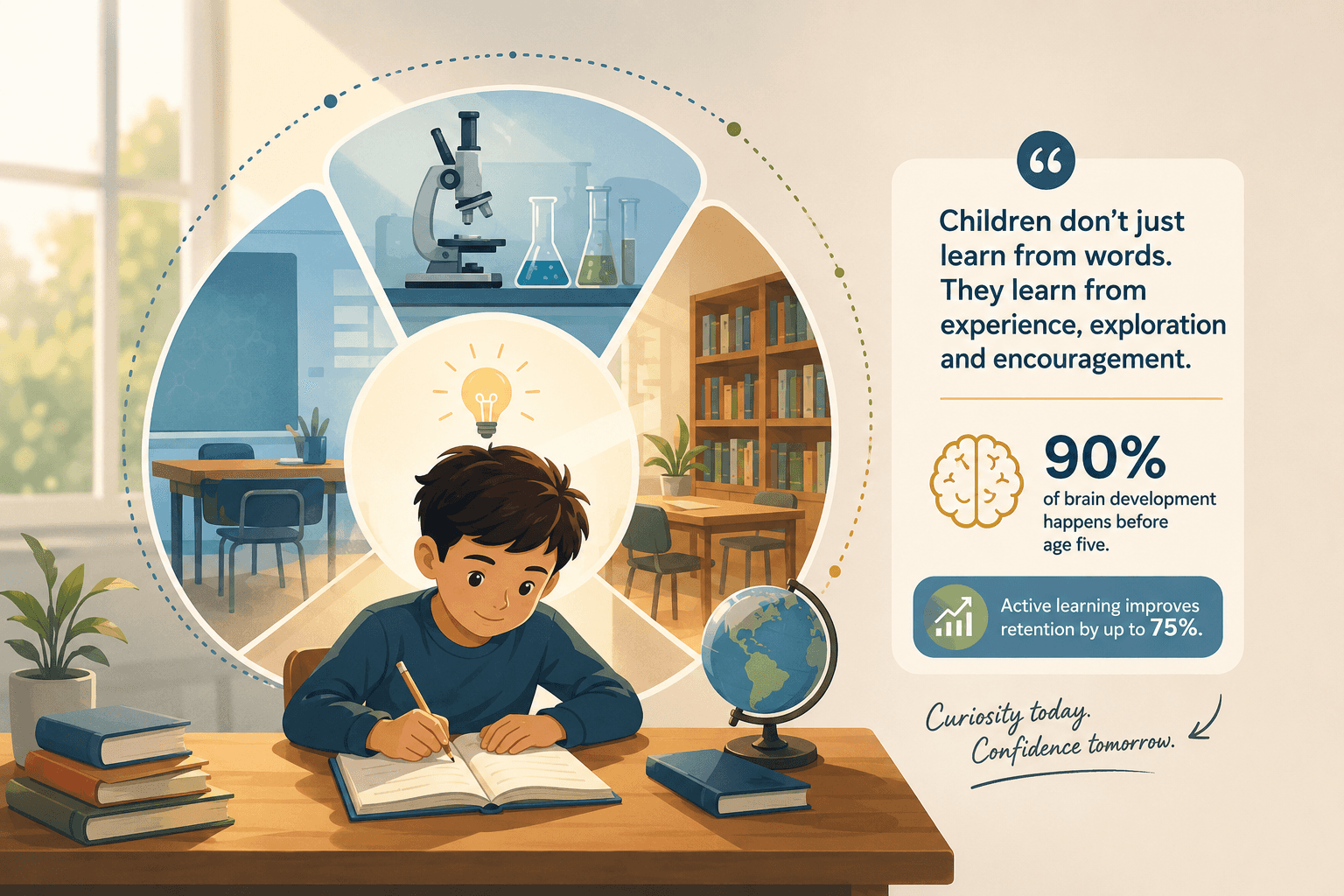

Have you ever wondered as to where actual learning takes place?
We generally assume that it happens at a wooden desk, mostly in a classroom. However, children do not learn everything sitting in a single room. Different skills develop in completely different physical spaces, with truly balanced education depending on exposure to a variety of environments.
Some of the best boarding schools in India, like Sri Devaraj Urs International School, are actively working towards this exact model. Instead of relying only on classroom instruction, schools such as this are creating different spaces where children can observe, experiment, and explore.
But what are these environments that are so conducive to learning? Read on to find out!
Also Read | The Psychology of Space: How Learning Environments Shape Young Minds
How Children Actually Learn
Child development experts have long noted that children absorb ideas in three different ways: by doing something with their hands, by seeing it modelled in front of them, and finally by grasping the idea in its abstract form. A textbook alone speaks only to that last stage, skipping the two steps that actually make an idea stick. Most classrooms, without meaning to, end up teaching only that final stage first.
This is not a new theory invented for a school brochure. Every doctor, engineer and scientist working today was once a child who mixed, measured or broke things long before writing a formula about any of it. Schools that skip this step are not saving time. They are building a gap that shows up years later, in a college classroom or a job interview.
India's own education policy has begun catching up with this idea. The National Education Policy of 2020 speaks repeatedly about experiential, activity-based learning and pushes schools away from rote memorising toward real understanding. Most schools agree with this on paper. In practice, it comes down to something simpler: whether a lab is a room that gets used every week or one that stays locked until the next inspection.
The 3 Spaces that Matter the Most
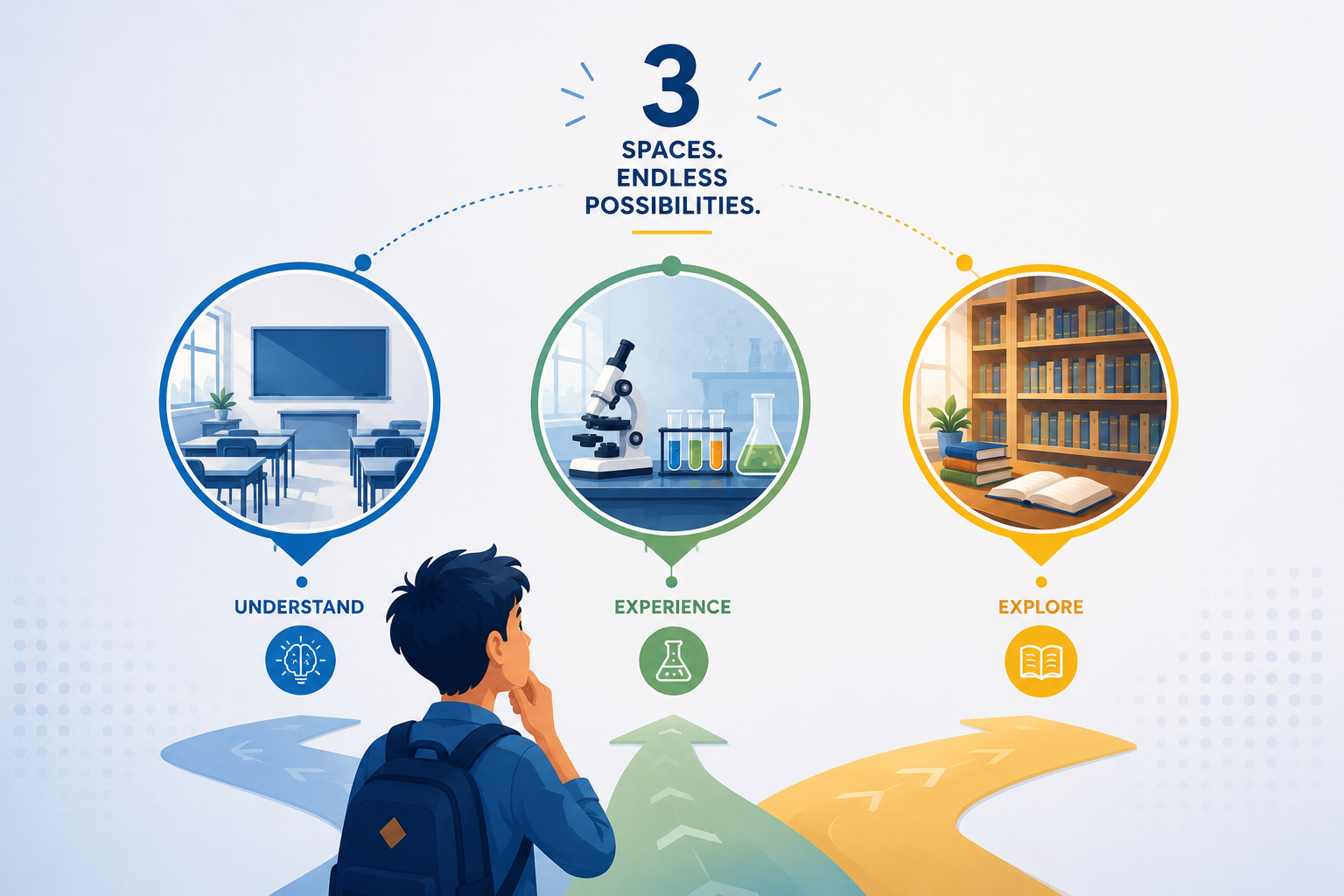
The following 3 spaces are of crucial importance in a school:
1. The Classroom for Understanding Concepts
This space remains the traditional heart of any school. The classroom is designed for a very specific purpose, with its main goal being the clear understanding of core concepts.
A well-designed classroom provides a structured environment for initial discovery. It is where young minds encounter brand new subjects for the very first time. In this space, educators guide students through the syllabus systematically.
A good classroom environment allows teachers to:
- Introduce complex new ideas clearly.
- Facilitate open and engaging group discussions.
- Build strong foundational knowledge across subjects.
- Encourage students to ask fundamental questions.
2. The Laboratories for Experiencing Discovery
Once a concept is understood, it needs to be tested. This is exactly where the laboratory comes into play.
Many people think labs only exist because education boards require them. We often view them as mandatory rooms filled with dusty equipment. However, the true purpose of a laboratory is to discover through direct experience.
This space is where theory meets reality. It is a controlled environment designed for safe experimentation. The laboratory is where students learn to trust their own observations.
It is in the laboratories that students can:
- Test wild ideas without any fear of failure.
- Make mistakes safely and learn from them immediately.
- Observe natural and mathematical patterns in real time.
- Collect concrete evidence to support their claims.
- Solve complex problems independently using logic.
3. The Library for Independent Exploration
Education must eventually become a self-driven pursuit. A child cannot rely on a teacher forever. The library is the space dedicated to this independent learning. It is the quiet environment where true academic exploration begins.
When a child walks into a library, they choose their own path. They are not restricted by a specific syllabus or a daily timetable. They can follow their own unique curiosity. This space is vital for developing long-term reading habits. It teaches children how to seek out information on their own.
Well-stocked libraries help children to:
- Research specific topics that spark their personal joy.
- Compare different viewpoints on historical events.
- Read literature far beyond their prescribed textbooks.
- Ask better and deeper analytical questions.
- Connect abstract ideas across completely different subjects.
This creates a beautiful narrative arc for a student. The classroom says, "Here is what you need to know." The laboratory says, "Let us see if it works." The library finally asks, "What else can I discover?"
Check Out | Why Libraries Still Matter in the Digital Age – Building Reading Culture
How Sri Devaraj Urs International School Brings This Approach to Life
Sri Devaraj Urs International Residential School, known widely as SDUIRS, was established in 2003 in Doddaballapur, about 35 kilometres from Bangalore city. One of the best coed residential schools in India, SDUIRS is spread across an 85-acre green campus and is affiliated with CBSE.
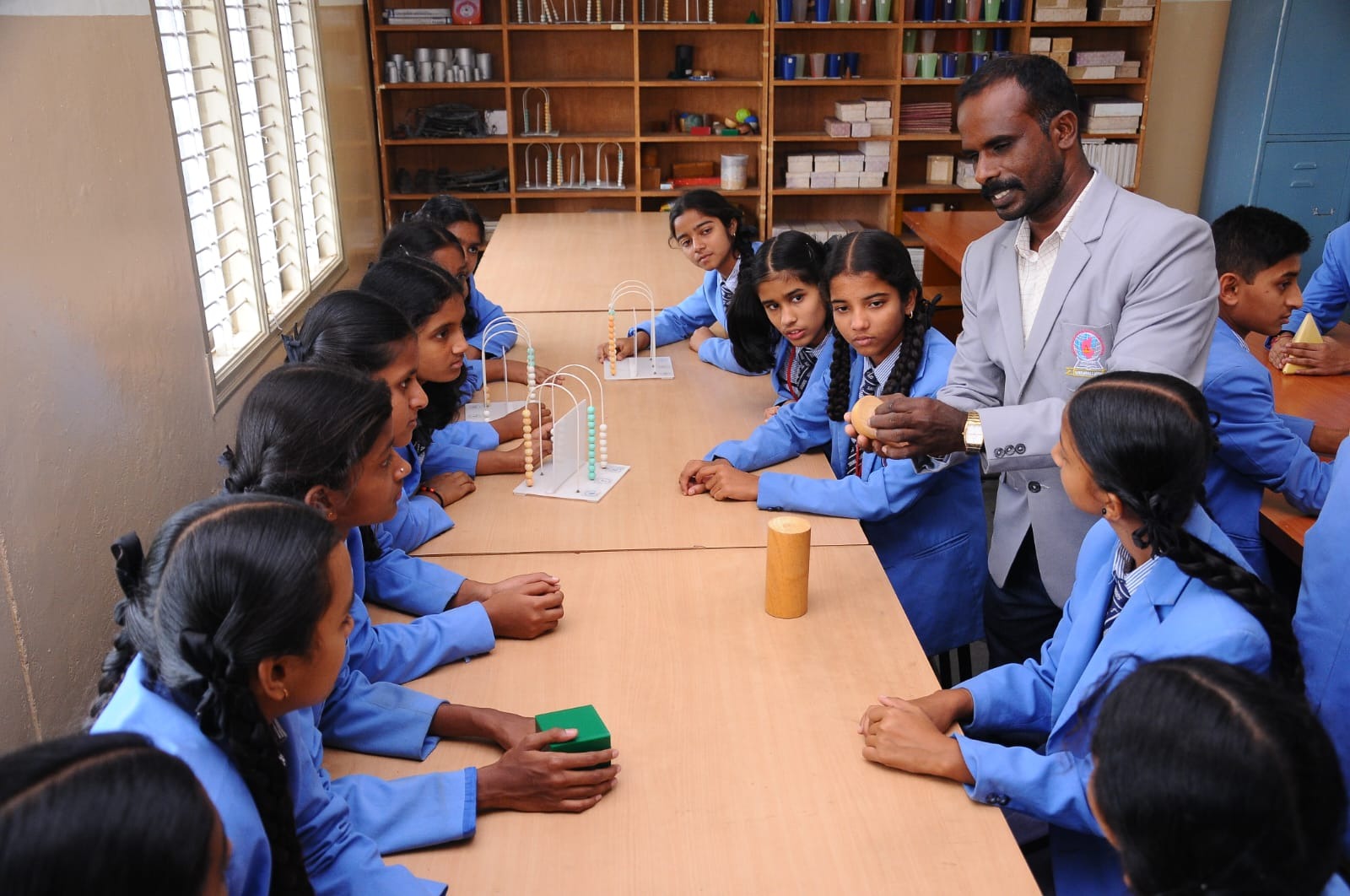
The school's learning philosophy reflects the idea that meaningful education happens through experience as much as instruction. While classrooms and the library continue to provide the academic foundation, students regularly step into dedicated science, mathematics, and computer laboratories where concepts are explored through practical activities.
The school's classrooms are built with this first stage of learning in mind. Each one is spacious and well-ventilated, fitted with modern furniture, and equipped with a television and DVD player to support digital lessons alongside regular teaching. The idea is simple: give every child a clear, distraction-free space to build the foundation before moving on to anything more advanced.
The foundation of learning is tested in the school's laboratories. The computer lab runs on 40 machines built on the i7 octa-core generation, giving each student individual internet access rather than a single shared terminal at the back of the room. Alongside it sits a dedicated science lab for regular practicals and a mathematics lab set up in line with CBSE's own guidance, where children work through problems using activity rather than repetition.
Independent exploration gets its own space too, in a library stocked with over 10,000 books. The collection runs across encyclopaedias, journals, periodicals, news magazines and novels, giving students plenty of room to read past the syllabus and follow whatever has caught their attention that week.
Beyond these three spaces, the campus includes an assembly hall, a hostel for its residential students, a gymnasium, and grounds for both indoor and outdoor sports. The trust behind the school was founded in 1985 by Sri R.L. Jalappa, a former union minister who spent over five decades in public service before turning his attention toward education in the region.
For more information on SDUIRS and other similar schools, check out this list of the best boarding schools in India.







 as a preferred source on