






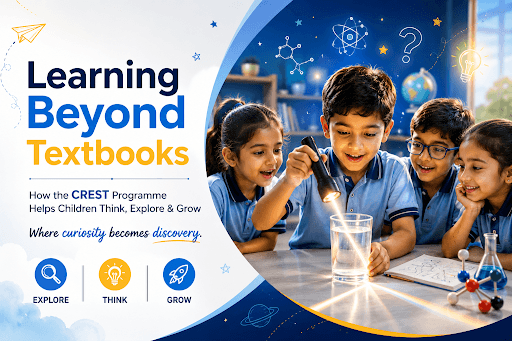

A seven-year-old Aryan came home one afternoon, back from school, and excitedly told his mother that he finally understood why the sky turns orange at sunset. Mother assumed that his teacher must have taught him that. But when she asked, Aryan shook his head. “We experimented, and I found it out myself.”
He kept on explaining about the experiment where they used the scattering of light via a torch and a glass of water. His mother was happy not because her son had learnt something, but because he had learnt something on his own, from a different perspective and a different approach.
That something is the CREST programme of Manav Rachna International School, an innovative way of teaching students from classes 1st to 5th. This is one of the most famous schools in faridabad, which not only offers quality education but also imparts values through unique approaches like CREST.
Also Read | Classroom to Playground: MRIS Charmwood's All-Round Development
What is CREST?
Usually, students are not fed loads of information, assuming that they will remember it all. Yes, they remember, only till they exit the classroom. To keep that fed information intact in their mind, they have to go through multiple revisions and encounter the same information to keep it familiar.
But here is the catch. When the same information is not fed to students directly, but rather comes from efforts of self-exploration and experiments, the chances of forgetting it are low. This is what happens in the CREST programme.
CREST stands for Conceptual Learning through Reasoning, Exploration, Skill, and Technology. It is an interdisciplinary curriculum that covers science and social sciences. The purpose of this programme is not just to feed the information, but to mindfully implant information for the long term. This way, students don’t just rely on rote learning but learn out of curiosity. It can be done in different ways.
Example of How the CREST Programme Works
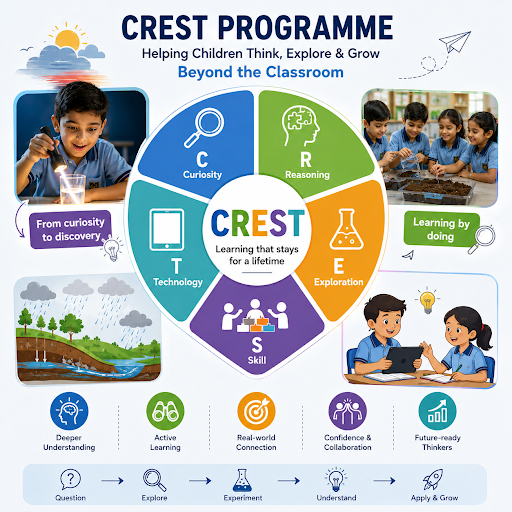
Take a simple classroom activity on soil and water conservation. Instead of reading about it from a chapter, students under CREST are handed soil samples, water, and a few basic tools. They are asked one question: "What happens to soil when it rains heavily?" From there, the learning unfolds entirely through their own observation — they pour, they measure, they record, they discuss. By the end of the session, concepts like erosion, absorption, and groundwater are not definitions to be memorised. They are things the child has seen with their own hands.
This works because:
- It is grounded in the Social Science + Science interdisciplinary nature of CREST
- It is age-appropriate and believable for primary years
- It directly demonstrates reasoning, exploration, skill, and technology (the four letters of CREST)
Learning That Begins with Wonder
Walk into a CREST-led session at MRIS Charmwood, and you will not find children copying notes from a board. Instead, you will find them experimenting, investigating, demonstrating, and applying- four pillars on which this curriculum is built.
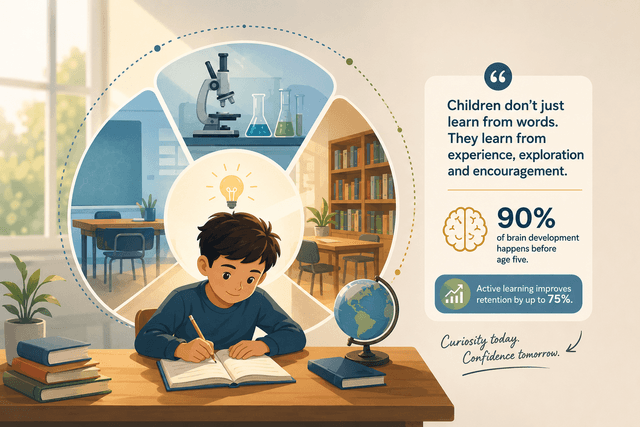
The pedagogy behind CREST uses age-appropriate instructional strategies designed to create unique and engaging learning experiences. Rather than telling children what the world is, CREST encourages them to explore it for themselves.
Child-centered, not curriculum-centered
Through the CREST programme, teachers and mentors understand the pace of learning of students. And this is the most important part of this programme. The child is not just sitting and listening to what the teachers are saying; instead, they are actively engaged. Child-centric learning changes the whole thing. It offers opportunities in different ways, such as experiments, demonstrations, investigations, and applications.
This approach also means that no two learning journeys look exactly the same. CREST honours the reality that different children learn differently, and designs experiences broad enough to engage every kind of learner — the observer, the tinkerer, the debater and the builder alike.
Globally Recognised, Locally Rooted in schools like MRIS
MRIS holds accreditation from AdvancED USA, and CREST is widely recognised as a highly engaging, inquiry and exploration-based interdisciplinary curriculum. The rich content of CREST follows a defined timeline that enables students to build in-depth knowledge progressively while preparing them for global exposure and competitive academic environments.
This international recognition reflects the rigour behind what might appear, to a passing eye, to be simply children having fun while they learn. The fun is intentional. The rigour is very real.
Also Read | Why Life Skills Matter from Early Childhood at MRIS Charmwood, Faridabad
Why Does it Matter for Your Child?
The world your child will graduate into does not reward those who recall facts the fastest. It rewards those who can connect ideas, adapt to new challenges, collaborate across disciplines, and think on their feet when no textbook offers a ready answer. These are precisely the capabilities that CREST develops, not as an add-on programme, but as the foundation of every learning experience.
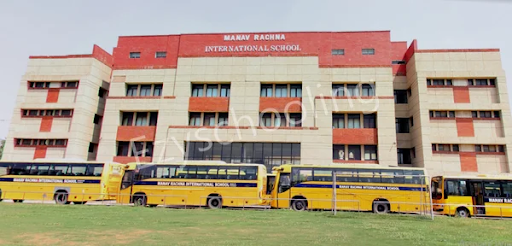
At MRIS Charmwood, one of the schools in Faridabad, CREST is not merely a feature of the school. It is a statement about what education can and should be: a journey of thinking deeply, exploring boldly, and growing continuously, one that begins inside the classroom but never stays confined to it.
In a time when information is easily accessible, the true value of education lies in helping children learn how to think rather than what to think. Through the CREST programme, MRIS Charmwood is creating an environment where learning is driven by discovery, understanding is built through experience, and every child is empowered to become an independent learner. The result is not just academic growth but the development of thoughtful, capable, and future-ready individuals who are equipped to thrive both inside and beyond the classroom.
Know more about this school and others in the nearby area of Faridabad:
 as a preferred source on