






Imagine your child scoring 95% in a science examination but struggling to explain why ice melts faster in the sun than in the shade. They remember the correct textbook answers, yet applying that knowledge to everyday situations feels difficult.
For many parents, good marks are reassuring. They suggest that their child is studying well and making academic progress. However, examination scores do not always reveal how deeply a child understands a subject.
When exploring the Best boarding school in India, parents may also want to understand how schools evaluate learning beyond examinations. Institutions such as DRS International School0, Hyderabad, which describe using different assessment methods, provide a relevant example.
What Do Good Marks Actually Tell Us?
Examination results provide useful information about a child's academic performance. They can show how well students remember information, understand questions, solve problems, and communicate answers within a given time.
However, the meaning of a score depends on what the examination measures.
For example, a child may correctly solve ten multiplication problems after practising similar questions repeatedly. But when asked to calculate the total cost of several items while shopping, they might struggle to recognise which calculation to use.
This does not necessarily mean the child has learned nothing. It simply shows that applying a familiar concept in a new situation may require further practice.
The OECD explains that student assessment should help identify both what learners know and what they can do with their knowledge.
Therefore, good marks are valuable indicators of progress, but they should not be the only measure of learning.
Why Understanding Goes Beyond Remembering Answers
Remembering information is an essential part of education. Children need to learn vocabulary, mathematical formulas, scientific facts, and historical events before they can explore more complicated ideas.
However, understanding becomes deeper when children can connect these facts and use them meaningfully.
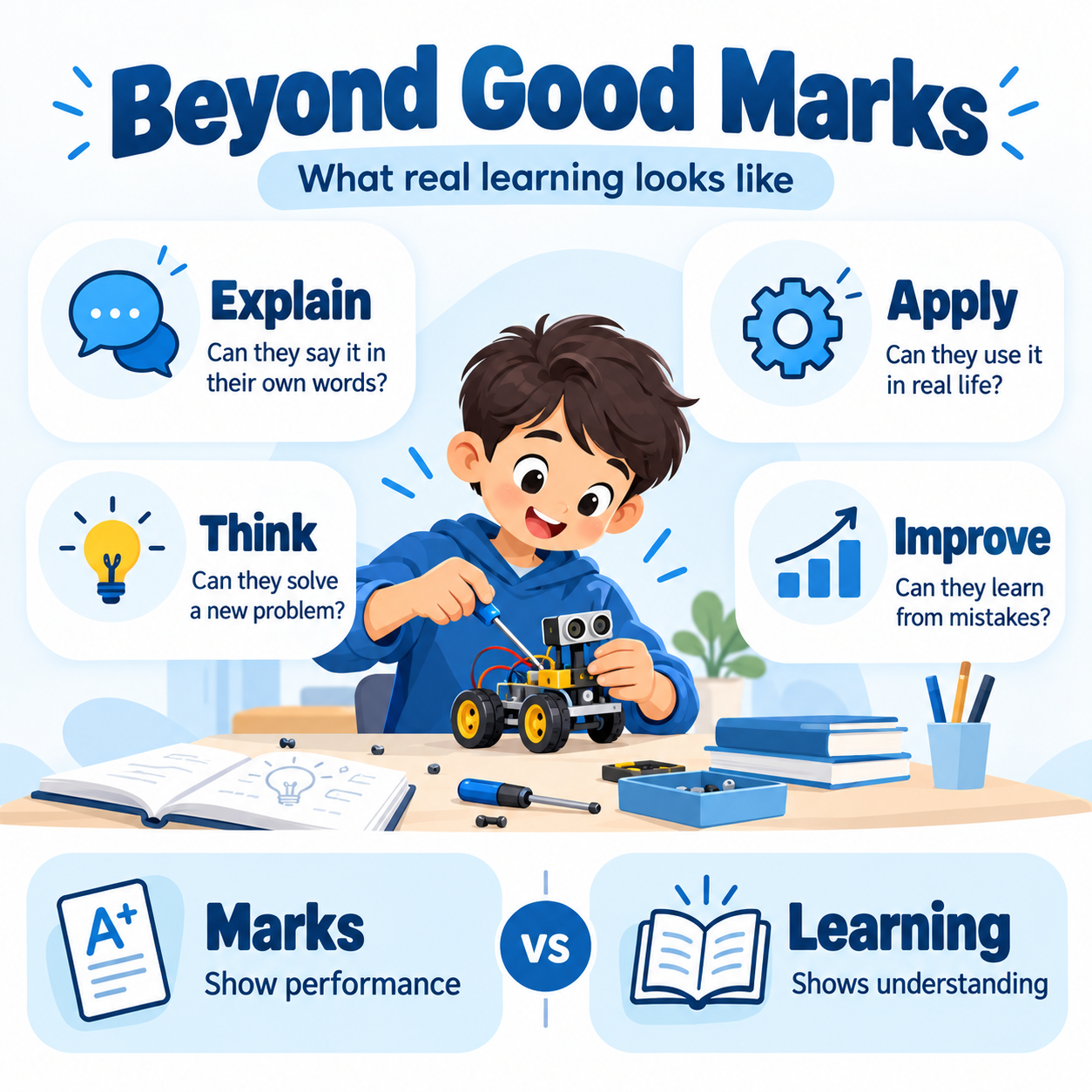
Three abilities can help parents recognise this difference.
1. Explaining Concepts in Their Own Words
A child who understands evaporation should be able to explain why wet clothes dry faster on a sunny or windy day, rather than only repeating a textbook definition.
Explaining something in simple language can reveal whether the child understands the idea behind it.
2. Applying Knowledge to New Situations
Understanding allows children to recognise familiar concepts in unfamiliar problems.
For instance, a child who understands fractions may use that knowledge while dividing food into equal portions or adjusting measurements in a recipe.
3. Recognising and Correcting Mistakes
Learning also involves identifying what went wrong.
When children can explain why an answer was incorrect and attempt another solution, they demonstrate an important part of the learning process.
These abilities complement memorisation rather than replace it.
How Can Parents Recognise Real Learning at Home?
Parents do not need additional examinations or complicated activities to understand how well their children are learning.
Small changes in everyday conversations can reveal useful information.
Ask Children to Explain What They Learned
Instead of asking only, "How many marks did you get?", try asking, "Can you explain one interesting thing you learned today?"
If your child studied the water cycle, encourage them to describe how rain forms using their own words.
Avoid correcting every small mistake immediately. Give them an opportunity to think and complete their explanation.
Introduce Familiar Concepts in New Situations
Practical questions can help children connect classroom knowledge with everyday experiences.
For example:
- Ask your child to calculate a discount while shopping.
- Encourage them to measure ingredients while cooking.
- Discuss why plants placed in different sunlight conditions may grow differently.
The purpose is not to test children constantly but to encourage them to recognise where their knowledge applies.
Discuss Mistakes Without Focusing Only on Marks
When reviewing an examination paper, look beyond the final score.
Ask your child which questions were difficult and why they chose particular answers.
A mistake might result from misunderstanding a concept, misreading a question, or making a calculation error. Each situation requires a different response.
These discussions can help parents identify where additional explanation or practice may be useful.
Why Schools Should Look Beyond Examination Results
Examinations remain important, but teachers often need additional information to understand how students are progressing.
Classroom discussions, assignments, projects, observations and regular feedback can provide different forms of evidence about learning.
The OECD highlights formative assessment, which involves checking students' understanding during the learning process and using that information to guide teaching.
Similarly, the Education Endowment Foundation emphasises that effective feedback should help students understand what they need to improve and how to improve it.
For example, rather than simply marking a mathematics answer incorrect, a teacher might explain which step contains the mistake and encourage the student to try again.
However, projects and classroom activities are not automatically better than examinations. Their value depends on how clearly they assess learning and how effectively teachers use the results.
Combining different assessment methods can provide a more complete picture of a child's progress.
How DRS International School Approaches Student Assessment
When parents research the Best boarding school in India, understanding how schools evaluate students can be as important as comparing academic results. DRS International School (DRSIS), Hyderabad, describes an assessment approach that examines student learning before, during, and after units of study.

According to its official website, teachers document learning through portfolios, projects, tasks, and assignments. The school also shares evidence of student progress with parents through meetings, parent-teacher conferences, student-led conferences, and exhibitions. Its stated approach uses assessment information to help teachers understand individual learning needs and plan suitable learning experiences. For families comparing options described as a Top boarding school in India, these practices highlight why it is worth examining assessment methods alongside examination performance.
Conclusion
Good marks deserve appreciation because they reflect important aspects of a child's academic progress. However, understanding becomes more meaningful when children can explain concepts, apply knowledge, and learn from mistakes.
Parents can support this development by asking thoughtful questions, discussing everyday examples, es and reviewing feedback alongside examination scores.
Ultimately, the goal is not simply to help children remember the right answers, but to help them understand why those answers are right.
For more information on this and similar schools, check out this list of the best boarding schools in India.










 as a preferred source on