








Every parent wants their child to succeed. Good marks, winning competitions, and positive feedback can naturally make both children and parents feel proud. But what happens when things do not go as planned?
A child may receive a lower mark than expected, lose a competition, miss a place on a sports team, or struggle with an assignment. For parents, the first instinct is often to protect the child from disappointment. Yet, learning how to handle setbacks is an important part of growing up. This is one reason parents exploring Modi World School, Jhunjhunu, and other boarding schools should look beyond academic performance and consider how a school helps children develop life skills.
The goal is not to make children fail. It is to help them understand what to do when failure inevitably happens.
Also Read| Beyond Blackboards and Books: The Multi-Pathway Approach
Why Are Parents Sometimes Afraid of Their Child's Failure?
It is natural for parents to want to make problems easier for their children. They may step in when a child struggles with homework, speak to a teacher after a poor result, or try to prevent their child from facing disappointment.
Support is important, but protecting children from every setback can sometimes leave them unprepared to deal with challenges independently.
Children need age-appropriate opportunities to make decisions, experience consequences, and solve manageable problems. These experiences can gradually teach them that a difficult moment does not have to become a permanent defeat.
What Does Failure Actually Teach Children?
A setback can teach lessons that are difficult to learn from success alone.
It Teaches Reflection
After something goes wrong, children can learn to ask, “What happened?” and “What could I do differently next time?”
This shifts their attention from simply feeling disappointed to understanding the experience.
It Teaches Persistence
A child who struggles with a difficult subject or loses a competition learns that improvement can take more than one attempt.
Trying again after receiving feedback can gradually build persistence.
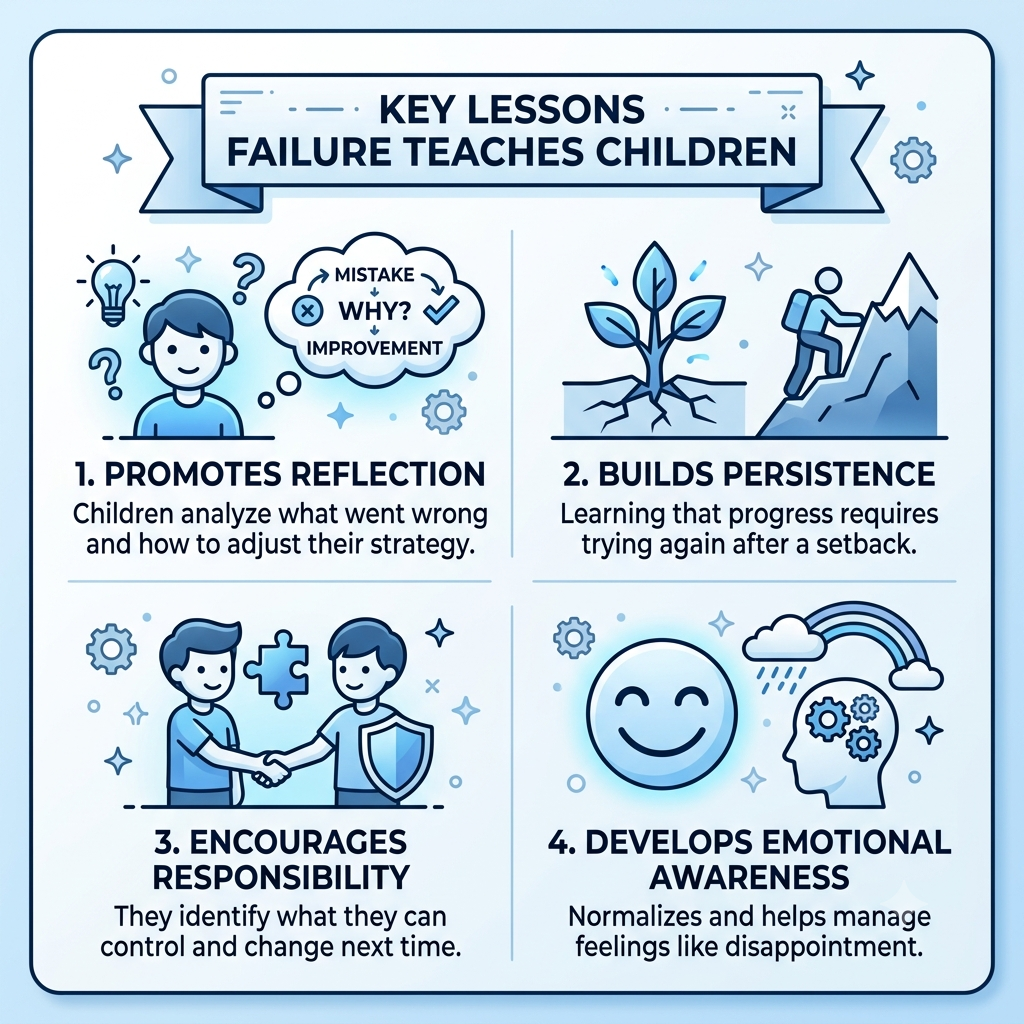
It Teaches Responsibility
Children can also learn to identify what they could control. Perhaps they needed more preparation, better time management, or a different strategy.
This does not mean blaming children for everything. It means helping them understand where they have the power to make a change.
It Builds Emotional Awareness
Failure can bring frustration, embarrassment, or disappointment. Children need to learn that these feelings are normal and can be managed rather than avoided.
Failure Should Be a Lesson, Not a Label
One of the most important things parents can teach is the difference between experiencing failure and being a failure.
“I did poorly on this test” describes an event.
“I am bad at everything” turns that event into an identity.
Parents can help children separate their performance from their self-worth. One poor result does not define a child's intelligence, personality, or future.
The focus should instead be on what happened, what was learned, and what can be tried next.
How Should Parents Respond When a Child Fails?
The way adults respond can influence how children view setbacks.
Let Them Feel Disappointed
Parents do not always need to immediately say, “It's okay.” If a child worked hard and did not get the expected result, disappointment is a normal response.
Give them some time to process it.
Ask Questions Instead of Giving Lectures
Once the child is ready to talk, simple questions can encourage reflection:
- What do you think went wrong?
- What part was most difficult?
- What would you change next time?
- What can we try now?
These questions can help children become active participants in solving the problem.
Focus on the Process
Instead of discussing only the final score, talk about preparation, strategy, effort, and learning.
For example, rather than saying, “Why did you get fewer marks than your friend?” a parent could ask, “Which topics were difficult for you, and how can we work on them?”
That creates a much healthier conversation around performance.
What Parents Should Avoid After a Failure
Certain reactions can make setbacks harder for children to handle.
Parents should avoid:
- Comparing children with classmates or siblings
- Making fun of mistakes
- Immediately blaming teachers
- Saying things such as “You always do this”
- Treating marks as a measure of a child's worth
- Solving every problem on the child's behalf
Children need both accountability and emotional support. They should understand that their actions have consequences while also knowing that one mistake does not change their value as a person.
Why Sports Can Be a Powerful Classroom for Failure
Sports provide children with something that textbooks cannot always recreate: the experience of winning, losing, practising and trying again.
A child may lose a badminton match, miss a goal or fail to make a team. These moments can be difficult, but they also create opportunities to learn about preparation, teamwork, pressure and persistence.
For example, after losing a match, a child can look at what happened. Was their technique weak? Did they become nervous? Was their strategy ineffective? What can they practise before the next match?
The same approach can later be applied to academics and other areas of life.
This is why parents should not judge activities only by trophies or medals. The learning that happens during both success and disappointment can be equally valuable.
What Can Schools Do to Build Resilient Children?
Schools can create an environment where mistakes and setbacks become part of learning.
Parents can look for schools that provide opportunities for:
- Constructive feedback
- Healthy competition
- Sports and physical activities
- Projects and problem-solving
- Student leadership
- Independent decision-making
- Teamwork
- Trying again after mistakes
Resilience is rarely developed through a single lesson. It grows through repeated experiences in which children face challenges, receive guidance, and gradually learn to handle situations on their own.
A Simple Parent's Resilience Checklist
Parents can also reflect on their child's everyday experiences:
- Does my child get opportunities to make age-appropriate decisions?
- Do I allow them to solve manageable problems independently?
- Can my child talk about mistakes without being afraid of my reaction?
- Do I focus too much on results?
- Am I comparing my child with others?
- Does my child participate in activities where winning and losing are both possible?
- After a setback, do we discuss what can be learned from it?
These questions can help parents identify whether they are supporting resilience or unintentionally trying to remove every obstacle.
Also Read| Play, Explore, and Grow: How Early Childhood Curricula Shape Lifelong Learners
How Modi World School Connects Learning With Resilience
For parents considering the Best Boarding School in India, Modi World School, Jhunjhunu provides several experiences that connect with the development of resilience and life skills. Its structured sports programme focuses on areas such as patience, teamwork, discipline, self-confidence, leadership and decision-making, while also aiming to help students cope with peer pressure and academic demands.

The school also provides students with leadership responsibilities through its student council, houses and clubs. In addition, its MODI YES initiative includes resilience, risk-taking, and problem-solving as part of its approach to real-world learning. These elements can be relevant for parents evaluating a Top Boarding School in India not only for academic education but also for opportunities that help children respond to challenges and take responsibility.
The Goal Isn't to Raise Children Who Never Fail
Children will eventually face difficult examinations, unsuccessful applications, challenging decisions, professional setbacks, and unexpected changes.
Parents cannot remove every difficulty from their children's lives. Nor should they have to.
Instead, children can gradually learn that disappointment is something they can face, understand, and move forward from.
The goal is not to raise children who win every time. It is to raise children who can lose, learn, adapt, and try again.
Sometimes, the most valuable lesson after a setback is not “How can I make sure this never happens again?” but “What can I learn from what happened, and what will I do differently next time?”
For more information on this and similar schools, check out this list of the best boarding schools in India.

 as a preferred source on