







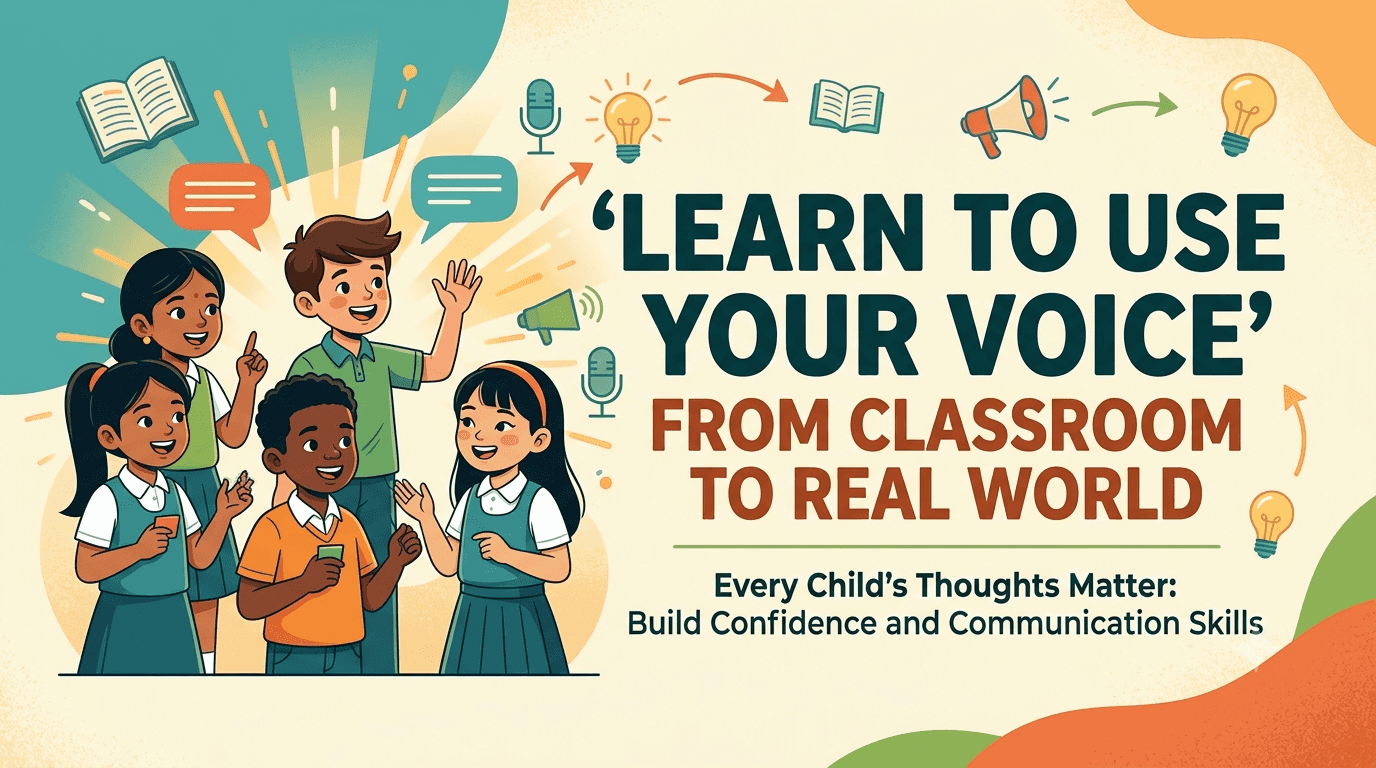

A child may know the answer but still hesitate to raise their hand. Another may talk freely at home but become quiet when asked to speak in front of others. Some children are naturally expressive, while others need more time before they feel comfortable sharing their thoughts.
These differences are normal. Communication is not about making every child outspoken. It is about helping children express an idea, ask a question, listen to another person, and share their thoughts without being afraid of getting everything perfect.
This is why learning to use their voice is an important part of growing up. From classroom discussions to everyday conversations, children need opportunities to communicate in ways that prepare them for situations beyond school.
Also Read| Beyond the Classroom: The Impact of a Supportive Residential School Life
Using Your Voice Means More Than Public Speaking
When people talk about communication skills, public speaking is often the first thing that comes to mind. But a child's ability to communicate involves much more than giving a speech.
A child uses their voice when they:
- Explain why they agree or disagree with an idea
- Ask a teacher to explain something again
- Share an opinion during a group discussion
- Tell a story or describe an experience
- Ask for help when they need it
- Listen to another person's point of view
- Explain their thinking to someone else
These everyday moments help children learn how to organise their thoughts and communicate them clearly.
Children also need to understand that good communication does not always mean having the right answer. Being able to say, “I don't understand,” “I have a different opinion,” or “Can you explain that?” is also a sign of healthy communication.
How Classroom Discussions Help Children Communicate
The classroom can be one of the first places where children regularly interact with people who may have different ideas from their own.
A good classroom discussion encourages students to listen before responding. They may need to explain their reasoning, respond to another student's point, or reconsider an opinion after hearing a different perspective.
These experiences can help develop several skills at the same time:
- Organising thoughts before speaking
- Explaining an opinion with reasons
- Listening carefully
- Responding appropriately
- Respecting different viewpoints
- Becoming comfortable with making mistakes
However, participation should not simply mean speaking the most.
A child who rarely volunteers to answer may still have thoughtful ideas. Some children are more comfortable speaking in pairs or small groups before addressing an entire class. Giving students different opportunities to participate can help more children become confident communicators.
The aim is not to create the loudest students. It is to help children understand that their ideas deserve to be heard.
Why Real-World Communication Matters
Communication becomes more meaningful when children have a real reason to use it.
Giving a presentation to classmates, working on a group project, interviewing someone, explaining a project, or participating in an event requires children to think about how their message will be understood by others.
These experiences can teach lessons that are difficult to learn from a textbook alone.
A child may begin to ask:
Is my explanation clear?
Have I listened properly to the other person?
How can I explain this idea differently?
What should I do if someone disagrees with me?
These small challenges gradually make communication more natural.
Real-world communication can also help children understand that their voice is not only useful for expressing personal opinions. It can be used to share information, collaborate with others, solve problems, and contribute to the community.
How Parents Can Help Children Find Their Voice
Communication skills are not developed only at school. Home can be one of the safest places for children to practise expressing themselves.
Ask questions that encourage conversation.
Instead of asking only, “How was school?”, try questions such as, “What was the most interesting thing you learned today?” or “What would you have done differently?”
Open-ended questions encourage children to explain their thoughts instead of giving one-word answers.
Give them time to speak.
Children sometimes need a few extra seconds to find the right words. Instead of completing their sentences immediately, allow them time to organise what they want to say.
Let them express different opinions.
Children should learn that disagreement is not automatically disrespectful. Family conversations can help them practise expressing a different view while remaining polite.
Encourage explanation instead of performance.
Rather than constantly asking children to speak louder or appear more confident, focus on whether they can communicate their thoughts clearly.
For example, asking “Why do you think that?” can encourage deeper thinking and better expression.
Give quieter children smaller opportunities.
Not every child will enjoy speaking before a large group immediately. A child may first feel comfortable talking to one friend, then a small group and eventually a larger audience.
Confidence can grow gradually.
- info.png)
What Should Parents Look for in a School?
Parents evaluating a school can look beyond whether it offers a separate public-speaking activity. A more useful question is whether children get regular opportunities to communicate as part of everyday learning.
Look for environments where students can:
- Participate in classroom discussions
- Work on group projects
- Present their ideas
- Ask questions
- Take part in performances and activities
- Listen to different viewpoints
- Communicate with people beyond their immediate classroom
It is also worth noticing whether a school creates opportunities for different types of children to participate. A confident speaker and a naturally quiet child may need different kinds of encouragement.
A school that values communication should give students space to practise, make mistakes and improve rather than expecting confidence to appear instantly.
Also Read| Distinct Spaces, Common Values: The Power of a Unified Boarding Community
A School-Specific Look: Guru Nanak Fifth Centenary School Shangri La
Guru Nanak Fifth Centenary School Shangri La provides students with opportunities to develop communication through participation beyond regular classroom learning. One distinctive example is Radio Khushi 90.4 FM, the school's community radio initiative, which provides a platform for communication and awareness.

The school has also documented student participation in Shangri-La House Day through presentations, skits, songs, and dances. These experiences offer different ways for students to express themselves, work with others, and communicate with an audience. For parents considering a Top Boarding School in India, such opportunities can be useful when looking at how a school encourages communication beyond textbooks. Families searching for a Best Boarding School in India can similarly consider whether students are given meaningful opportunities to express ideas, participate, and develop confidence through everyday school experiences.
A Child's Voice Grows With Practice
Children do not become confident communicators after giving one speech or participating in one school event. Communication develops gradually through repeated experiences of speaking, listening, questioning, explaining, and trying again.
The goal is not to make every child the most outspoken person in the room.
It is to help them feel comfortable enough to say:
“I have an idea.”
“I don't understand.”
“I see it differently.”
“Can you explain that?”
When children learn that their thoughts are worth expressing and that other people's thoughts are worth hearing, they develop a skill that can support them far beyond their school years.
For more information on this and similar schools, check out this list of the best boarding schools in India.
 as a preferred source on