







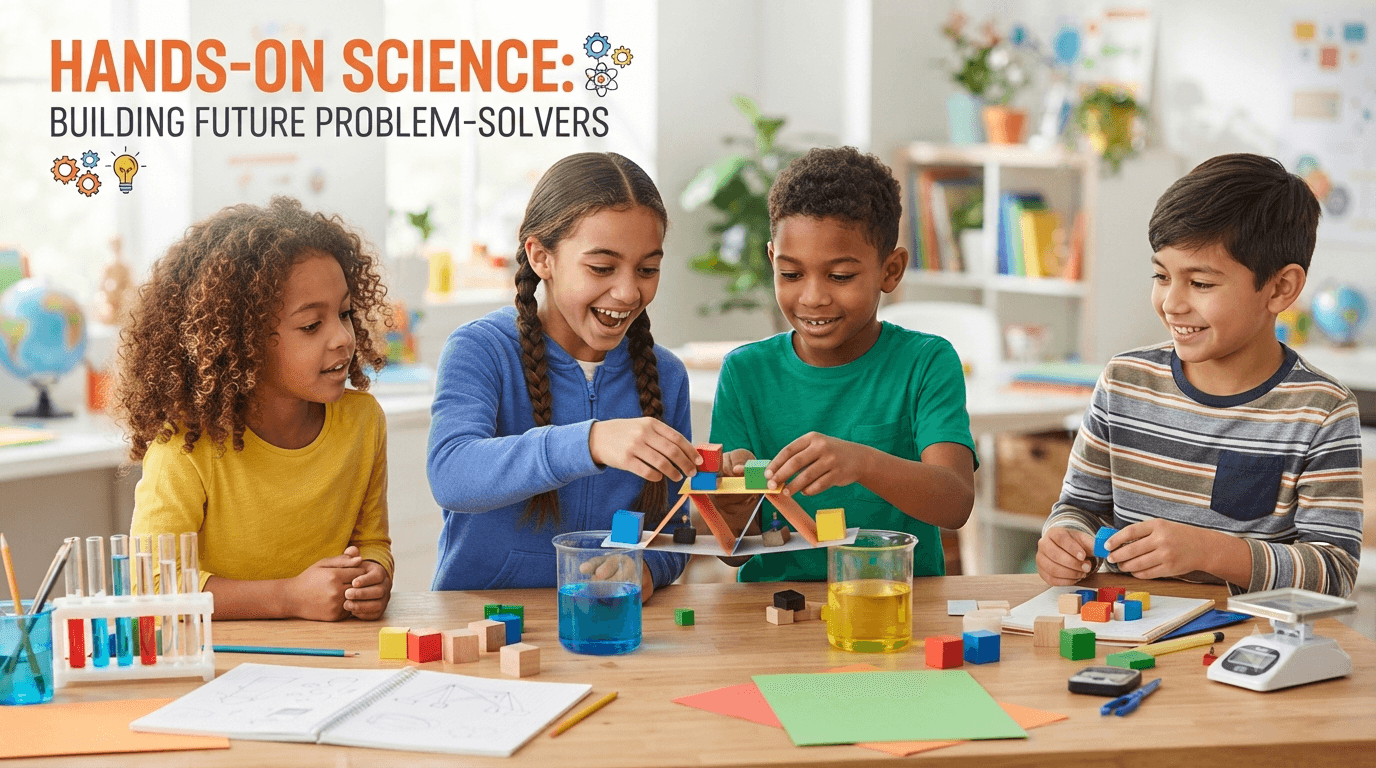

Children often learn scientific facts from textbooks, but using that knowledge to solve a real problem is a different experience. A child may know that some objects float and others sink, for example, but what happens when they have to design a boat that can carry several coins without sinking? That is where practical science becomes valuable.
For parents exploring the Best Boarding School in India, it is worth looking beyond textbooks and exam preparation. Opportunities to experiment, ask questions, and explore different solutions can help children develop skills that they use in school and everyday life. At Mussoorie International School (MIS), the school's documented science learning activities offer a relevant starting point for understanding this approach.
Hands-on science is not simply about making learning more enjoyable. It gives children opportunities to think independently, test their ideas, and understand why a solution works—or does not.
Also Read| Empowering Girls with Knowledge & Confidence
How Hands-On Science Turns Questions into Solutions
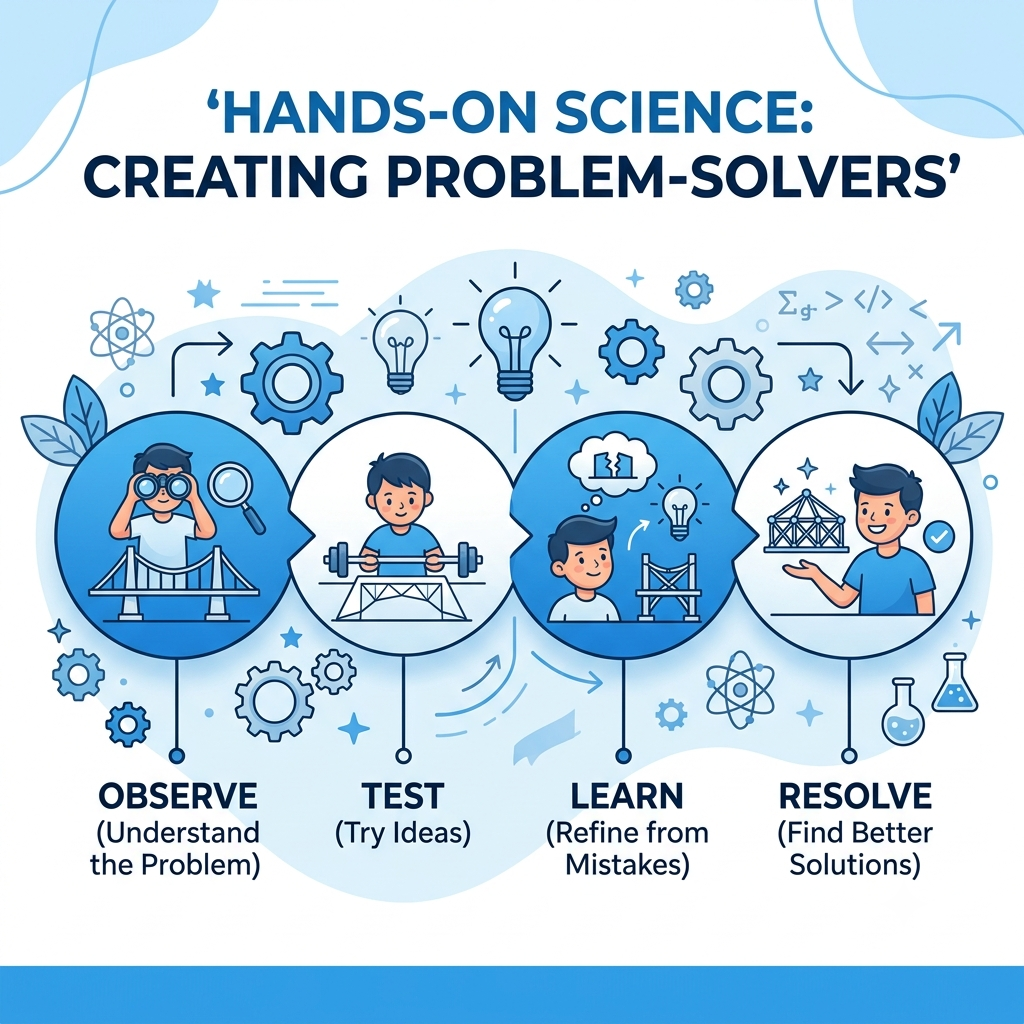
Learning to Observe Before Jumping to Conclusions
Good problem-solving often begins with careful observation. Before suggesting a solution, children need to understand what is happening and identify the problem.
Imagine a child building a bridge with sheets of paper. The bridge collapses when small objects are placed on it. Instead of immediately rebuilding it, the child can examine where it bends, how the paper is positioned, and how the weight is distributed.
This process teaches children to pay attention to details rather than make quick guesses. Over time, they can learn to ask better questions and identify the information they need before making a decision.
Testing Ideas Instead of Guessing
Science encourages children to turn questions into experiments. They can make a prediction, test it, and compare the result with what they expected.
For example, a child might predict that folding a sheet of paper will make a bridge stronger. By testing flat, folded, and rolled paper designs, the child can compare the results and discover which design works best under similar conditions.
The important lesson is that an idea needs to be tested. Children begin to understand that evidence is more useful than simply believing that an answer sounds correct.
Learning from Experiments That Fail
Not every experiment produces the expected result. A paper parachute may fall too quickly, a homemade structure may collapse, or a prediction about an object's behaviour may turn out to be wrong.
These moments can teach children to pause, review what happened, and try a different approach. Rather than seeing a mistake as proof that they cannot solve a problem, they can begin to see it as information that helps them improve.
This also encourages patience. Children learn that finding a solution may take several attempts, and changing their approach is often part of the process.
The Problem-Solving Skills Children Develop Through Experiments
Hands-on science can help children practise several skills that extend beyond the science classroom.
- Logical thinking: Children learn to connect actions with results. They can compare different outcomes and work out why one approach may be more effective than another.
- Creativity: An experiment may have several possible solutions. Children learn to explore alternatives instead of assuming there is only one correct method.
- Patience and persistence: When an idea does not work, children get opportunities to make changes, test again, and continue working towards a solution.
- Decision-making: By observing results and comparing options, children practise choosing their next steps based on evidence rather than guesswork.
These skills are useful in everyday situations, too. A child who learns to break a science problem into smaller steps may also use that approach when organising a project, resolving a disagreement or tackling a difficult school assignment.
The goal is not to expect every child to become a scientist. It is to help children develop a thoughtful approach to unfamiliar challenges.
Simple Ways Parents Can Encourage Scientific Thinking at Home
Parents do not need expensive equipment or complicated experiments to encourage curiosity. Everyday materials can offer plenty of opportunities to investigate questions together.
1. Build a Paper Bridge
Ask your child to make a bridge between two books using paper. Test how many coins it can hold, then try folding the paper differently. Discuss which design worked better and why.
2. Compare Absorbent Materials
Use small, equal amounts of water to test materials such as paper towels and cotton cloth. Ask your child to predict which will absorb more and compare the results fairly.
3. Observe Changing Shadows
Observe a tree or another stationary object at different times of day. Ask your child to notice how its shadow changes and suggest reasons for the difference.
During these activities, resist the urge to explain everything immediately. Instead, ask questions such as, “What do you think will happen?” “What did you notice?” and “What could we change next time?”
Allowing children to explain their reasoning is just as important as completing the activity.
What Should Parents Look for in a School's Science Learning Approach?
When exploring schools, parents can ask how students experience science beyond reading textbooks and preparing for examinations.
Look for opportunities for children to participate in experiments, handle age-appropriate materials, investigate questions, and discuss their findings. A useful science activity should give students a chance to think and make decisions, not simply watch a teacher demonstrate the correct answer.
Parents can also ask how teachers help students when an experiment does not go as planned. Are children encouraged to review their methods and try again? Do they get opportunities to explain what they observed?
A well-supported learning environment balances practical exploration with clear instruction and appropriate safety measures. The aim is to help children understand scientific ideas and practise applying them to unfamiliar situations.
Also Read| Preserving Heritage: The Role of Indian Traditions and Values
Practical Science at Mussoorie International School
For parents considering the Best Boarding School in India, the opportunities a school provides for students to explore scientific ideas can be an important part of the decision. Mussoorie International School (MIS) has documented a Space Science Workshop conducted in collaboration with Brahmshala School of Astronomy, featuring activities such as hydro rockets and stargazing.

These experiences offer students opportunities to engage with scientific concepts beyond conventional textbook learning. For families comparing options for a Top Boarding School in India, it is useful to explore how a school's practical activities fit into its wider educational approach and how students are encouraged to question, observe, and investigate.
Let Children Discover How to Find Answers
Children become better problem-solvers when they have opportunities to think through challenges rather than receive every answer immediately. Hands-on science creates space for them to ask questions, test ideas, learn from unexpected results, and improve their solutions.
Parents can support this process through simple activities at home and by choosing learning environments that encourage active participation. What matters is not whether every experiment succeeds on the first attempt, but whether children learn to approach problems with curiosity, patience, and an open mind.
These habits can help children become more confident learners who are willing to explore unfamiliar challenges and work towards finding their own solutions.
For more information on this and similar schools, check out this list of the best boarding schools in India.
 as a preferred source on