









A child may know the answer in class but still hesitate to raise their hand. Another may have plenty of ideas but struggle to explain them clearly. At MVM School, communication is among the areas the school says it seeks to nurture alongside academics and other talents.
These situations show why communication skills are about much more than speaking fluently. Children need to learn how to express their thoughts, listen carefully, ask questions, work with others, and share their opinions respectfully. School can play an important role in giving them regular opportunities to practise these skills.
Also Read| Why Do Children Need Experiential Learning?
Why Are Communication Skills Important for Children?
Good communication helps children in both their academic and everyday lives. A student who can explain an idea clearly may find it easier to participate in class, ask for help, and present their understanding of a topic.
Communication also affects relationships. Children need to listen to their friends, understand different viewpoints, and express disagreement without being disrespectful. These are skills that develop gradually through everyday interactions.
Importantly, communication should not be confused with being outspoken. A quiet child can also be an excellent communicator. The goal is not to make every child talk constantly, but to help each child feel comfortable expressing themselves when it matters.
5 Ways Schools Can Build Better Communication Skills
1. Encourage Classroom Discussions
A classroom should provide opportunities for children to explain why they think something rather than simply give the correct answer.
Teachers can ask open-ended questions, invite different viewpoints, and encourage students to explain their reasoning. Even a short classroom discussion can help children organise their thoughts before speaking.
Over time, these small opportunities can make speaking in front of others feel less intimidating.
2. Give Children Opportunities to Present
Presentations, storytelling, speeches and project-based activities can help children practise communicating ideas in a structured way.
A child preparing a presentation has to think about what they want to say, organise the information and consider how to explain it to an audience. They also gradually become familiar with speaking while others are listening.
For children who are shy, schools can begin with smaller activities before moving towards larger presentations. The focus should be on gradual confidence-building rather than putting unnecessary pressure on them.
3. Make Group Activities Part of Learning
Communication becomes especially meaningful when children have to work with other people.
During group activities, students may need to divide responsibilities, explain their ideas, listen to classmates, and find a solution when opinions differ. These experiences teach children that communication is a two-way process.
It is not only about making yourself heard. It is also about understanding what someone else is saying.
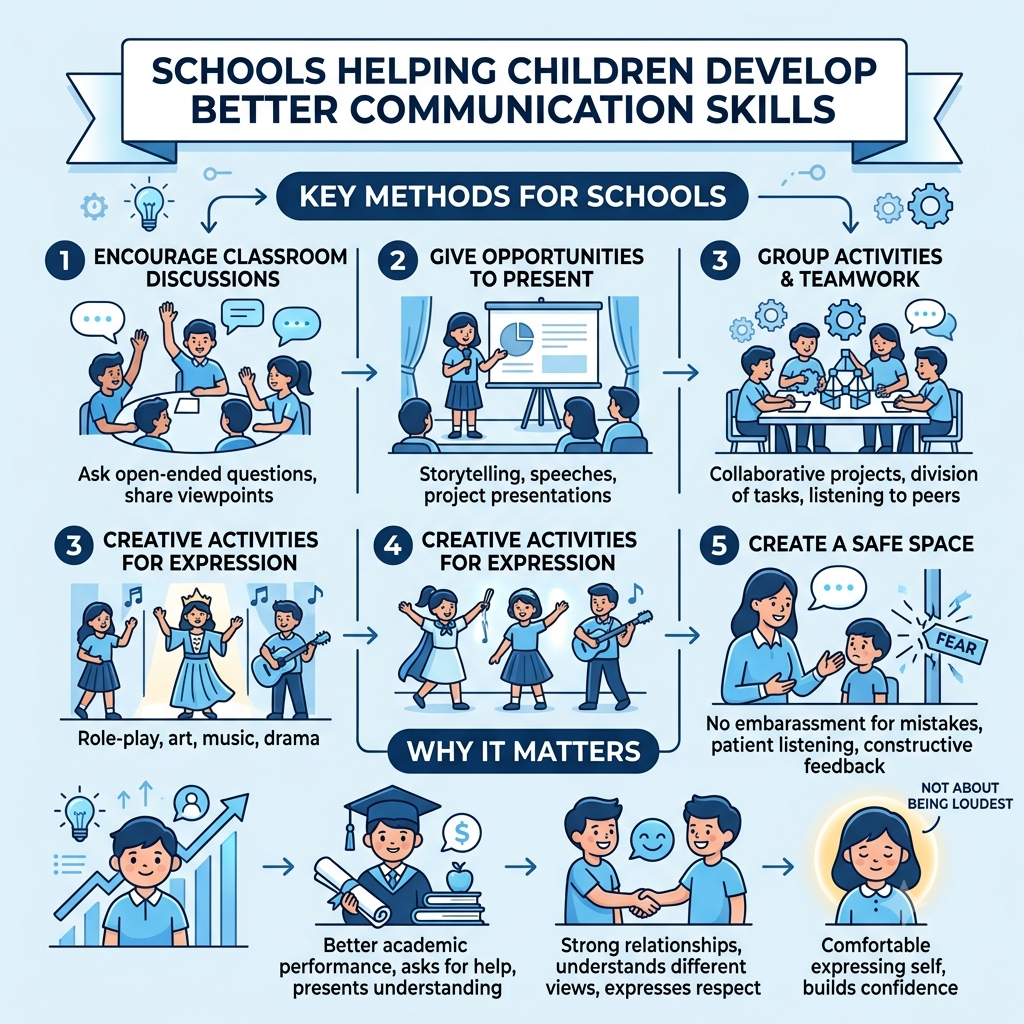
4. Use Creative Activities for Expression
Not every child communicates best through a traditional classroom answer. Activities such as drama, storytelling, music, and other creative forms can give students different ways to express themselves.
Role-play, for example, can encourage children to think about how another person might feel or respond in a particular situation. Storytelling can help them structure ideas, while drama can encourage expression through both words and body language.
Such activities can be particularly useful for children who need alternative ways to become comfortable expressing themselves.
5. Create a Safe Space for Mistakes
Children are more likely to participate when they know that making a mistake will not lead to embarrassment.
If a student is constantly worried about giving the wrong answer, being laughed at, or being compared with a more confident classmate, they may choose not to speak at all.
Teachers can help by listening patiently, correcting mistakes constructively, and giving children time to formulate their responses. A supportive classroom does not mean avoiding correction. It means making correction part of learning rather than making children afraid to participate.
How Can Parents Support Communication at Home?
Schools can provide opportunities, but communication also develops through everyday conversations at home.
Parents can support this development by making simple changes:
- Let children finish their thoughts before responding.
- Ask questions that encourage more than a “yes” or “no” answer.
- Ask children to explain why they made a particular choice.
- Discuss stories, news or everyday experiences together.
- Encourage children to express disagreement respectfully.
- Give them opportunities to speak with relatives, teachers and other adults.
- Avoid correcting every small language mistake while they are trying to communicate.
Reading together can also create useful conversations. Instead of only asking what happened in a story, parents can ask, “What would you have done?” or “Why do you think the character behaved that way?”
These questions encourage children to think, explain, and listen.
What Should Parents Look for in a School?
When choosing a school, parents can look beyond academic results and ask how often children actually get opportunities to communicate.
Some useful questions include:
- Are students encouraged to ask questions?
- Do children participate in discussions?
- Are presentations and group activities part of school life?
- Are creative activities available for self-expression?
- Can quieter children participate without unnecessary pressure?
- Do teachers listen to students' ideas?
- Does the school value communication alongside academic learning?
These questions can help parents understand whether communication is treated as an everyday skill or simply as something children practise before an occasional speech or competition.
Also Read| Why Comfortable Living Spaces Matter in Boarding Schools
How MVM School Connects With Communication Development
For families researching a Top boarding school in India, MVM School provides a relevant example of an institution that states its focus includes nurturing communication alongside other areas of student development. Its listed extracurricular opportunities include debate, music, drama, art and craft, and dance, while the school also identifies communication among the talents it aims to nurture.

These kinds of opportunities can give children different settings in which to practise expressing ideas, listening to others and participating with confidence. For parents looking for a Best boarding school in India, the broader question is therefore worth asking: does the school provide regular, meaningful opportunities for children to communicate and express themselves?
Conclusion
Strong communication does not develop in a single speech or presentation. It grows through everyday opportunities to ask questions, share ideas, listen to others, work in groups, and learn from mistakes.
A good school environment can make these experiences part of a child's regular routine. At home, parents can reinforce them through simple conversations and patient listening.
The goal is not to turn every child into the loudest person in the room. It is to help children become comfortable expressing what they think, understanding what others mean, and communicating with confidence and respect.
For more information on this and similar schools, check out this list of the best boarding schools in India.
 as a preferred source on