







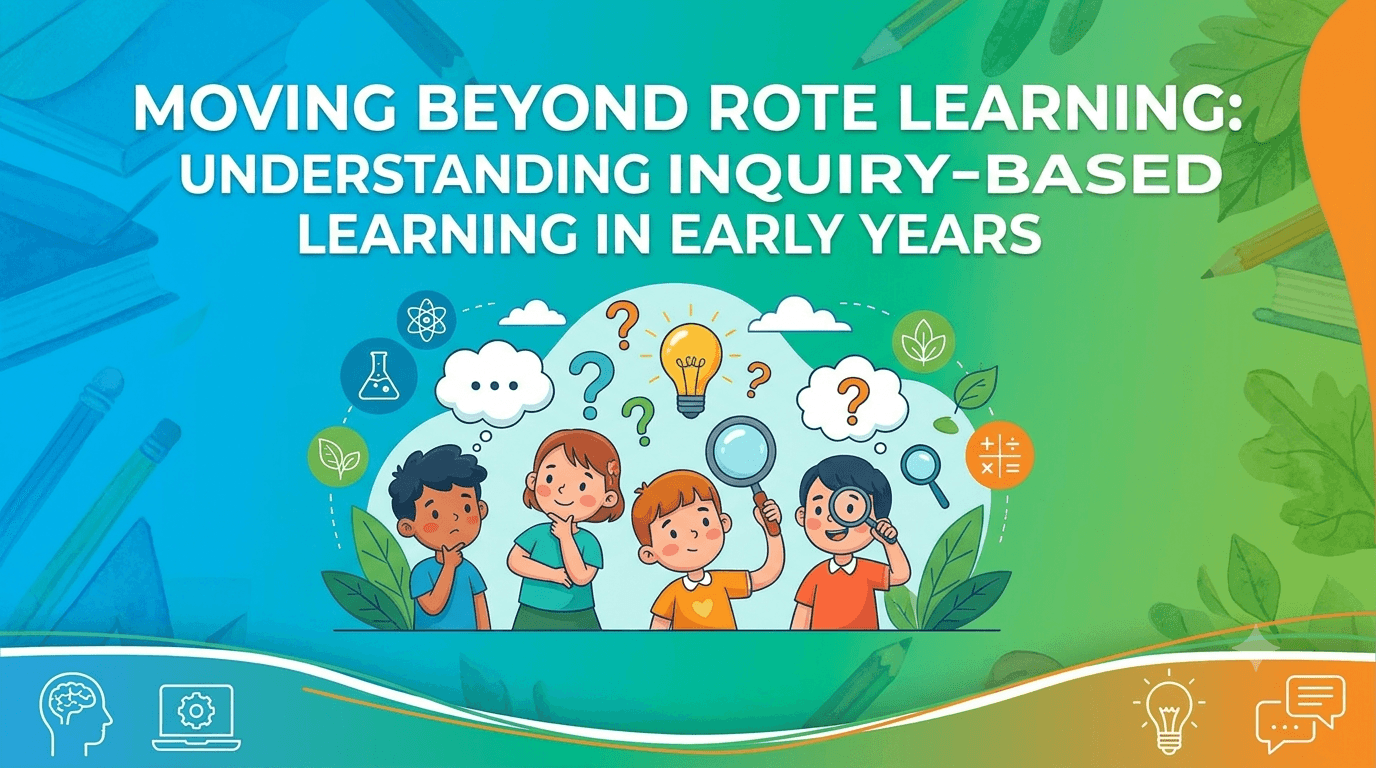

A child may be able to remember an answer for a test but still struggle when asked, “Why does this happen?” That small difference can tell us a lot about how children learn.
At Cambrian Hall School, the shift towards inquiry-based learning in the Primary Wing reflects a growing focus on helping children understand ideas rather than simply remember them. But what does moving beyond rote learning actually mean for a young learner? And does it mean memorisation no longer has a place in school?
The answer is more balanced than it may seem.
Also Read| What Makes Education Truly Transformative in Today’s World?
Rote Learning Is Not the Enemy—But It Cannot Be the Whole Picture
Rote learning means remembering information through repetition. It can be useful for children. Learning multiplication tables, spellings, vocabulary, and basic facts often requires practice and recall.
The problem begins when remembering becomes the main goal of learning.
For example, a child may memorise that plants need sunlight, water and air. But deeper learning begins when the child starts asking questions such as:
- What happens if a plant gets very little sunlight?
- Why do some plants grow better in certain places?
- Can a plant survive without water for a few days?
The child is no longer simply recalling information. They are beginning to use knowledge to investigate something.
That is where inquiry-based learning becomes valuable.
So, What Does Inquiry-Based Learning Actually Look Like?
Inquiry-based learning starts with curiosity. Instead of always giving children the answer first, teachers create opportunities for them to observe, question, investigate, and explain.
A classroom might begin with:
“What do you notice?”
Then move towards:
“Why do you think this happened?”
And eventually:
“How could we find out?”
The teacher still plays an important role. Inquiry does not mean leaving children to figure everything out by themselves. Teachers guide discussions, introduce useful information, ask follow-up questions, and help children connect their discoveries with concepts.
Questions Become Part of Learning
Young children naturally ask questions. A good learning environment can use that curiosity instead of treating it as a distraction.
When children are encouraged to explain why they think something is true, they begin to organise their thoughts. When they hear another child's explanation, they may also discover that the same problem can have different approaches.
Over time, this can make classroom learning more active and thoughtful.
A Simple Classroom Example
Imagine a lesson about objects that float and sink.
In a purely answer-focused lesson, children might learn the definition and write it down.
In an inquiry-based lesson, they might first predict what will happen when different objects are placed in water. They can test their predictions, compare the results, and discuss why some objects behaved differently from others.
The important part is not simply conducting an activity. It is the process of predicting, observing, questioning, and explaining.
What Can Children Develop Through This Approach?
Inquiry-based learning can support several skills that children need both inside and outside the classroom.
Critical Thinking
Children learn to look beyond the first answer. They can be encouraged to ask whether something makes sense, what evidence supports an idea, and whether there could be another explanation.
Problem-Solving
Not every investigation produces the expected result. That can be useful. Children learn that when something does not work, they can try another approach rather than immediately giving up.
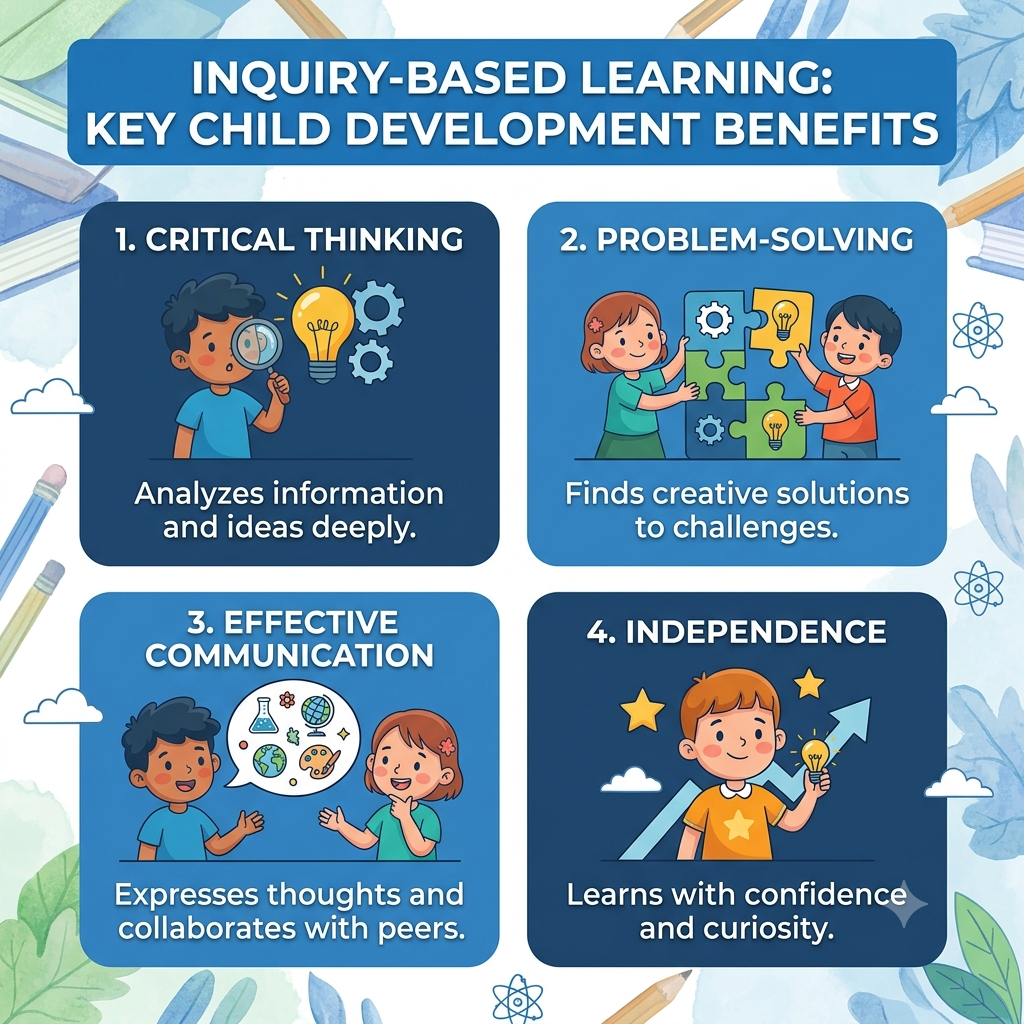
Communication
Explaining how they reached an answer can be just as important as giving the answer itself. Children gradually learn to put their thoughts into words and listen to different viewpoints.
Independence
When children get regular opportunities to investigate questions, they can become more comfortable thinking before immediately waiting for someone else to provide the solution.
These skills do not develop from one activity or one lesson. They grow through repeated opportunities to think, question, and reflect.
Does Moving Beyond Rote Learning Mean Children Stop Memorising?
No.
This is an important distinction for parents.
Children still need foundational knowledge. A child cannot solve a mathematics problem without knowing basic mathematical concepts. Reading requires vocabulary. Science requires knowledge of important terms and ideas.
The goal is not to replace knowledge with questions.
Instead, knowledge becomes the foundation for deeper thinking.
A child first needs to know something. Then they can begin asking what it means, why it happens, how it can be applied, and what might happen if the situation changes.
In this sense, effective learning needs both knowledge and understanding.
What Should Parents Look for in an Inquiry-Based School?
Parents do not need to become education experts to understand whether a school encourages this approach. During a school visit or interaction with teachers, they can look for simple signs.
Ask:
- Are children encouraged to ask questions?
- Do teachers ask children to explain their thinking?
- Are students given opportunities to explore ideas instead of only copying answers?
- Are mistakes treated as opportunities to learn?
- Do children get chances to solve problems independently?
- Does classroom discussion go beyond finding one correct answer?
These questions can reveal more about a school's learning culture than educational labels alone.
Also Read| From Awareness to Action: The Three-Dimensional Learning Revolution
How Cambrian Hall School Is Bringing This Approach to Its Primary Wing
Cambrian Hall School has introduced the Cambridge Methodology for its junior-school students, describing it as a change in pedagogical approach rather than simply a change in textbooks. Its stated focus includes inquiry-based learning, critical thinking and problem-solving, with an emphasis on developing curiosity from the formative years.

The school also describes its approach as helping students become more articulate, confident, and independent learners. For parents considering a Top boarding school in India or looking for a Best boarding school in India, this kind of shift towards learning through questioning and understanding offers a useful point to examine when evaluating a school's primary education approach.
Conclusion
Moving beyond rote learning does not mean asking children to stop memorising. It means giving them opportunities to do something with what they remember.
A child who knows an answer has gained information. A child who can explain it, question it, apply it, and connect it to something new is developing a deeper form of understanding.
For young learners, that difference can matter. School is not only about helping children collect answers. It is also about helping them become curious enough to keep asking better questions.
For more information on this and similar schools, check out this list of the best boarding schools in India.
 as a preferred source on