









What does real success look like for a ten-year-old? Is it acing mathematics tests, or is it knowing how to handle disappointment when things don't go as planned? Is it memorizing historical dates, or understanding how to resolve conflicts with empathy?
For decades, Indian education has championed academic achievement as the ultimate goal. Yet, in classrooms across the country, students who excel on paper often struggle with anxiety, peer relationships, and ethical decision-making. The world is changing, and so must our approach to education.
Cambrian Hall School (CHS), Dehradun, stands at the forefront of this transformation. By integrating Emory University's SEE Learning framework with Cambridge methodology, the school has created an educational model that develops emotionally intelligent, globally conscious students without compromising academic rigour.
In this article, we explore the three-dimensional learning approach revolutionizing student development, examine why traditional education falls short, and understand how SEE Learning creates well-rounded individuals prepared for life's complexities.
Also Read | Beyond the Marshmallow Test: Emotional Intelligence as Academic Advantage
The Crisis in Contemporary Education: Why Academic Excellence Isn't Enough
Walk into any competitive exam coaching centre, and you'll find students buried in textbooks, racing against time and each other. Academic pressure has reached unprecedented levels, but what about the skills needed to navigate life beyond examinations?
The Empathy Deficit in Modern Classrooms
Today's students face challenges that previous generations never encountered. Social media comparison, information overload, and performance pressure create a toxic cocktail affecting mental health. According to a 2023 National Crime Records Bureau report, student suicides in India have slightly increased annually over the past five years.
The problem isn't just academic stress—it's the lack of emotional tools to cope with it. Traditional schooling rarely addresses self-awareness, impulse control, or relationship-building. Students learn quadratic equations, but not how to manage frustration when they can't solve one.
What Research Reveals About Whole-Child Development
The evidence is compelling. A comprehensive meta-analysis published in Child Development journal examined 270,000 students across 213 school-based social-emotional learning programs. The findings were remarkable: students demonstrated an 11% improvement in academic performance alongside better emotional regulation and stronger peer relationships.
These aren't abstract benefits. Students with developed emotional intelligence show higher college completion rates, better career prospects, and improved mental health outcomes. The question isn't whether schools should teach these skills—it's how quickly they can integrate them.
Decoding the SEE Learning Framework: A Scientific Approach to Human Development

Developed through collaboration between Emory University and the Dalai Lama Foundation, SEE Learning represents a paradigm shift in education. It's not an add-on program squeezed between mathematics and science—it's a comprehensive framework reshaping how students engage with themselves, others, and the world.
The framework operates on a simple yet profound 3×3 matrix: three dimensions applied across three domains of development.
The Three Core Dimensions Explained
Awareness trains students to observe their thoughts and emotions without judgment. Imagine a student recognizing rising frustration during a difficult exam and consciously choosing calm over panic. That's awareness in action—the foundation of emotional intelligence.
Compassion extends beyond feeling sympathy. It involves understanding others' perspectives while maintaining personal boundaries. Students learn that kindness isn't weakness and that empathy strengthens rather than diminishes them.
Engagement transforms knowledge into action. Students don't just learn about environmental issues—they initiate recycling drives. They don't merely study ethics—they practice ethical decision-making in daily situations.
Three Domains of Student Growth
The three dimensions operate across personal, social, and systems domains, creating a comprehensive development roadmap.
The personal domain focuses inward. Students develop self-regulation, recognizing emotional triggers and managing impulsive reactions. A child who previously threw tantrums over losing a game learns to process disappointment constructively.
The social domain builds outward. Students cultivate meaningful relationships through active listening, conflict resolution, and collaborative problem-solving. Classroom group projects transform from chaotic competitions into genuine teamwork experiences.
The systems domain expands globally. Students understand interconnectedness—how individual actions affect communities, how local decisions impact global systems. They develop the critical thinking needed for responsible citizenship in an increasingly complex world.
From Theory to Practice: How SEE Learning Transforms Daily School Life
SEE Learning succeeds because it's experiential, not theoretical. Students don't sit through lectures on empathy—they practice it through carefully designed activities that make learning engaging and memorable.
Interactive Learning Over Lectures
Remember the famous marshmallow experiment? Researchers offered children one marshmallow immediately or two if they waited fifteen minutes. This simple test measured impulse control—a critical life skill predicting future success more accurately than IQ scores.
Schools implementing SEE Learning use similar exercises. Role-playing activities place students in real-world ethical dilemmas. Should you report a friend's cheating, or stay silent out of loyalty? There's no textbook answer, only the opportunity to explore values and consequences.
Mindfulness exercises help students recognize stress patterns. Laughter yoga sessions—yes, intentional laughing—reduce anxiety and build resilience. Non-verbal communication challenges develop empathy by forcing students to understand emotions without words.
Building the Four Essential Pillars
SEE Learning rests on four interconnected pillars that support complete student development.
- Self-awareness and emotional intelligence: Students identify emotions accurately, understanding why they feel what they feel. This metacognitive skill prevents emotional hijacking during stressful situations.
- Self-regulation and growth mindset: Challenges become opportunities rather than threats. Students develop grit—the ability to persist through difficulty without crumbling under pressure.
- Relationship-building through empathy: Communication skills sharpen. Students learn active listening, perspective-taking, and constructive feedback. Playground conflicts are resolved through dialogue rather than aggression.
- Ethical decision-making capabilities: Right and wrong aren't always obvious. Students develop moral reasoning, considering consequences beyond immediate gratification and understanding their responsibility within larger communities.
The Cambridge-SEE Integration: A Dual Framework for Future Readiness
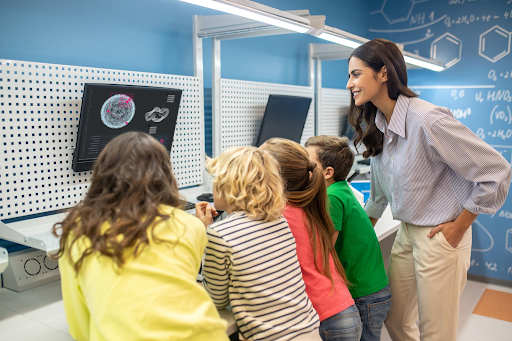
What happens when rigorous academic inquiry meets comprehensive emotional development? You get students who think critically while caring deeply—scholars who can solve complex problems and navigate human relationships with equal skill.
When Academic Rigour Meets Emotional Intelligence
Cambridge methodology emphasizes inquiry-based learning. Students don't memorize facts—they question, investigate, and construct understanding. "Why does this happen?" replaces "What is the answer?" This approach develops analytical thinking and intellectual curiosity.
SEE Learning complements this perfectly. While Cambridge develops cognitive abilities, SEE cultivates emotional and social competencies. Students become comfortable with uncertainty, viewing knowledge as evolving rather than fixed.
The combination creates remarkable synergy. A student researching climate change through Cambridge's investigative approach simultaneously develops systems thinking through SEE's global citizenship lens. They understand both the science and their ethical responsibility toward environmental stewardship.
This dual framework prepares students for universities and careers demanding both technical expertise and human skills—the collaboration, creativity, and emotional intelligence that artificial intelligence cannot replicate.
Check Out | How Multiple Intelligence Theory Empowers Your Child to Thrive
Cambrian Hall School, Dehradun: Where Three-Dimensional Learning Shapes Tomorrow's Leaders

Established in 1954, Cambrian Hall School operates as a premier day school in Dehradun, offering both CBSE and Cambridge curricula. The institution's green campus, deliberately located away from urban congestion, provides students with a healthy, focused learning environment equipped with modern infrastructure including AI and Robotics Labs, STEM facilities, and comprehensive science laboratories.
The school's 70-year legacy of academic excellence stems from its commitment to evolving with educational needs. Last year marked a significant milestone with the introduction of Cambridge methodology in the Primary Wing, complementing the school's existing partnership with Emory University and the Dalai Lama Foundation for SEE Learning implementation. This dual framework positions Cambrian Hall School uniquely among Indian institutions.
The alumni network speaks volumes—Army and Navy officers, CEOs, artists, and global changemakers—all products of an education emphasizing character alongside competence. The school's House system, comprising Judha, Mainwaring, Shashi, and Edwards houses, fosters leadership through healthy competition and collaborative spirit.
Beyond academics, comprehensive counseling support with a licensed school counselor ensures student well-being. Career guidance programs featuring assessments and workshops prepare students for future pathways. Clubs including Model United Nations, STEM initiatives, and social service programs provide platforms for applying SEE Learning principles in real-world contexts. Professional sports coaching and performing arts programs round out the holistic development approach.
Cambrian Hall School doesn't just prepare students for examinations—it prepares them for life. The three-dimensional SEE Learning framework integrated with Cambridge's inquiry-based approach creates emotionally intelligent, ethically grounded, and academically excellent individuals ready to navigate an increasingly complex world with confidence, compassion, and competence.
Discover how Cambrian Hall School, Dehradun nurtures compassionate, resilient learners ready for tomorrow's challenges. Visit the school to experience this transformational approach to education firsthand.
For more information on this and similar schools in the area, check out this list of the best schools in Dehradun.
 as a preferred source on