









As knowledge rapidly evolves and industries seek adaptable thinkers, traditional models of education are increasingly being challenged. The future of learning is no longer about rote memorization or exam scores alone- it's about mastering skills, understanding concepts deeply, and applying them in real-life contexts. This is where Competency-Based Education (CBE) stands out.
Delhi Public School (DPS), Sector 132, Noida, one of the best schools in Noida, has been at the forefront of educational innovation. With a commitment to academic excellence and student-centric learning, the school has embraced Competency-Based Education to ensure every child is prepared not just for exams, but for life.
In this article, we’ll explore what Competency-Based Education is, its key features, the advantages it offers students in the 21st century, and how DPS, Sector 132, Noida, is successfully integrating this approach into everyday learning.
Also Read | Beyond Traditional PTMs: A Look at DPS Gautam Buddh Nagar
What is Competency-Based Education (CBE)?
Competency-Based Education is a learner-centered, skill-driven approach that prioritizes actual learning over time spent in a classroom. It allows students to move forward only after demonstrating mastery, ensuring deep understanding and practical application of knowledge.
Here’s how CBE works through its core principles:
-
Learning Through Mastery: Students advance only when they’ve fully understood a concept or skill. Success isn’t about scores on a test, it’s about proving they can apply what they’ve learned.
-
Pace That Fits the Learner: Every child learns differently. CBE lets faster learners move ahead while providing extra support to those who need more time, ensuring no one is left behind.
-
Clear, Measurable Goals: Learning is broken down into specific, clearly defined competencies. Students know exactly what they’re expected to learn and how they will be assessed.
-
Real-World Application: Students don’t just memorize facts- they apply what they know in practical settings. Whether it’s solving real problems or creating meaningful projects, learning is connected to life.
Key Features of Competency-Based Learning
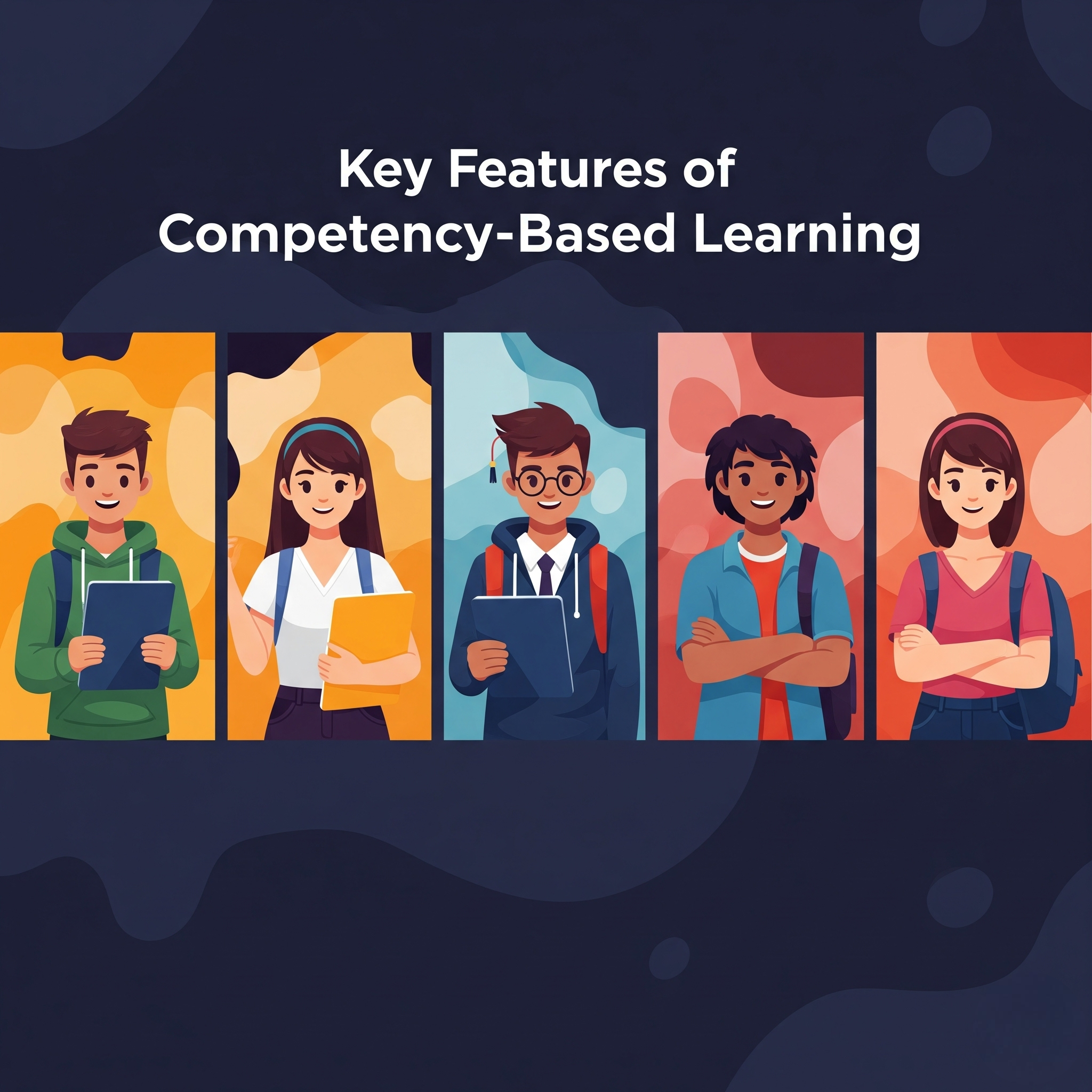
CBE transforms how students learn by centering the process around skill-building and continuous growth, rather than standardized grading and rigid timelines. Below are the core features that make CBE a modern and effective approach:
-
Personalized Learning Journeys: Each student’s learning path is uniquely tailored. Teachers design activities, resources, and assessments that align with individual student interests, skill levels, and learning styles. For instance, a student passionate about art may explore scientific concepts through creative design projects, making learning relevant and engaging.
-
Formative and Continuous Assessments: Instead of one final exam, students are regularly evaluated through projects, portfolios, peer reviews, and self-assessments. These ongoing evaluations offer real-time feedback and help students track their growth, revisit areas of weakness, and take ownership of their progress.
-
Integration of Life Skills: CBE includes essential life competencies like critical thinking, collaboration, emotional intelligence, communication, and ethical decision-making, within academic subjects. Students don’t just learn subjects; they learn how to function effectively in a diverse and ever-changing world.
-
Teacher as Facilitator, Not Just Instructor: In a CBE classroom, teachers act more like mentors and coaches. They support students in setting goals, reflecting on their learning, and developing problem-solving strategies, creating an environment where students are empowered to take charge of their learning journey.
-
Flexible Curriculum Design: The curriculum under CBE isn’t set in stone. It allows room for interdisciplinary connections (e.g., integrating science and environmental studies) and adapting content based on student needs, interests, or current global developments. This keeps learning current, meaningful, and responsive.
Benefits of Competency-Based Education (CBE)
CBE is rapidly gaining popularity because of its powerful impact on student outcomes and overall well-being. Here’s how this model benefits learners across academic, emotional, and practical dimensions:
-
Increased Student Engagement: Students are more engaged when they’re learning at a pace that suits them and when content is aligned with their personal goals and interests. CBE encourages curiosity, motivation, and a deeper connection with subjects, transforming passive learners into active explorers.
-
Stronger Conceptual Understanding: Rather than rushing through syllabi to meet deadlines, students have the time and support to dig deep into each concept. They revisit tough topics until they fully understand them, leading to a stronger foundation in every subject and fewer knowledge gaps in the long run.
-
Preparation for Careers of Tomorrow: With a focus on competencies like problem-solving, adaptability, digital literacy, collaboration, and resilience, students are prepared for dynamic career paths- including those that haven’t been invented yet. They learn how to think, innovate, and lead in complex real-world settings.
-
Reduced Stress and Academic Pressure: Since students aren’t forced to compete or conform to a fixed schedule, the pressure of exams and performance anxiety is greatly reduced. The emphasis on growth over grades leads to a healthier mindset, emotional well-being, and a love for lifelong learning.
-
Equitable Learning Outcomes: CBE ensures that every student has the opportunity to succeed, regardless of background, ability, or learning speed. Struggling students receive the time and support they need, while others are challenged with advanced tasks, promoting fairness and inclusivity across the board.
Check Out | Gurukul and Modern Education: Combining the Best of Both Worlds
Delhi Public School (DPS), Sector 132, Noida: Empowering Through Competency-Based Learning
One of the leading CBSE institutions in Noida, Delhi Public School (DPS), Sector 132, established in 2012, offers education from Pre-Nursery to Grade 12. The school has successfully integrated CBE principles into its learning environment to make education more meaningful and future-ready.
, Sector 132, Noida.png)
At DPS, Sector 132, students are encouraged to grow at their own pace, with clear outcomes and holistic development goals. Assessments go beyond report cards to include reflections, performance tasks, and collaborative projects, which are true indicators of understanding and skill.
The school boasts a 10-acre co-educational campus, purpose-built for modern education. With a student-teacher ratio of 20:1, learners get the attention they need to thrive in a CBE model. Smart classrooms, innovation labs, maker spaces, and collaborative learning zones allow experiential learning to flourish. At DPS, CBE is not a buzzword- it’s a lived reality. The school provides structured competency maps, learning profiles for students, and tools for self-paced learning. Students engage in Design Thinking workshops, STEAM-based projects, and peer learning sessions that help them become reflective, self-aware learners.
For more information on this and other such schools in the area, check out this list of the best schools in Noida.









 as a preferred source on