







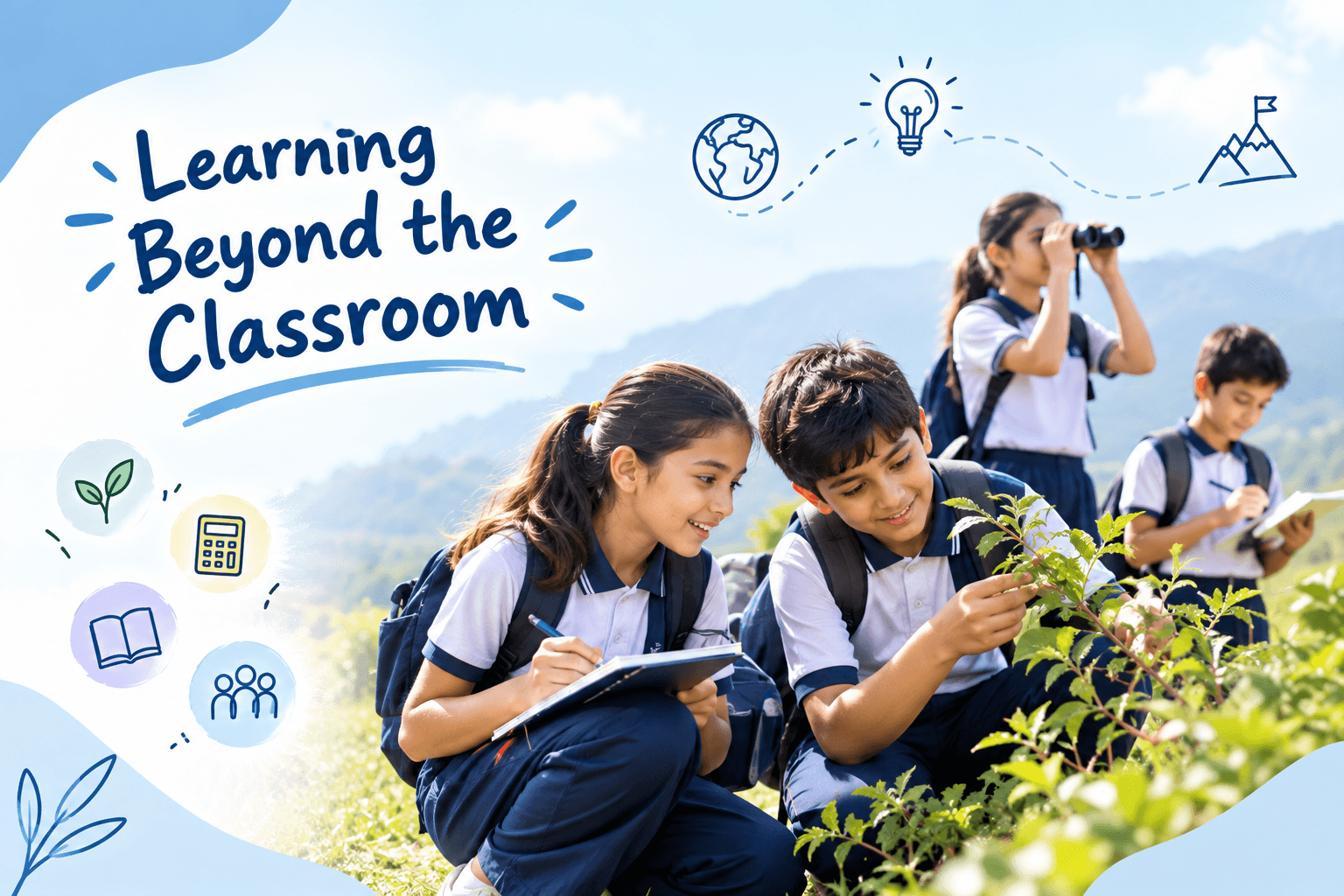

“Why do I need to learn this?” It is a question many children ask when a lesson feels disconnected from everyday life. A chapter in a textbook can explain a concept, but sometimes children understand it much better when they get a chance to see it, use it, or explore it themselves.
This is where learning outside the classroom can make a difference. For families exploring a Top Boarding school in India or a Best boarding school in India, the learning experience should not be limited to textbooks and worksheets. Experiences, projects, observations, and real-world activities can give children another way to understand what they are studying. Manchester Global School also describes its educational approach around meaningful, experiential and real-world learning.
Also Read| Learning Without Limits: Educational Excellence Beyond the Classroom
What Does Learning Outside the Classroom Really Mean?
Learning outside the classroom does not simply mean taking children on educational trips. It is a broader approach in which children connect what they learn in lessons with the world around them.
It could involve observing plants during a science lesson, collecting information for a social studies project, measuring objects while learning mathematics, interviewing people for a language activity, or studying a local issue as part of a classroom project.
The location is not the most important part. The purpose behind the activity matters more.
A good experience gives children something to observe, question, discuss, or solve. It allows them to become active participants rather than simply receiving information.
How Real-World Experiences Can Make Subjects Easier to Understand
Some school concepts can feel abstract when children only read about them. Practical experiences can give those ideas a familiar context.
Science becomes something children can observe
Instead of only reading about plants, children can observe how they grow and change. They can record what they notice, ask questions, and discuss possible reasons for those changes.
This type of activity encourages children to look closely and think about what they are seeing.
Mathematics becomes part of everyday life.
Mathematics is not limited to numbers written on a page. Children use measurement, time, distance, money, shapes and data in everyday situations.
For example, planning a simple activity can involve calculating quantities, estimating time or comparing measurements. These experiences can help children see why mathematical concepts matter beyond an examination.
Social studies becomes more relatabl.e
History, geography and civics can sometimes feel distant when taught only through written information.
Learning about a community, observing how people use public spaces, or exploring the history of a local area can help children connect larger ideas with things they can understand and observe.
Language learning gets a real purpose.
Children develop communication skills when they have something meaningful to say.
Writing about an experience, presenting the findings of a project, interviewing someone or discussing an observation can give children a practical reason to read, write, listen and speak.
What Skills Can Children Develop Through Experiential Learning?
The value of learning outside the classroom is not limited to remembering subject content.
When children investigate something themselves, they may also practise:
- Observation: noticing details and identifying patterns.
- Questioning: asking why something happens and looking for explanations.
- Problem-solving: thinking about possible solutions instead of waiting for an answer.
- Communication: explaining ideas to teachers and classmates.
- Teamwork: completing activities with other students.
- Independence: taking responsibility for part of a task.
- Reflection: thinking about what they learned and what they could do differently.
- info sept.png)
These skills can develop gradually. One activity will not automatically create them, but regular opportunities to explore and apply knowledge can give children more chances to practise.
A School Trip Is Not Automatically Meaningful Learning
It is easy to assume that any activity outside the classroom is educational. But simply changing the location of a lesson does not guarantee meaningful learning.
A useful experience should have a clear connection to what children are learning.
For example, if students visit a historical place, they could be given questions to investigate rather than simply being asked to look around. After returning to school, they could discuss their observations, research further or create a project based on what they discovered.
The same idea applies to nature walks, community visits, practical activities and fieldwork.
Before and after the experience, children should have opportunities to prepare, explore and reflect.
What Should Parents Look For in Experiential Learning?
Parents can understand a school's approach by asking simple questions:
- Do students get opportunities to apply classroom concepts?
- Are children encouraged to ask questions and explore ideas?
- Do projects involve actual problem-solving?
- Are students given opportunities to work independently?
- Do teachers connect activities back to academic concepts?
- Are children encouraged to discuss what they learned afterwards?
- Is learning designed around understanding rather than simply completing an activity?
The answers can tell parents more than the number of activities a school organises.
The aim is not to keep children outside the classroom all the time. Classroom teaching remains important. Experiential activities work best when they complement lessons and help children understand how knowledge can be used.
Also Read| Beyond the Classroom: Building Real-World Skills
How Manchester Global School Connects With Experiential Learning
For families exploring a Top Boarding school in India, Manchester Global School presents an educational approach that places importance on experiential learning, inquiry, project-based learning, and real-world application. Its stated approach focuses on encouraging students to ask questions, explore concepts, work collaboratively, and connect learning with practical situations.

For parents also considering a Best boarding school in India, this offers a useful example of how a school's educational philosophy can look beyond memorising information and place greater emphasis on understanding, exploration and application. The important consideration is how consistently these principles are reflected in children's everyday learning experiences.
Learning Becomes More Meaningful When Children Can Use It
Children do not always need more information to understand a subject. Sometimes they need an opportunity to experience an idea from a different angle.
A science concept may become clearer through observation. Mathematics may make more sense when used in a real situation. A history lesson may become more memorable when connected to a place or story. A writing activity may become easier when children have something interesting to write about.
Learning outside the classroom works best when it has a clear purpose and connects naturally with what children are studying.
Ultimately, meaningful education is not only about helping children remember what they have learned. It is also about helping them understand where that knowledge fits into the world around them.
For more information on this and similar schools, check out this list of the best boarding schools in India.


 as a preferred source on