






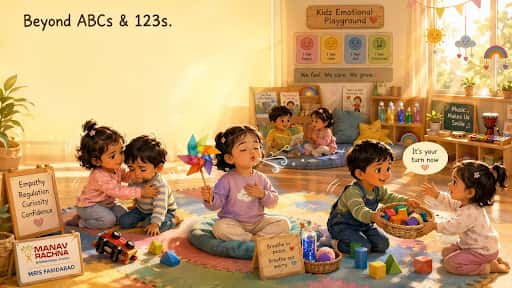

Do you remember the first time your little one threw a toy not in anger, but in sheer frustration at not being able to make it work? In that tiny, quivering lip lies the birth of a massive human struggle: the battle between wanting to master the world and learning to manage the feelings when we cannot.
For decades, we have measured "good" preschools by the thickness of the alphabet charts on their walls. Yet, any parent who has watched a child’s face light up, not at a correct answer, but at the joy of figuring something out, knows the truth. Education is not a race to recite. It is the art of raising the human heart.
In this article, we move beyond the jargon of rote learning to explore the science of emotional safety, the architecture of curiosity, and how the toddler curriculum at one of the best schools in Faridabad, Manav Rachna International School, is quietly shifting the focus from "what children know" to "who they are becoming."
Also Read: How Media Education Helps Students Become Confident Communicators at MRIS, Sector 21C, Faridabad
The Silent Curriculum: Why Self-Regulation Comes Before Phonics
Before a child can write the letter 'A', they must first learn to sit with the shame of not knowing how to draw the line. The modern toddler is over-stimulated yet emotionally under-equipped. We hand them iPads to calm meltdowns, yet we expect silent compliance on a classroom mat. This disconnect is where traditional academics fail silently.
According to the Head Start Early Learning Framework, emotional self-regulation is not a "soft skill." It is the literal foundation of school readiness. A child who cannot manage frustration cannot absorb phonics. It is that simple.
But what does calm actually look like in a toddler classroom? It looks nothing like silence. Let us walk into that room now.
Curiosity as a Muscle: Moving Beyond the "Right Answer”
There is a world of difference between a child who recites a fact and a child who whispers, "Why?" We have all seen the streetlight effect in early education: we test for letters because they are easy to measure, not because they are most important. The Social Science Research Council now advocates for prioritising FOLD skills - curiosity, creativity, and perspective-taking during the preschool years.
The Value of a Happy Accident
When a toddler mixes blue and yellow paint and lands on green, the "mistake" holds more value than any correct answer.
- Process over product: The neural magic happens in the trial, not the triumph. A child who tries a different block after the first falls is building cognitive self-regulation.
- Persistence without pressure: This is the ability to filter out distractionS and stay with difficulty. Studies show this predicts later math comprehension better than early counting does.
But curiosity cannot survive in a lonely heart. A child may be endlessly curious about a spinning top, but what happens when another child wants the same top? That is where emotional vocabulary enters.
The Power of "We": Building Emotional Vocabulary in Community
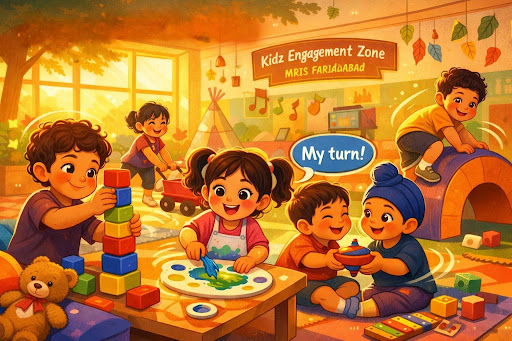
We forget that for a two-year-old, the hardest intellectual problem is not the alphabet. It is the other child sitting three inches away. How do I ask for a turn? What do I do when they say no? How do I survive the rage of losing a shiny object? These are the high-stakes moments of early childhood. And they are rarely taught.
Responsive Caregiving in Action
Research on responsive caregiving shows that when adults verbalise feelings: "I see you are frustrated because the tower fell"- toddlers build the exact vocabulary they need to manage strong emotions.
- From bite to breath
Instead of punishing a push, skilled educators model replacement language. "Say 'stop' instead of hitting."
- The milestone no one celebrates
When a toddler learns to say "my turn" instead of screaming, that is a greater academic achievement than any test score.
And yet, none of this emotional work happens in a vacuum. It happens inside a body that is still learning how to be still and when to move.
The Physical Foundation: Why Movement Is Not a Break from Learning
We have made a grave error in modern schooling. We treat the body as a mere taxi for the brain. In truth, the body is the brain's first teacher. Movement activities: climbing, balancing, running, stimulate the vestibular system. That system is directly linked to attention span and visual tracking, both required for reading.
Why Wiggling Is Not Misbehaving
A toddler who cannot sit still is not defiant. They are often dysregulated.
- Proprioceptive input
Heavy work like carrying blocks or pulling a wagon actually calms the nervous system.
- Logorhythmics
Moving to a beat teaches impulse control. Wait for the rhythm. Stop when the music stops. This is self-regulation worn on the sleeve.
So where does a school begin if it wants to honour all of this: The emotion, the curiosity, the body, the community? Let us now look at one place that has quietly built its toddler years around exactly these truths.
Check Out: How Toddlers Learn Through Play | Toddlers Curriculum at MRIS Sector 21C Faridabad
How Manav Rachna International School Builds from the Inside Out
This is not about flashy infrastructure. It is about philosophy made visible. At Manav Rachna International School, the toddler years are not treated as "pre-academic boot camp." They are treated as the emotional and cognitive bedrock of a lifetime. The curriculum moves beyond the CREST approach: Interdisciplinary, hands-on exploration, and into something older and wiser: respect for the whole child.
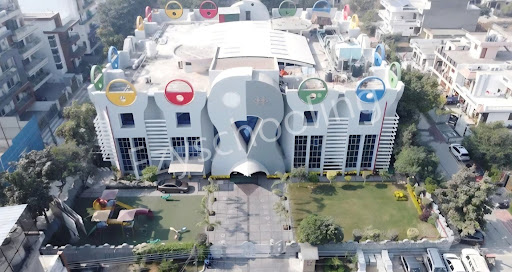
The School is specifically built for the youngest learners, and the Kidz Engagement Zone acts as a gentle bridge between the warmth of home and the structure of school. Here, toddlers learn the delicate art of initiative, stepping away from the teacher's hand to touch a leaf or greet a friend with the quiet security of knowing they can return. Life skills like sharing, waiting, speaking, and stopping are taught explicitly here, never assumed.
Conclusion
The schools that produce tomorrow's thinkers and empathetic leaders are not the ones with the longest list of academics taught earliest. They are the ones who understood long before it became fashionable that the child who learns to feel deeply, wonder freely, and persist bravely will ultimately learn everything else with far greater ease. The ABCs and 123s will come. They always do. But what arrives first and stays longest is the emotional bedrock laid in those tender, irreplaceable early years.
Begin your search for the right early years school on Ezyschooling - India's most trusted school discovery platform.
For more information on this and other similar schools in the area, check out this list of the best schools in Faridabad.
 as a preferred source on