







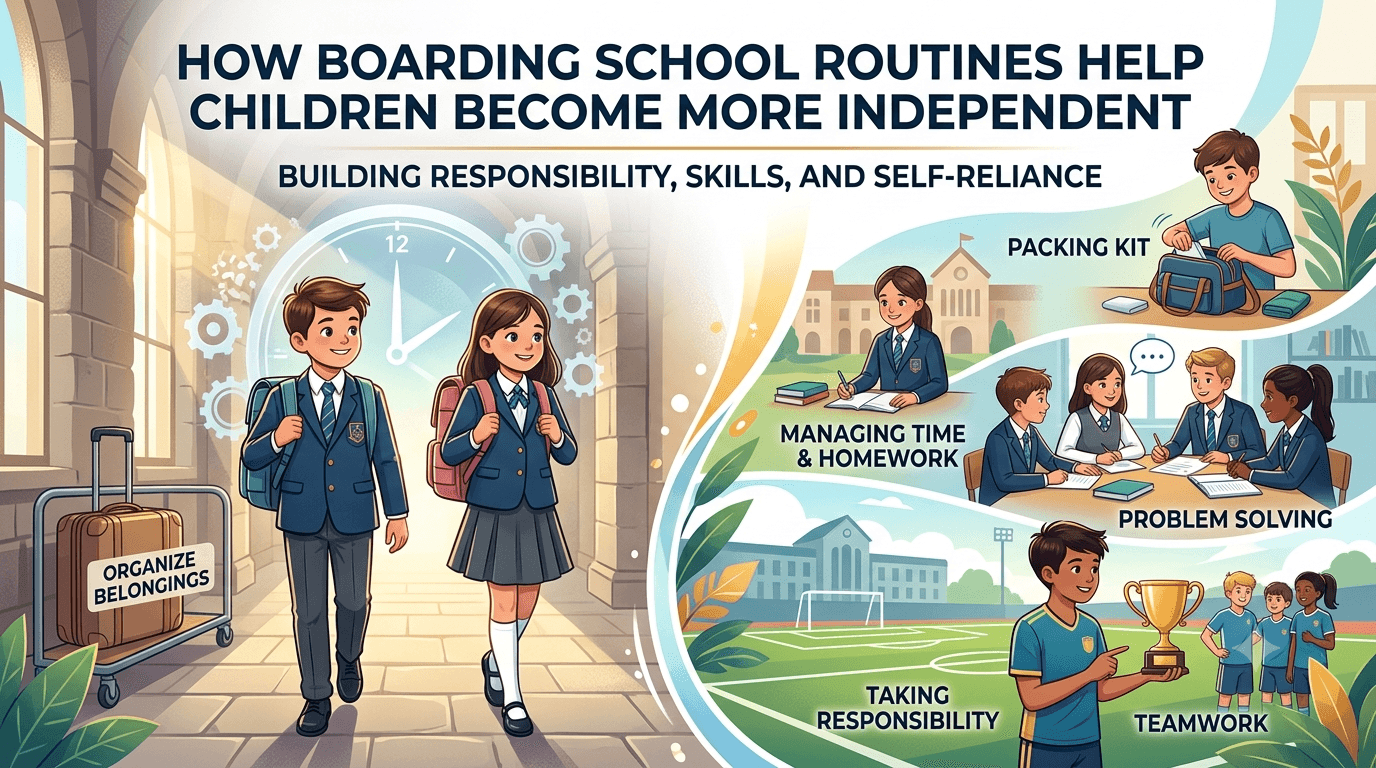

“Have you packed your bag? Where is your homework? Did you remember to keep your sports kit ready?” For many parents, these reminders become part of everyday life. Children naturally depend on adults for guidance, but as they grow, learning to manage these small responsibilities becomes an important part of growing up. For families exploring a Top boarding school in India, the question is often not only about academics but also about how school life can help children become more responsible and self-reliant. Sehwag International School (SIS), Jhajjar, for example, is one of the schools parents may consider while exploring residential education options.
Also Read| Why Individual Mentoring Matters at Sehwag International School?
What Does Independence Mean for a School-Age Child?
Independence does not mean expecting a child to solve every problem alone. For a school-going child, it usually develops through small, age-appropriate responsibilities.
A child may begin by:
- Keeping personal belongings organised.
- Following a daily routine without constant reminders.
- Preparing for classes and activities.
- Making simple decisions independently.
- Taking responsibility when something goes wrong.
- Knowing when and how to ask an adult for help.
These skills may appear simple, but they take regular practice. A structured school environment can give children repeated opportunities to practise them.
How Daily Boarding Routines Encourage Self-Reliance
One of the useful aspects of residential schooling is that children experience many parts of their daily routine away from their parents. Instead of having a parent remind them about every small task, they gradually learn to anticipate what needs to be done.
1. Managing Time
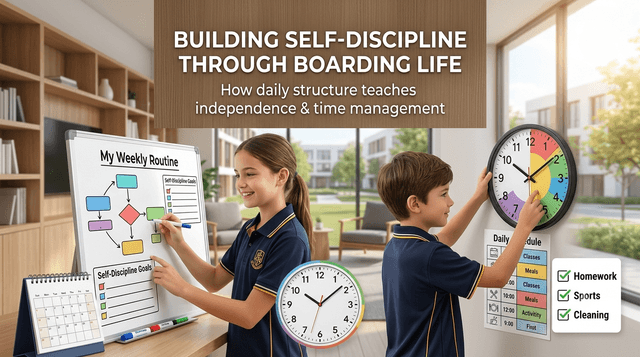
Boarding life usually involves moving between different parts of the day, such as classes, meals, study periods, activities, and rest. Learning to be ready for each part of the routine can help children understand the value of time.
Over time, a child may become better at planning what needs to be done first and remembering important responsibilities without waiting for a parent to give instructions.
2. Looking After Personal Belongings
At home, it is easy for parents to find a misplaced notebook, uniform or pair of shoes. In a residential setting, children have more reason to keep track of their own belongings.
Simple habits such as organising clothes, school materials and activity equipment can gradually build a sense of responsibility.
3. Taking Responsibility for Everyday Tasks
Independence grows when children understand that their actions have consequences. Forgetting something, missing a deadline or failing to prepare for an activity can become a learning opportunity when handled appropriately.
The aim is not to punish children for mistakes but to help them understand what they can do differently next time.
4. Learning to Live With Others
Residential education also involves sharing spaces and routines with other students. Children learn to communicate, cooperate, respect boundaries, and adjust to different personalities.
These experiences can support social independence too. A child learns that not every disagreement requires a parent to step in and solve it.
Independence Works Best With the Right Support
There is an important difference between independence and being left alone.
Children need boundaries, supervision, and trusted adults who can guide them when they face difficulties. This is especially important when a child is adjusting to life away from home.
Parents considering a boarding school can therefore look beyond the question, “Will my child become independent?” They can ask:
- Are children given age-appropriate responsibilities?
- Is there a clear daily structure?
- Can students approach adults when they need help?
- How does the school support children emotionally?
- Are mistakes treated as opportunities to learn?
- Does the residential environment provide appropriate supervision?
A healthy residential environment should give children room to manage responsibilities while ensuring that guidance is available when necessary.
Also Read| The Role of Structured Boarding Life in Student Development
How Parents Can Prepare Children for Boarding Life
Parents do not have to wait until admission day to start building independence. Everyday life at home can provide plenty of practice.
Try giving children responsibilities such as:
- Packing their school bag for the next day.
- Keeping their study area organised.
- Preparing clothes or sports equipment in advance.
- Managing a simple homework schedule.
- Making age-appropriate choices about their free time.
- Solving minor problems before asking an adult to intervene.
It is also useful to resist the urge to immediately fix every small problem. When children are allowed to think through manageable challenges, they begin to develop confidence in their own ability to find solutions.
How Sehwag International School Fits Into the Boarding School Conversation
Comparing options described as the Best boarding school in India, it is useful to look at how a school approaches children's overall development rather than focusing only on academics. Sehwag International School (SIS), Jhajjar can be considered as part of this wider conversation around residential education, where children have opportunities to learn, interact with peers, follow routines and gradually take greater responsibility for everyday tasks.

Ultimately, parents should consider a school's overall learning environment, student support, residential arrangements and approach to age-appropriate responsibility when deciding whether it is suitable for their child.
The Goal Is Gradual Growth, Not Instant Independence
Boarding school cannot make every child independent overnight. Children develop at different speeds, and some may need more reassurance during the transition than others.
What a well-structured residential environment can provide is practice. Children get regular chances to organise themselves, manage responsibilities, interact with others and make age-appropriate decisions. With consistent guidance, these small experiences can gradually become everyday habits.
For parents, the most useful question may therefore be less about whether boarding school will make a child independent and more about how the school creates safe opportunities for independence. Looking at routines, supervision, student responsibilities, and emotional support can help families understand whether a residential environment is suited to their child's needs.
For more information on this and similar schools, check out this list of the best boarding schools in India.



 as a preferred source on