







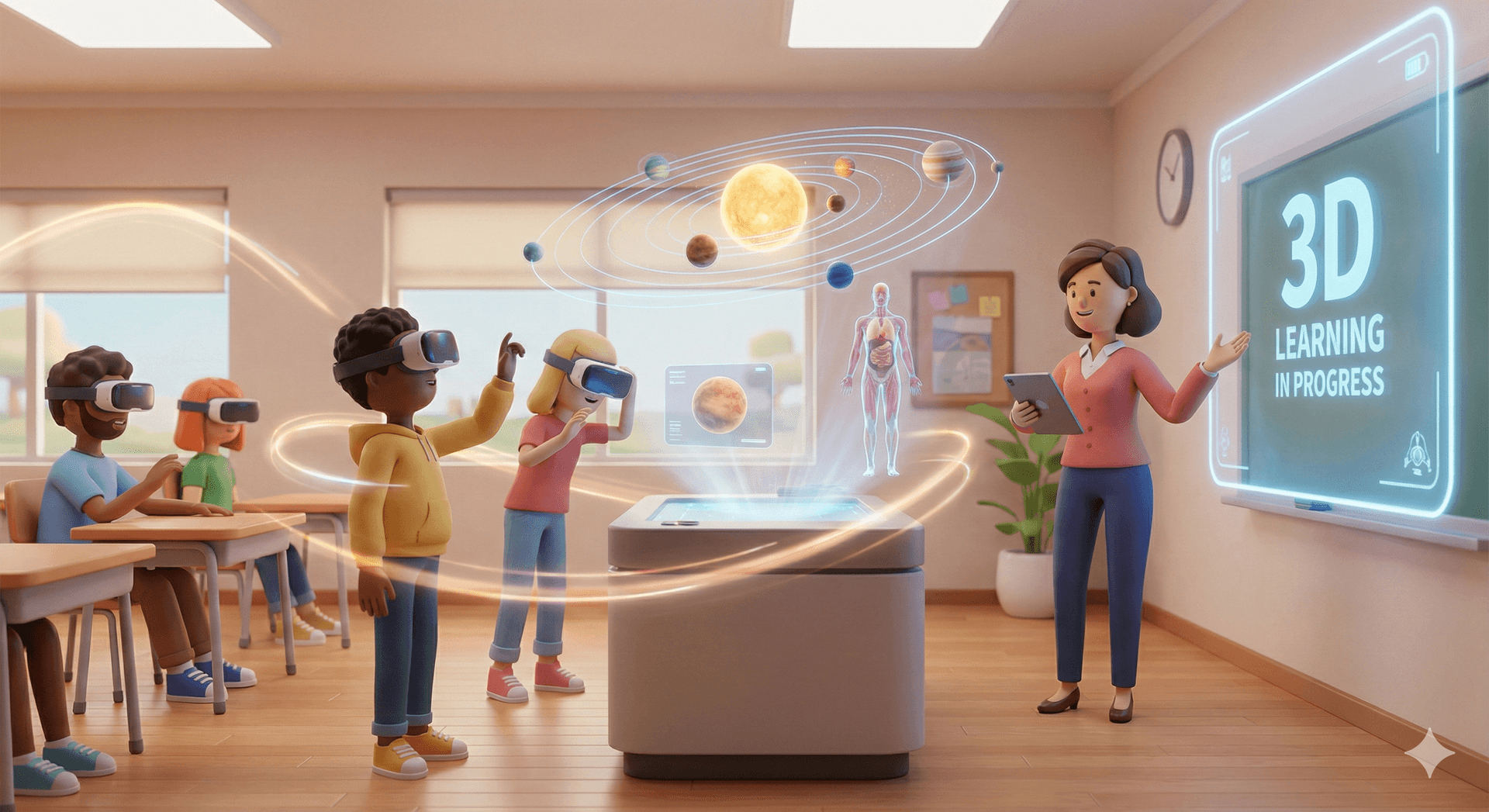

For many years, Indian schools used blackboards, textbooks, and 2D charts to teach. These tools worked for some students, but they made it hard to explain ideas that need imagination. For example, it is tough to understand what an atom looks like or how the Taj Mahal is built by only looking at a flat picture. That is when 3D learning helps.
3D learning uses three-dimensional models, Virtual Reality (VR), Augmented Reality (AR), and 3D printing to teach lessons. It helps students see and understand difficult ideas in a clear and realistic way in some of the best schools in Bangalore.
Also Read: Learn Farming & Life Skills
What is 3D Teaching and Learning?
3D teaching uses three-dimensional objects, digital models, and printing tools to teach different subjects. Instead of only reading about a plant cell or a historical building, students can look at a 3D model or hold it in their hands. This method helps them understand hard ideas more quickly by making lessons clear and easy to see.
Why is 3D Learning Important in India?
India is moving toward 3D learning because the human brain understands pictures much faster than words, about 60,000 times faster. When students can see and touch what they learn, they understand lessons better.
Better Memory: Research shows students remember only about 10–20% of what they read or hear. But when they use 3D tools and take part in lessons, they can remember almost 75–90%.
More Interest: In a 3D classroom, students do not just sit and listen. They take part and explore. For example, a geography student can take a virtual trip to the Himalayas to see soil erosion instead of only reading about it.
Easier Learning: Tough subjects like calculus, physics, and organic chemistry become simple when students can play with 3D models of graphs, forces, and molecules.
Develops Problem-Solving Skills: With 3D printing and design, students make their own models. They plan, test, and fix their mistakes. This helps them think critically and become more creative.
Helps Students with Different Learning Needs: 3D models that students can touch help those who are visually impaired or have trouble reading or understanding abstract ideas. These models give them a hands-on learning experience.
Supports STEM Education: 3D printers make Science, Technology, Engineering, and Math (STEM) easier to learn. Students can build robots or design mechanical parts, using what they learn in class to solve real-world problems.
Also Read: Building Confidence Through Theatre
How 3D Learning Works in Indian Schools?
Multiple best schools in Koramangala, Bangalore use different types of 3D tools to make learning fun and easy to understand.
- 3D Printing: Schools use 3D printers to make real models like shapes, molecules, maps, or old objects. These help students learn subjects such as math, science, geography, and history.
- 3D Animations and Videos: Schools show animation videos to explain how things work, like how blood moves or how an engine runs.
- Holographic Displays and Virtual Reality (VR): Some schools use VR and holograms so students can explore virtual worlds, such as the human body or ancient cities.
- Augmented Reality (AR) Apps: Students can use phones or tablets to scan their textbooks and see 3D pictures appear on the screen. This makes learning more exciting and real.
Challenges in Adopting 3D Learning in India
Indian schools face some problems while using 3D learning, even though it has many benefits.
- 3D printers and equipment cost a lot.
- Teachers need special training to use 3D tools.
- Rural schools have less access than urban ones.
- Schools take time to add new technologies to their syllabus.
Still, government programs like Digital India and Make in India are helping schools use 3D and other digital learning tools faster.
The Growing Market for 3D Education Tools in India
India’s 3D printing market was worth around USD 707 million in 2024. Experts expect it to grow quickly and reach over USD 4.3 billion by 2033. This growth comes from more use of 3D technology in schools, hospitals, car companies, and factories. As 3D tools become cheaper, more schools will start using them in classrooms.
3D Learning at Podar Global School: A Model of Innovation
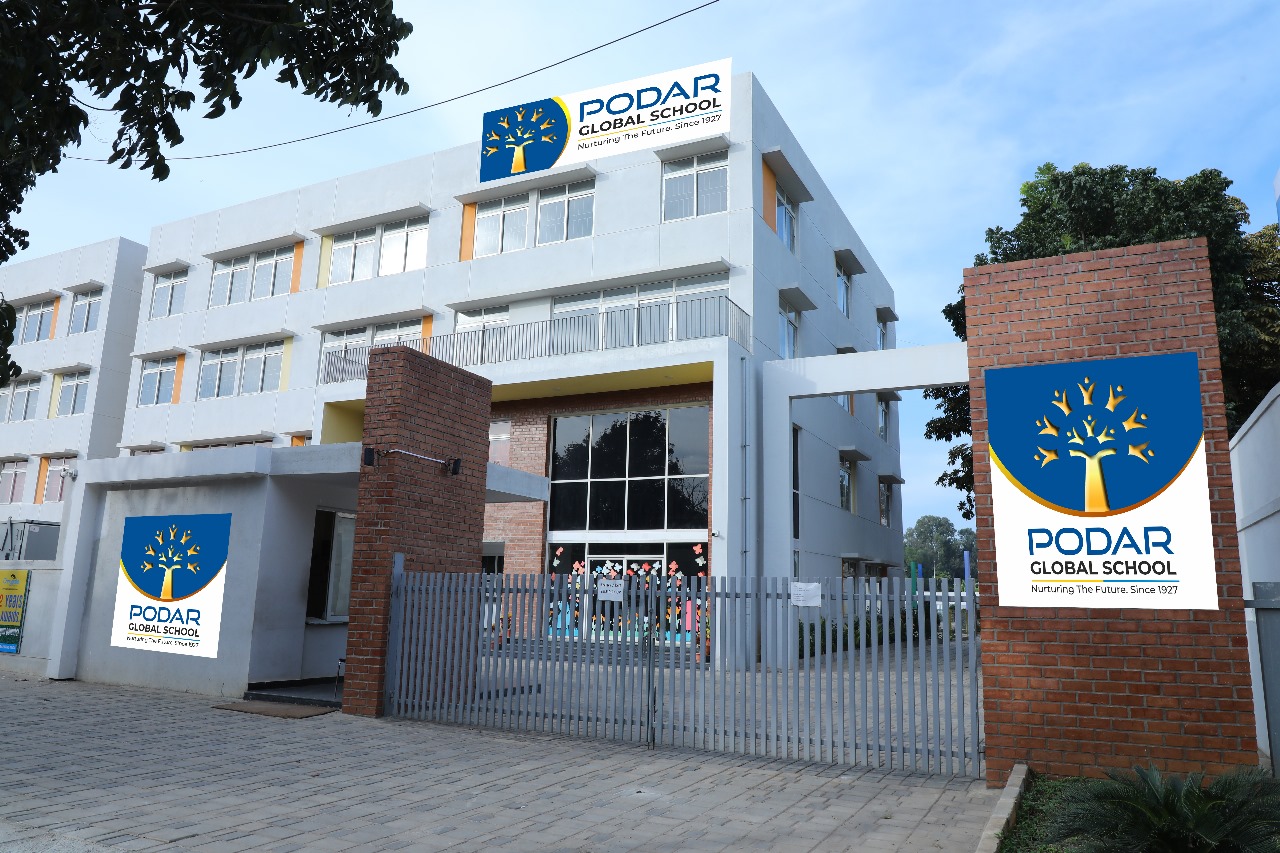
Podar Global School in Yelahanka, Bangalore, is one of India’s top schools in 3D teaching and learning. The school uses 3D printing, coding, and digital tools in its lessons to help students get ready for future challenges.
The Innovation Lab
PGS Yelahanka uses modern technology to help students learn better. At the center of this effort is its Innovation Lab. This lab is more than just a computer room. It is a maker space where students use “Design Thinking” to create and solve problems.
One of the most exciting parts of this lab is the 3D printing area. In most schools, students draw their product ideas on paper. But at PGS Yelahanka, students design their models on a computer and then print them using 3D printers. This activity helps them learn the basics of engineering, geometry, and product design in a fun, hands-on way.
Interactive 3D Modules and Digital Classrooms
PGS Yelahanka also uses special “3D Teaching Technology” in its classrooms. Instead of ordinary smart boards, teachers use high-quality 3D lessons to explain difficult topics in science and math.
The school uses 3D learning, which helps students see things in 3D. This makes it easier to understand subjects like biology, where they study the human body, and physics, where they study forces and motion.
In the Innovation Lab, students can also do virtual experiments. They can safely repeat experiments that might be too risky or expensive to do in real life. This kind of practice helps them truly understand each concept.
Conclusion
Using 3D teaching and learning in Indian schools is not just a new idea, it is an important step forward. It helps students move from being passive learners to active creators and thinkers. Schools like Podar Global School, Yelahanka, show how powerful this change can be.
When children get tools like 3D printers and immersive labs, they start to explore and innovate without limits. As this technology reaches more schools, India will see a generation of students who don’t just remember facts but build the future with their own hands.
To learn more about this and other schools nearby, see this list of the top schools in Bangalore.







 as a preferred source on