







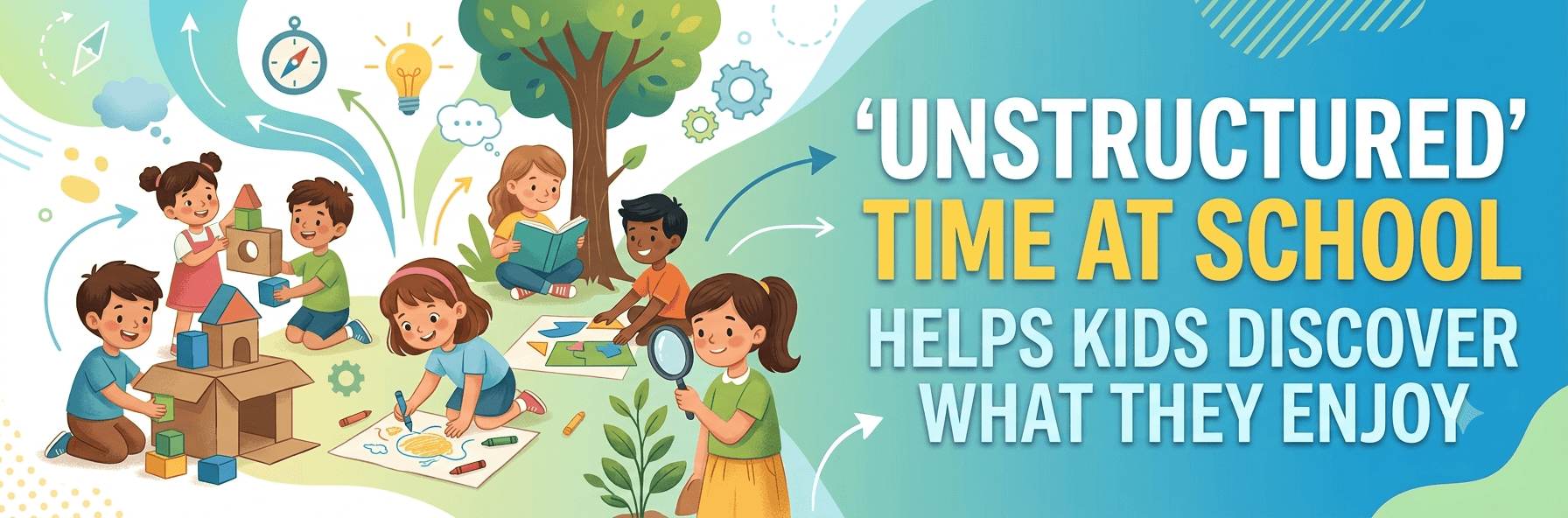

School days can become surprisingly busy. Classes, homework, sports, tuition, competitions, and planned activities can leave children with very little time to simply choose what they want to explore.
But does every minute of a child's day need to have a clearly defined purpose?
Not necessarily.
Children also need some space to make choices, follow an interest, talk to others, experiment with an idea, or simply figure out what they want to do next. Delhi Public School Gurugram follows a Whole Child approach that looks beyond academics to include cognitive, physical,l and emotional development. This broader view of school life raises an important question for parents: how much room do children have to discover themselves within their everyday learning experience?
Also Read| Why Global Exposure Belongs in the School Years
What Does “Unstructured Time” Actually Mean?
Unstructured time does not mean leaving children without supervision or allowing the school day to become chaotic.
It means giving children some freedom within appropriate boundaries.
For example, children might have an opportunity to choose how they spend part of a break, which materials they want to use for an activity, what topic they want to explore further, or how they want to approach a task.
There is still a framework. Adults remain available to guide and support them.
The difference is that the child has some control over what happens next.
This balance matters because children need both structure and independence. A completely unplanned day can be difficult, but a day where every decision is made for them leaves little room for initiative.
Why Choice Can Help Children Discover What They Enjoy
Children cannot always tell parents what they are interested in because they may not have discovered those interests yet.
A child may think they dislike science until they get an opportunity to build something. Another may discover an interest in storytelling after being given the freedom to create a short play. Someone who rarely talks about art may spend a long time drawing when nobody has told them what the picture should look like.
These moments matter because interests are often discovered through trying things, not simply being asked, “What do you like?”
Children Learn More About Themselves
When children have some freedom to choose, they begin noticing their own preferences.
They may discover:
- What activities hold their attention
- What they enjoy practising
- What kinds of problems they like solving
- What challenges they are willing to spend time on
- What they would like to learn more about
This kind of self-awareness can take time. It cannot always be created through a fixed list of extracurricular classes.
What Do Children Practise When Adults Step Back?
Giving children some choice is not the same as stepping away from their development. In fact, it can create opportunities to practise important skills.
Decision-Making
Even small choices require children to think.
If several activities are available, a child has to decide what interests them. If they are working on an open-ended task, they may need to choose materials, divide their time, or decide how to begin.
These are small decisions, but children gradually become more comfortable making them.
Independence
A child who is always told what to do may become dependent on instructions.
Open-ended time gives children opportunities to initiate something themselves.
They may start a drawing, invent a game, pick up a book, build something, or begin a conversation without waiting for an adult to direct every step.
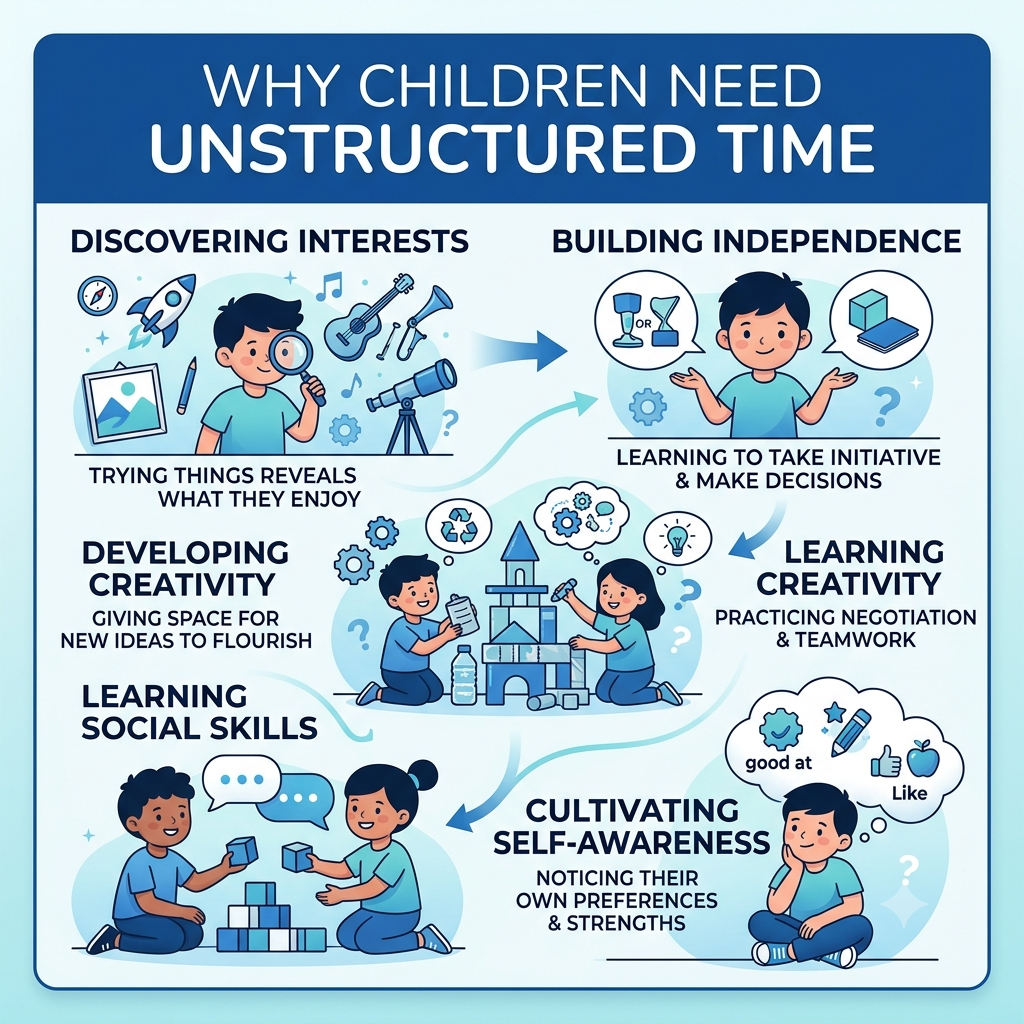
Creativity
Creativity often needs space.
If children are always given the same activity, same materials, and same expected result, there may be little reason to develop their own ideas.
Open-ended situations allow children to ask:
“What else could I do with this?”
Social Skills
Unstructured moments can also involve other children.
They may have to decide what game to play, share resources, negotiate different ideas,s or work out disagreements.
These everyday interactions can teach lessons about cooperation that cannot always be reproduced through a worksheet.
Why Boredom Is Not Always the Enemy
A child says, “I'm bored.”
Many parents immediately look for something to occupy them.
Sometimes that is necessary. But short periods of manageable boredom are not necessarily a problem.
When there is no ready-made activity waiting, children may eventually begin creating their own.
They might build something, draw, read, invent a game, or simply start exploring an idea.
The point is not that children should be left without support. It is that adults do not always need to fill every empty moment.
A little space can encourage children to become more comfortable with their own ideas.
How Parents Can Create More Choice at Home
Parents do not need to completely change their family's routine to encourage this.
Leave Some Time Unplanned
Not every part of the evening or weekend needs to have an activity attached to it.
Allow children some time to decide what they want to do.
Offer Choices, Not Instructions
Instead of saying, “Go and do this,” try offering two or three reasonable options.
This gives children some ownership while keeping boundaries clear.
Let Them Start Their Own Projects
If a child suddenly wants to build a model, create a story,y or organise a small game, give them room to explore the idea.
It does not have to become a competition or a formal project.
Do Not Turn Every Interest Into a Class
If a child enjoys drawing for a few weeks, parents do not necessarily need to immediately enrol them in an art course.
Sometimes it is useful simply to observe whether the interest continues.
Watch What They Choose
Unstructured moments can tell parents something valuable.
Notice what children repeatedly return to when nobody has told them what to do. Those patterns may offer clues about emerging interests.
What Should Parents Look for in a School?
When comparing schools, parents often look at academic results, curriculum, facilities, and the number of activities offered.
These are important, but another question is worth asking:
Does the school give children opportunities to explore different interests and take some ownership of their learning experience?
Parents can look for environments where students have opportunities to:
- Explore different areas of learning
- Make age-appropriate choices
- Participate in creative and physical activities
- Work collaboratively
- Ask questions and investigate ideas
- Develop interests beyond textbook learning
- Grow in confidence at their own pace
A school offering many activities is not automatically giving children meaningful choice. The more important factor is whether children have opportunities to engage with different experiences in ways that allow them to discover what genuinely interests them.
Also Read| The 3 Silent Killers of a Child’s Creativity
How Delhi Public School Gurugram Supports Whole-Child Development
Delhi Public School Gurugram describes its approach through three learning pillars—cognitive, kinesthetic and affective—covering areas such as critical thinking, communication, STEM and robotics, mindfulness and yoga, performing and fine arts, physical education, social-emotional learning, counselling and global cultural exchanges.

For parents considering a Top school in Gurugram, this broader range of learning experiences can be useful to examine alongside academics. Families looking for the Best school in Gurugram can also consider whether a school's environment gives children opportunities to explore different areas and gradually understand where their interests and strengths lie.
Children Need Space to Discover
Children need structure. They need guidance, boundaries, and teachers who help them learn.
But they also need some room within that structure to make choices.
A child may discover a new interest while drawing during a free moment, building something with classmates, reading a book they chose themselves, or simply wondering how something works.
These moments may not always produce a grade or a measurable outcome.
But they can help children discover something equally valuable: what makes them curious.
Sometimes, children discover what they enjoy only when adults give them enough space to look for it.
For more information on similar schools, check out this list of the best schools in Gurugram.

 as a preferred source on