








Children today come across information everywhere, from YouTube videos and social media posts to WhatsApp messages shared by family members. Some of it is useful, some is misleading, and some is created simply to attract attention. The challenge is helping children understand the difference.
For parents, the goal is not to make children suspicious of everything they see online. It is to help them develop the habit of asking questions before accepting information as true. This ability is an important part of digital literacy and critical thinking, especially as children become more independent online. At K.R. Mangalam World School, the emphasis on inquiry-based learning provides a relevant connection to the importance of questioning, investigating, and understanding information.
Also Read| Merging Technology with Learning for Maximum Benefits
Why Do Children Sometimes Believe What They See Online?
Children may assume that information is trustworthy because it looks professional, has thousands of views, or has been shared by someone they know. However, popularity does not prove that something is true.
Online content is often designed to attract attention. Dramatic headlines, emotional stories, edited videos, and convincing images can encourage people to react before thinking carefully. With artificial intelligence (AI) tools making it easier to create realistic-looking images and videos, checking information has become even more important.
For example, a child might see a video claiming that schools across a city will remain closed the next day. Instead of immediately believing it or forwarding it to classmates, the child needs to know how to check the date, identify the original source, and look for an official announcement.
These small decisions can help children become more thoughtful and responsible internet users.
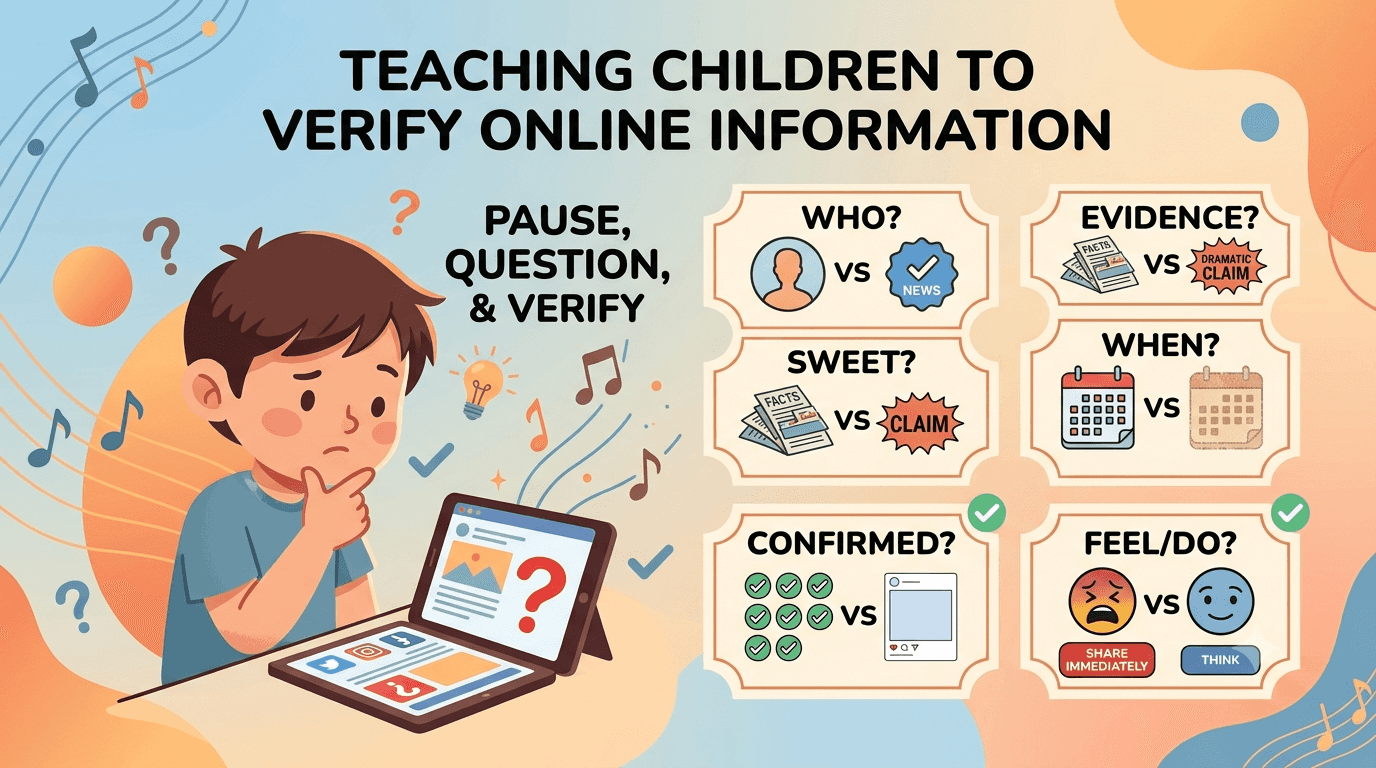
Teach Children to Ask Five Questions Before Believing a Post
Instead of giving children a long list of internet rules, parents can teach them five simple questions to use whenever they encounter surprising or questionable information.
1. Who created this information?
Ask children to identify the source. Is the post from an official organisation, a recognised news outlet, a named expert, or an unknown account? A familiar name or professional-looking logo is not enough to establish credibility.
2. What evidence supports the claim?
Encourage children to look for facts, examples, original documents, or reliable sources. A post that makes a dramatic claim without offering evidence deserves closer attention.
3. When was it published?
Old photographs, videos, and news reports can be shared again as if they describe a current event. Checking the date and context can prevent misunderstandings.
4. Can another reliable source confirm it?
Teach children to search for the same claim in other trustworthy sources. For important announcements, such as school closures, they should check official school communication channels rather than relying on forwarded messages.
5. What is this post trying to make me feel or do?
Some posts use fear, anger, excitement, or urgency to encourage people to react quickly. If a message says, "Share this with everyone immediately," children should learn to pause instead of forwarding it automatically.
These questions help children develop a habit of checking information rather than judging it by appearance or popularity.
Turn Fact-Checking into an Everyday Habit
Children do not need advanced technical knowledge to begin checking information. Parents can introduce simple activities during everyday conversations.
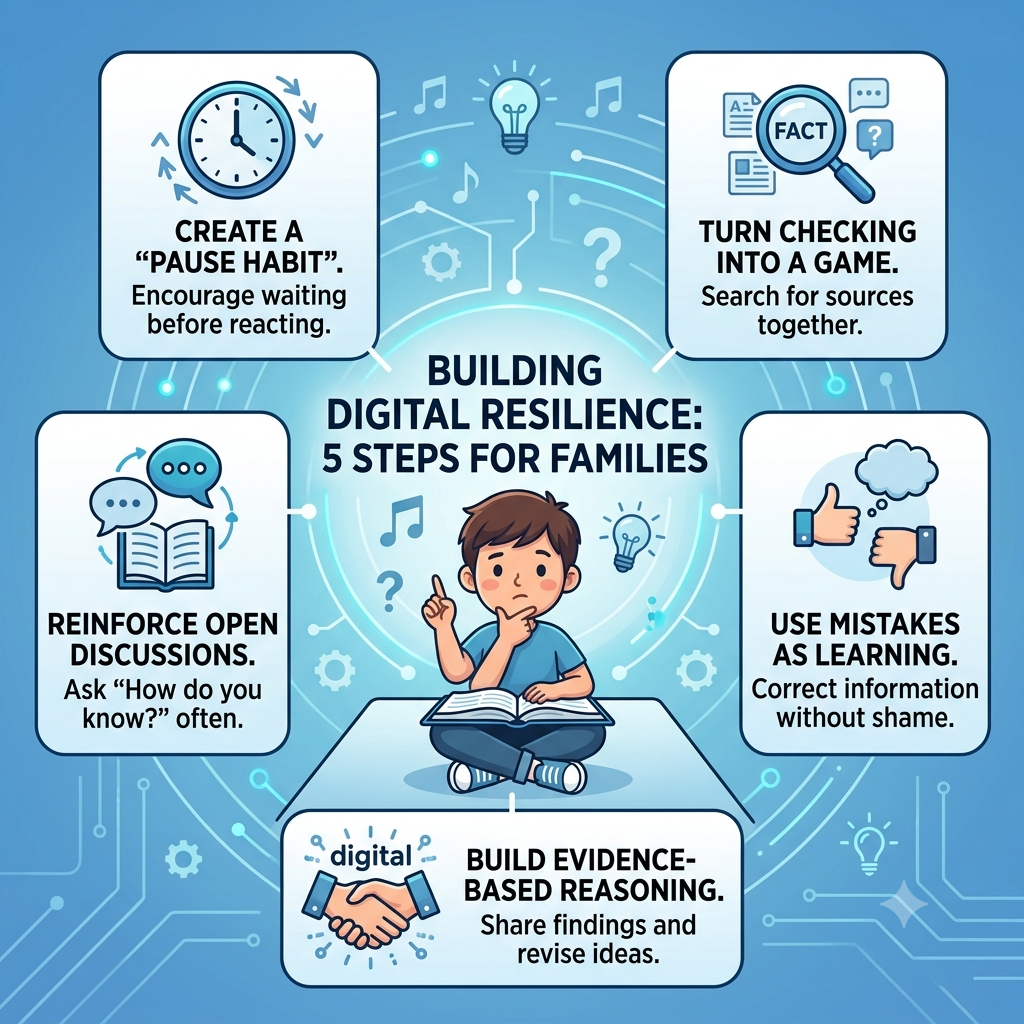
For instance, if a child comes across a surprising animal fact or a dramatic news headline, explore it together. Search for the source, check when it was published, and compare what other credible sources say. Let the child explain what they discovered and why they trust one source over another.
Images and videos need similar attention. A photograph may be genuine but taken out of context, while a video may be edited to leave out important details. Parents can demonstrate reverse-image search to help trace where a picture appeared earlier. When a video or image seems suspicious, children should avoid treating it as proof until its source and context are checked.
AI-generated content adds another challenge. An image that looks realistic or an AI chatbot that responds confidently can still be misleading. Teach children to verify important claims using reliable sources instead of accepting an answer simply because it sounds convincing.
The key is to make checking information a shared learning activity, not a test that children are expected to pass every time.
How Parents and Schools Can Build Critical Thinking Together
Children are more likely to ask questions when they feel comfortable admitting that they do not know something. If a child shares false information, avoid immediately scolding or embarrassing them. Instead, ask, "What made you believe this?" and "How could we check whether it is true?"
This approach turns a mistake into a learning opportunity. Children should also understand that if they have already shared something incorrect, they can correct it, delete the message where possible, and tell others that the information was inaccurate.
Schools can reinforce these habits through classroom discussions, research assignments, debates, and projects that ask students to compare sources and support their conclusions with evidence. Such activities help children understand that learning involves questioning, investigating, and revising their ideas when new evidence emerges.
Also read: Philosophy in Education: Strategies for Growth and Development
How K.R. Mangalam World School, Gurugram, Connects Learning with Critical Thinking
For parents looking for a Top school in Gurugram, it is worth considering how a school's teaching approach supports independent thinking alongside academic learning. K.R. Mangalam World School, Gurugram, describes an inquiry-based approach in which students investigate questions, explore resources, and apply information through structured projects.

These learning practices connect with the skills children need to examine information, consider different perspectives, and reach reasoned conclusions. For families exploring a Best school in Gurugram, opportunities to develop curiosity, analytical thinking, and evidence-based reasoning are useful factors to consider when evaluating a school's learning environment.
Help Children Think Before They Share
Children do not need to doubt everything they read online. They need to understand that information deserves careful thought before it is accepted or passed on.
Parents can help by asking questions, checking information together, and showing children how to correct mistakes without feeling ashamed. Over time, these everyday conversations can help children become more thoughtful readers, responsible digital citizens, and confident decision-makers.
The most valuable lesson is simple: before believing or sharing something online, pause, question, and verify.
For more information on similar schools, check out this list of the best schools in Gurugram.

 as a preferred source on