







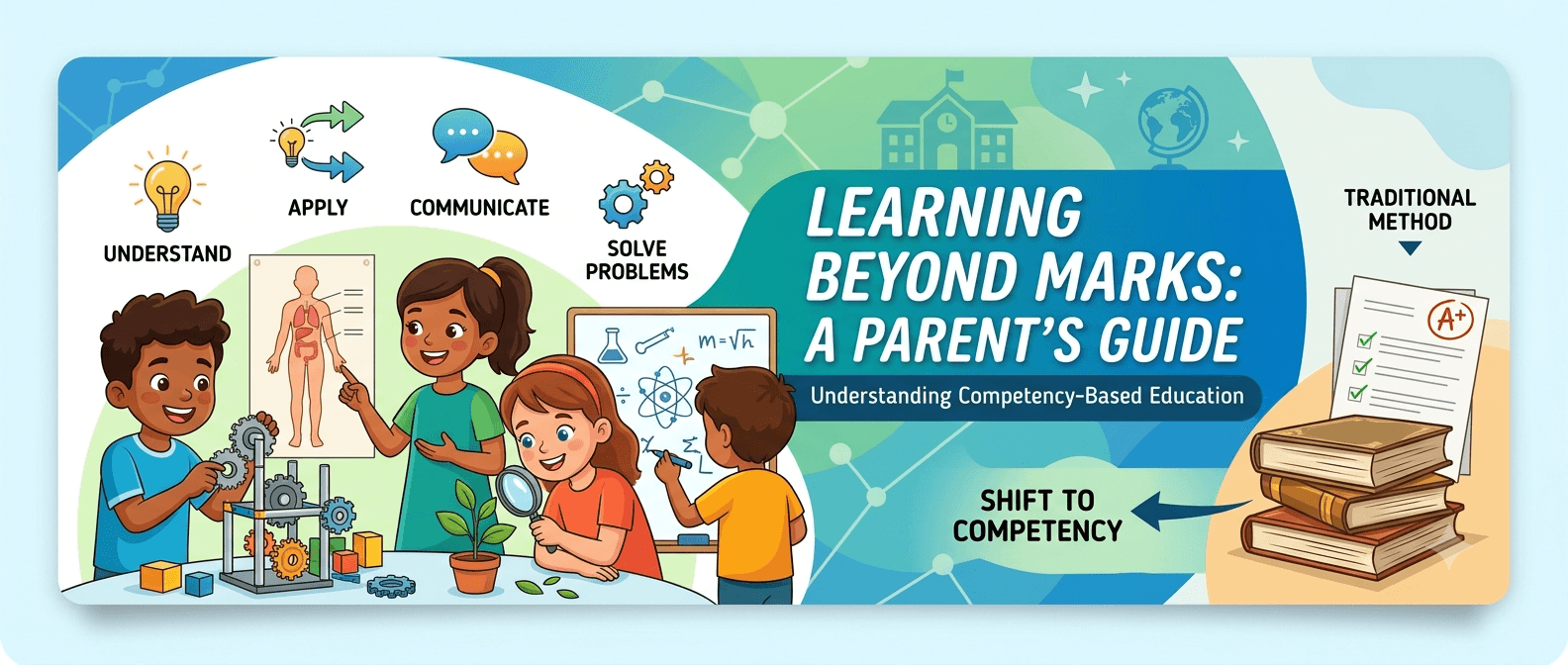

A child may remember a science definition perfectly for a test but struggle to explain how that concept works in everyday life. Similarly, they may know a mathematical formula but feel unsure about which formula to use when faced with a new problem. This is where competency-based learning becomes important.
At Gurugram Global Heights School, the approach to learning includes concept-based and experiential methods that encourage children to go beyond simply remembering information. The larger idea is simple: education should help children understand what they learn and use that knowledge meaningfully.
But what does this mean for parents? And does learning beyond marks mean academic performance is no longer important?
Also Read| Blending Eastern Wisdom and Western Methodology
What Is Competency-Based Learning?
Competency-based learning focuses on what a child can understand, apply, and demonstrate, rather than only how much information they can remember.
For example, knowing that plants need sunlight is one level of learning. Being able to explain why sunlight matters, observe what happens when a plant receives less light, and use that understanding to care for a plant demonstrates deeper learning.
The goal is not to remove knowledge from education. Children still need strong foundations in subjects such as mathematics, science, languages, and social studies. The difference is that they are encouraged to use that knowledge, rather than treating memorisation as the final goal.
How Is It Different From Rote Learning?
Rote learning can help children remember facts, definitions, formulas, and other important information. However, problems can arise when remembering becomes the only measure of learning.
Competency-based learning takes the next step by asking what children can do with what they know.
|
Rote-Focused Learning |
Competency-Based Learning |
|
Remembering information |
Understanding information |
|
Reproducing an answer |
Applying knowledge |
|
Practising similar questions |
Tackling unfamiliar situations |
|
Focusing mainly on the final answer |
Looking at the reasoning behind it |
|
Preparing for a particular test |
Developing skills that can be used beyond the test |
This does not mean one approach completely replaces the other. Memorising basic information has its place. The important thing is to give children opportunities to understand, question, apply and connect what they learn.
What Can Children Develop Through Competency-Based Learning?
Better Problem-Solving Skills
Real-life problems rarely arrive with instructions telling us which formula or method to use. Children therefore benefit from learning how to identify a problem, consider different approaches, and decide what might work.
Activities that allow them to experiment and try again can make this process more natural.
Critical and Creative Thinking
Competency-focused learning can encourage children to ask questions rather than accept every answer immediately.
They may compare different ideas, look for evidence, make connections between subjects, or come up with more than one possible solution. These habits can be useful both inside and outside school.
Communication and Collaboration
Learning is not always an individual activity. Group projects, discussions and presentations can require children to explain their thinking, listen to others and work towards a shared outcome.
These experiences can help children understand that knowing something and being able to communicate what they know are two different skills.
Confidence in Applying Knowledge
A child who understands how a concept works may be better prepared when the question is presented differently.
Instead of asking, “What is the answer?” competency-based learning can encourage children to think, “What do I know, and how can I use it here?”
How Does Assessment Change?
One of the biggest differences parents may notice is that assessment does not necessarily depend only on a final examination.
Teachers can use projects, presentations, classroom activities, case studies, practical work, discussions, and continuous assessment to understand how students are progressing.
This gives teachers opportunities to observe not just what a child remembers, but also how they reason, communicate and apply their understanding.
That does not make marks meaningless. Marks can still provide useful information about academic performance. However, they are only one part of the larger picture of a child's learning.
How Can Parents Encourage This at Home?
Parents do not need to create extra worksheets or complicated activities to support competency-based learning. Small changes in everyday conversations can make a difference.
Ask “Why?” and “How?”
Instead of only asking, “What did you learn today?”, try questions such as:
- “Why do you think that happens?”
- “How would you explain this to someone younger?”
- “Where could you use this in real life?”
- “What would happen if we changed something?”
Such questions encourage children to think about their learning instead of simply recalling it.
Connect Lessons With Everyday Life
Everyday situations can become opportunities to apply school learning.
Shopping can involve mathematics and budgeting. Cooking can introduce measurements and changes in ingredients. A walk outdoors can lead to conversations about plants, weather, or the environment.
These simple connections show children that learning does not stop when the school day ends.
Let Children Try Before Helping
When a child gets stuck, it can be tempting to immediately provide the solution. Instead, parents can ask, “What have you tried so far?” or “Is there another way you could approach this?”
Making mistakes and reconsidering an approach are valuable parts of learning.
Focus on the Thinking, Not Only the Answer
A correct answer is important, but so is the process used to reach it.
Parents can recognise thoughtful attempts, useful questions and improvements, even when the first solution is not perfect. This can help children become more comfortable with challenging problems.
Also Read| Discover the Magic of Excursions
How Gurugram Global Heights School Connects Learning With Application
Gurugram Global Heights School reflects this broader approach through its documented emphasis on concept-based and experiential learning. Its pedagogical approach includes projects, case studies, role-play, hands-on experiences, real-life applications, and continuous assessment, creating opportunities for students to use knowledge in different contexts.
, Gurgaon - Info.png)
For parents considering a Top school in Gurugram or a Best school in Gurugram, such an approach can be one useful factor to consider alongside curriculum, teaching practices, and the overall learning environment.
Learning That Goes Beyond the Report Card
Marks can tell parents something important about a child's academic performance, but they cannot always show the complete picture.
A child also needs to understand ideas, ask questions, solve unfamiliar problems, communicate clearly, and use knowledge in new situations. These abilities become increasingly valuable as children move through school and encounter more complex challenges.
For parents, the goal is therefore not to stop caring about marks. It is to look beyond them too. When children learn to understand rather than simply remember, their education becomes something they can carry with them long after a particular test is over.
For more information on similar schools, check out this list of the best schools in Gurugram.

 as a preferred source on