







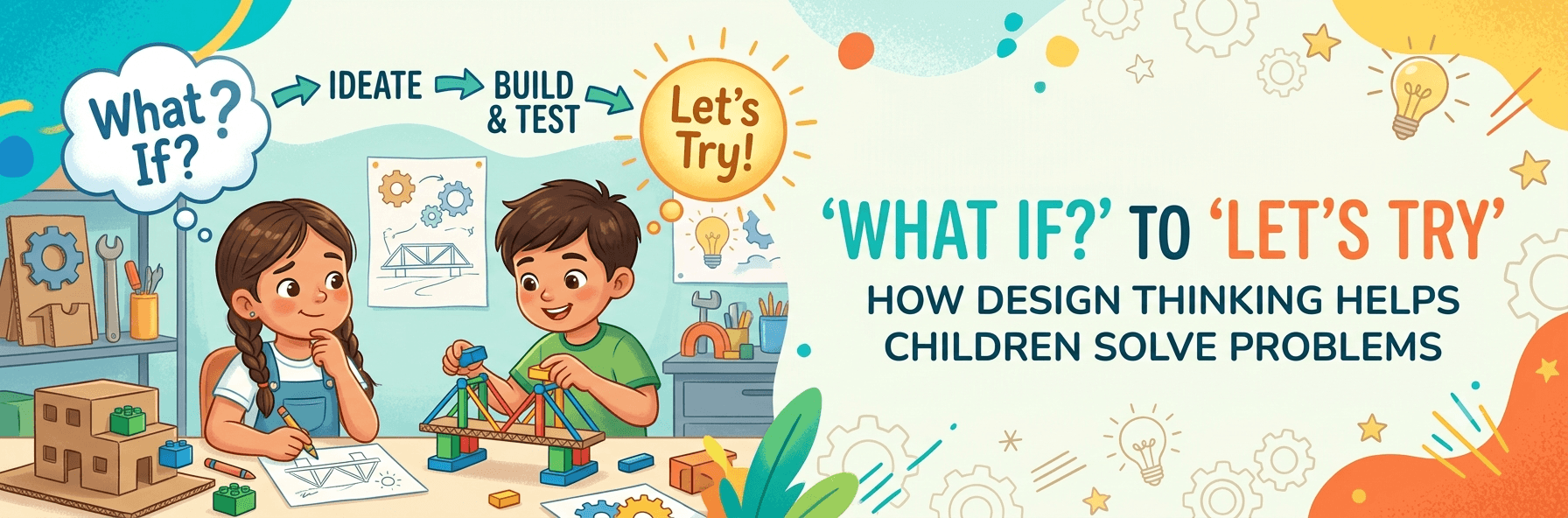

A child comes across a problem they have never seen before. They could wait for someone to show them what to do, or they could ask a different question: “What if I try this?”
That small shift can change how a child approaches learning.
For parents, education is often measured through grades, completed homework, and exam performance. But children will eventually face situations where there is no textbook answer or step-by-step instruction. They will need to observe a problem, think of possibilities, test an idea, and change their approach when something does not work.
This is where design thinking can become a valuable part of school learning. At The Beacon School, the emphasis on design thinking and hands-on exploration offers one example of how children can be encouraged to move from simply understanding an idea to trying, testing, and improving it.
Also Read| How Professional Coaching Improves Sports in Schools
What Is Design Thinking for Children?
Design thinking may sound like a concept used by engineers or businesses, but its basic idea is quite simple for children.
It is a way of approaching a problem by moving through a cycle of questioning, imagining, creating, testing, and improving.
For example, imagine that children are asked to build a structure that can hold a certain amount of weight. There may not be one correct design. They might try one shape, discover that it falls, change the structure,e and test it again.
The important part is not just whether the final structure works. Children are learning to ask:
- What went wrong?
- Why did it happen?
- What could I change?
- Is there another way to solve it?
These questions encourage children to become active participants in their own learning.
Why “Trying Again” Matters
Children sometimes develop the idea that making a mistake means they have failed. Design thinking can help change that mindset.
When an idea does not work, children have an opportunity to understand why it did not work. They can then use that information to make their next attempt better.
This develops an important learning habit: improvement through experimentation.
A child who builds something that collapses, for instance, may discover that the base was too narrow. The next attempt may be stronger because the child has learned something from the first one.
This process also helps children become more comfortable with uncertainty. They learn that not knowing the answer immediately does not mean they cannot solve the problem.
What Skills Can Design Thinking Develop?
Design thinking is not just about making things. The process can support several skills children need both inside and outside the classroom.
Better Problem-Solving
Instead of looking at a difficult problem as one large challenge, children learn to break it into smaller questions.
They begin thinking about what they already know, what they need to find out,t and what they could try next.
Critical Thinking
Children are encouraged to look beyond the first answer.
If something happens, they can ask why it happened rather than simply accepting it. Over time, this can encourage them to examine information, compare possibilities, and make more thoughtful decisions.
Creativity With Purpose
Creativity is not only about drawing, writing stories, or making attractive objects.
It can also mean finding different ways to solve a problem. Design thinking gives children a reason to use their imagination: Can I find a better solution?
Confidence to Experiment
Children who regularly get opportunities to test ideas may become less afraid of getting things wrong.
They learn that an unsuccessful attempt can provide useful information for the next one.
How Parents Can Encourage Design Thinking at Home
Parents do not need special equipment or complicated activities to encourage this way of thinking.
1. Ask Before Giving the Answer
When your child has a problem, resist the urge to solve it immediately.
Instead of saying, “Do it this way,” try asking, “What do you think we could try?”
This gives children an opportunity to think independently.
2. Encourage More Than One Solution
If your child finds one way to complete a task, ask whether there could be another.
For example, while organising books, packing a bag, or arranging a study table, ask:
“Could we make this easier somehow?”
Simple questions can encourage children to look for improvements in everyday situations.
3. Give Them Space to Make Mistakes
If something goes wrong, avoid immediately correcting it.
Give your child a moment to observe the problem and think about what happened. You can then ask, “What would you change if you tried it again?”
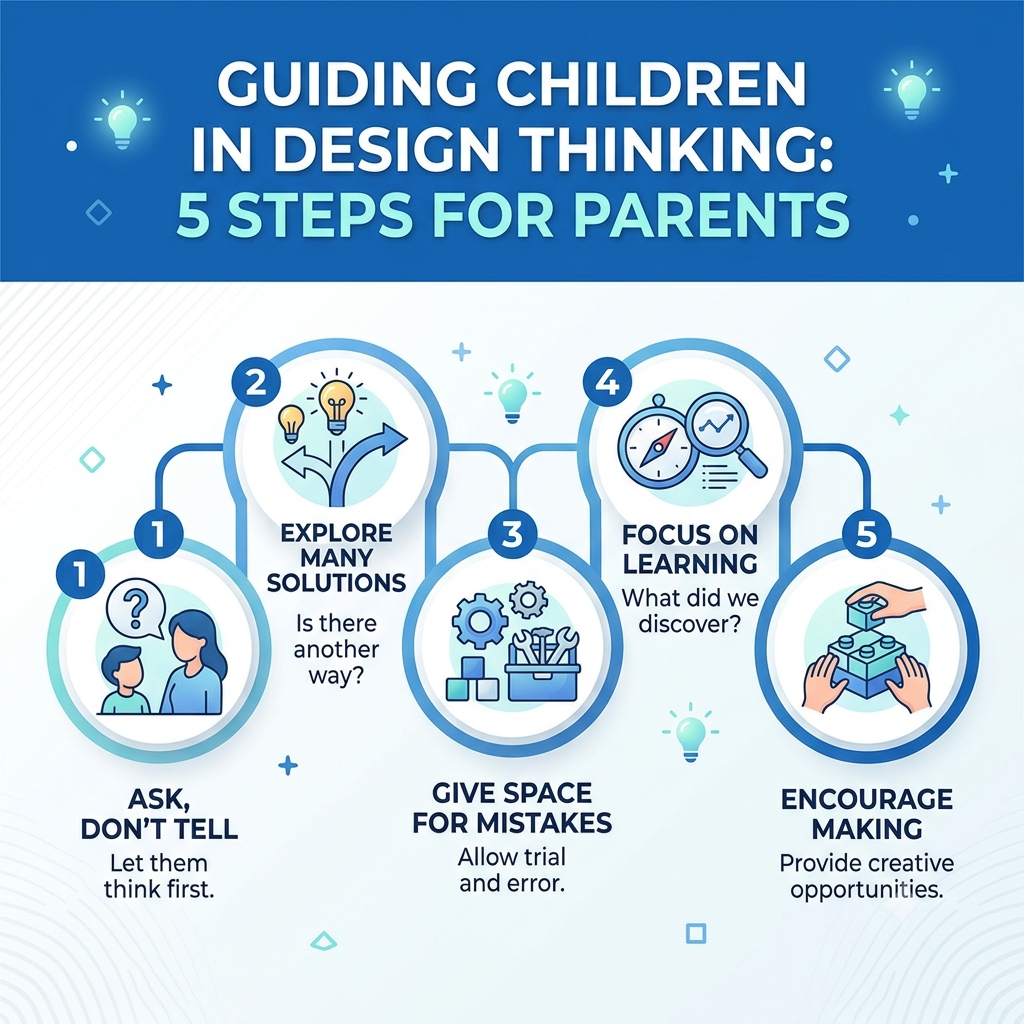
4. Focus on What They Learned
After an unsuccessful attempt, ask what the child discovered.
This shifts the conversation from “It didn't work” to “Now we know something we didn't know before.”
5. Let Children Make Things
Building, drawing, cooking, assembling objects, or creating simple models can all provide opportunities to plan, test, and improve.
The activity itself does not have to be complicated. What matters is giving children some ownership over the process.
What Should Parents Look for in a School?
Parents evaluating schools often look at curriculum, teachers, academic results,s and facilities. These are important, but it is also worth asking how often children get opportunities to think beyond a predetermined answer.
Look for learning experiences where children can:
- Ask their own questions
- Work on open-ended problems
- Build or create something
- Test different ideas
- Work with classmates
- Learn from unsuccessful attempts
- Improve their work after receiving feedback
A school does not necessarily need a long list of “innovation” programmes. What matters more is whether children are regularly given the opportunity to think, make, test and rethink.
Also Read| What Experiential Learning Looks Like in Class 11 & 12
How The Beacon School Connects Learning With Design Thinking
The Beacon School incorporates design thinking into its learning approach and provides opportunities for students to engage with ideas through making and exploration. Its learning environment includes spaces such as a Makers Lab and activities connected with STEM and hands-on experimentation. These elements provide a relevant example of how learning can move beyond simply receiving information.

For parents considering a Top school in Gurugram, this kind of approach can be worth examining alongside academics, while those looking for the Best school in Gurugram may also want to understand how a school helps children develop the confidence to experiment, solve problems, and improve their ideas.
The Goal Is Not to Get Everything Right the First Time
Children do not need to have the perfect solution every time they face a challenge.
They need opportunities to observe, ask questions, try an idea, discover what went wrong, and make another attempt.
That is one of the most valuable lessons design thinking can offer. It teaches children that a problem is not always something to fear or avoid. Sometimes, it is simply an invitation to ask:
“What if we tried something different?”
For more information on similar schools, check out this list of the best schools in Gurugram.

 as a preferred source on