







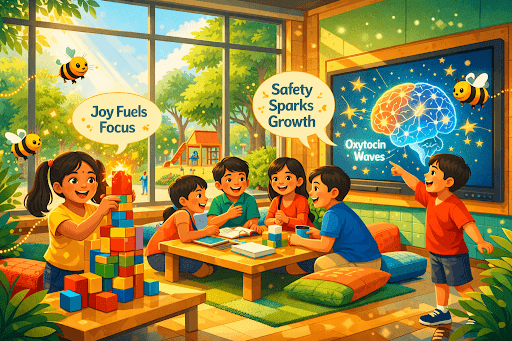

Remember the last time you saw your child truly happy? Not just distracted by a screen, but deeply, joyfully engaged. That sparkle in their eyes isn’t just a moment to cherish; it is, as neuroscience now proves, the very engine of their academic success.
For too long, we have been sold the lie that pressure produces performance. We have equated silence in a classroom with discipline, and long homework hours with rigour. Yet, emerging research from leading educational psychologists and neuroscientists paints a radically different, almost opposite, picture.
Today, we will explore the scientific link between a positive school environment and cognitive development. We will also decode how joy fuels the learning brain, why emotional safety is non-negotiable for memory retention, and how one of the right physical spaces, like Goldenbee Global School, acts as a “third teacher” for your child.
Also Read | How Curriculum and School Culture Interact in a Growing Bangalore Locality
The Neurochemistry of a Smile: How Joy Unlocks Learning
What happens inside a child's head when they feel safe, valued, and happy? A beautiful cascade of neurochemicals transforms potential into performance. This is not magic, but biology.
- Research confirms that positive school climates directly boost neurochemical conditions for learning. A 2018 OECD study of 500,000+ students found that schools with strong relational trust improved academic performance by the equivalent of nearly one year of schooling.
- Another study in Frontiers in Psychology (2020) showed that students who felt emotionally safe had 35% higher dopamine response during learning tasks, improving memory retention.
- Additionally, a Harvard meta-analysis (2021) linked oxytocin release to reduced cortisol (stress hormone), noting that supportive classrooms lowered anxiety by 43%, allowing prefrontal engagement for complex problem-solving.
The Role of Dopamine and Oxytocin
- Dopamine is the gateway to focus. This "feel-good" neurotransmitter primes the brain's prefrontal cortex for attention, memory, and problem-solving.
- Oxytocin creates belonging. Called the "bonding hormone," it reduces fear and anxiety, allowing the logical brain to take over from the reactive amygdala.
When a school prioritises relationships and positive reinforcement, it is engineering the optimal chemical state for higher-order thinking.
But here is what most parents miss - this beautiful neurochemistry does not exist in a vacuum. It is either nourished or destroyed by the physical space a child sits in for six hours every day.
Beyond Four Walls: The Environment as a Silent Teacher
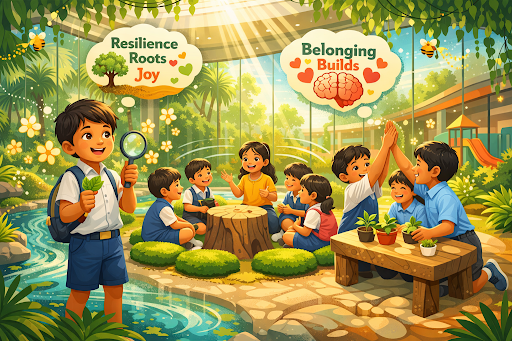
The building itself speaks to your child. Colours, noise levels, air quality, and furniture arrangement send constant signals to a child's nervous system. These signals tell them whether they are in a place of threat or a place of discovery.
Schools that understand this science design every corner with intention. That is why parents searching for the schools in Bangalore should look beyond brochures and observe the light, the greenery, and the movement within the walls.
Light, Greenery, and Movement
- Natural light boosts academic outcomes. Students in the brightest classrooms progress 20% faster in maths and 26% faster in reading.
- Greenery reduces cognitive fatigue. Even a view of a tree from a window can help a child regain their ability to pay attention.
- Movement is a necessity, not a distraction. The cerebellum coordinates both movement and attention.
Yet even the most beautiful, light-filled classroom will fail a child if one critical element is missing. Do you know what that element is? It is not better technology or smaller desks. It is something far more fundamental: the unspoken lessons children absorb from one another every single day.
The Invisible Curriculum: What Children Learn From Each Other
A happy learner is not a passive observer. The most successful schools create a "warm demander" culture, high expectations wrapped in unwavering support. This delicate balance is where true resilience is built, lesson by lesson, interaction by interaction.
The Power of Restorative Practices
Instead of punitive measures for mistakes, restorative practices ask, "What happened?" and "How do we make it right?" This approach keeps the child in the community while holding them accountable.
- Mistakes become data, not labels. When a child is not afraid to be wrong, their brain is free to take intellectual risks. This is where deep learning begins.
- Peer relationships become academic leverage. Collaboration teaches negotiation, empathy, and communication skills now more valuable than rote memorisation.
For parents exploring options, this invisible curriculum is a key differentiator. When you browse lists of the best schools in Bannerghatta, watch how children speak to one another when no adult is looking. That interaction tells you everything about the school's true culture.
You might be thinking, "This all sounds wonderful in theory. But does any school actually practice this science?" The answer is yes. And once you see it in action, you will never evaluate a school the same way again.
Check Out | Where Curiosity Meets Discovery: Well-Equipped Laboratories at Goldenbee Global School
A Blueprint in Action: Goldenbee Global School
Schools that implement these principles feel different the moment you walk in. The noise level is not zero, but purposeful, a gentle hum of engagement rather than the silence of compliance.
Consider Goldenbee Global School, Bannerghatta. A quick look at their school profile on Ezyschooling reveals a conscious effort to blend emotional safety with academic rigour.

From student-teacher ratios that allow genuine connection to spaces that encourage collaborative problem-solving, they embody the research we have discussed.
Founded in 2014, spread across 3.5 acres, and maintaining a student-teacher ratio of 14:1, GBG is built around the idea that children learn best when they are genuinely.
Its infrastructure reflects a similar ambition: smart classrooms, a robotics lab, science and language labs, a swimming pool, a skating rink, and dedicated spaces for debate, music, dance, and drama.
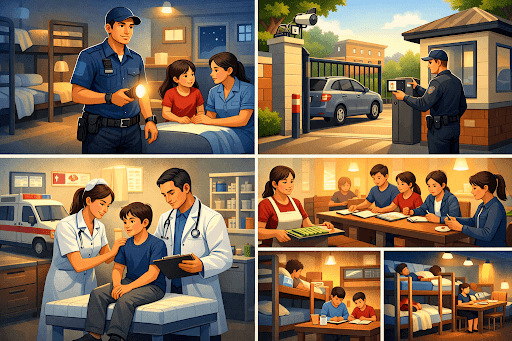
Safety is woven in too:
- CCTV coverage
- GPS bus tracking, and
- A student tracking app ensures that trust is maintained beyond the classroom walls.
But the clearest signal comes from the school's own vision. Principal Ms. Monika Chawla Katyal describes GBG's mission as preparing children not just for exams, but for life, balancing academic rigour with emotional intelligence and social responsibility.
That balance is not idealism. So, after all this science - the dopamine, the natural light, the invisible curriculum of peer relationships: what is the one metric you should actually watch as a parent? It is simpler than you think.
Conclusion
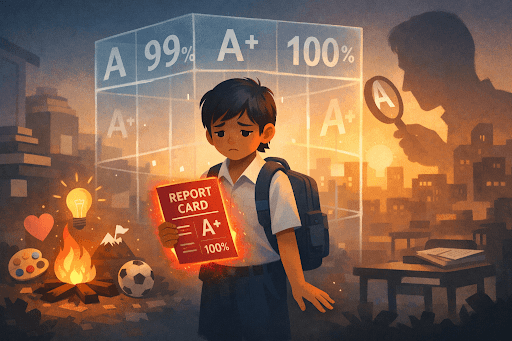
We often obsess over the wrong data points - test scores, rankings, worksheets sent home. But the most powerful metric is right in front of you. It is the eager report of the day's events at dinner: the reluctance to leave the school gate at pickup. A positive school environment is not a luxury. It is a biological necessity. Happiness is not the enemy of achievement; it is its most essential ingredient.
Trust the science. Listen to their laughter. That feeling of safety and joy is not just childhood. It is the foundation of their future success.
To learn more about this and other schools in the area, see this list of the top schools in Bangalore.






 as a preferred source on