









Most parents go through the same checklist when picking a school:
- Results
- Faculty
- Fees
- Distance
While these things are definitely important, there is one factor that almost never makes the list, and it probably should, i.e. the physical environment the child is in every single day.
According to the World Health Organisation, children aged 5 to 17 spend nearly 30% of their waking hours in school buildings. And if that building runs on wasteful energy, generates mountains of unmanaged waste, pulls from a groundwater table it never replenishes, and has no green cover to speak of, that is taking a lot from the planet and their own future.
Schools that have made a genuine commitment to sustainable campuses are doing the opposite. They are letting the environment itself carry a message about responsibility, care, and long-term thinking. Swarnprastha Public School in Sonipat, Haryana, one of the best boarding schools in India, has been doing exactly this for years, and the story of how is worth understanding properly.
The "Hidden Curriculum" Nobody Talks About
There is a term in education theory called the "hidden curriculum." It refers to the values and habits children absorb not from lessons, but from how an institution actually operates day to day.
A school that segregates its waste teaches children that categories and systems matter. A school that runs on solar power shows them that energy has a source and a cost. A school with a rainwater harvesting system quietly demonstrates that water is not infinite.
On the other side, a school that burns its garbage, lets lights run all night, and has never thought about where its water comes from, even that has something to teach children. Remember, children are watchful observers. They learn what they see, and they believe what their elders, especially what their parents and teachers project.
What a Green Campus Actually Looks Like
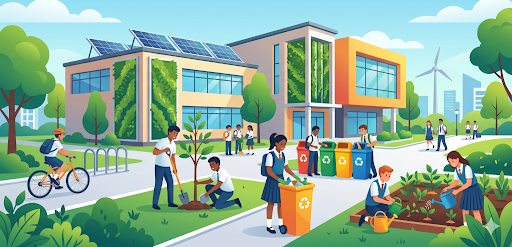
India has over 1.5 million schools. According to reports by the Centre for Science and Environment, the majority generate thousands of tonnes of waste annually with little to no structured management plan. Studies suggest the average Indian school building uses 3 to 5 times more energy per square metre athan it actually needs.
The phrase "green campus" gets used loosely. A genuinely sustainable school operates differently from the ground up. Here is what that actually involves:
- Energy Use: Solar panel installations reduce dependence on the grid. Thoughtful architectural choices, like high ceiling heights that allow hot air to rise naturally, reducing the need for cooling and cut electricity consumption without sacrificing comfort. Energy-efficient lighting systems, particularly those using focused optics that direct light exactly where it is needed, avoid waste at the fixture level.
- Water Management: Rainwater harvesting systems that channel roof runoff into strategically placed recharge pits near borewells do not just reduce water bills. They replenish the very aquifer the school draws from.
- Waste: Solid waste segregation at source, active recycling, and a strict no-burning policy are the foundations of waste management. The recycling rate at a school is a surprisingly honest metric of institutional seriousness about sustainability.
- Textbook and Material Reuse: Encouraging the school community to pass on textbooks rather than discard them reduces paper waste and instils in children a mindset of extending the life of resources. Students can also be encouraged to be mindful while using these books and materials so as to effectively pass them on to the next batch of students.
How to Actually Evaluate a School's Green Credentials
Many schools will mention sustainability on their website. Fewer have done the hard, unglamorous work of building systems that actually function. Here are a few questions worth asking on your next school visit:
- Does the school have a working solar power system, and can you see the panel infrastructure?
- Where does rainwater go? Is there a harvesting and recharge system in place?
- How does the school manage its daily solid waste? Is there segregation at source?
- Does the school have a no-burning policy for waste, and how is it enforced?
- Has the school received any independent environmental recognition?
Check Out | Sustainability in Education: Green Initiatives in School
Swarnprastha Public School’s Green Campus
One of the best boarding schools in Haryana, Swarnprastha Public School was established under the Indraprastha Education and Charitable Society, part of the larger Sparsh Group of Institutions. With 95 teachers on faculty and a teacher-to-section ratio of 1.62:1, the school follows the vision: "Empowering young minds to cultivate strong character, develop essential competencies, and navigate their future careers with confidence and purpose."
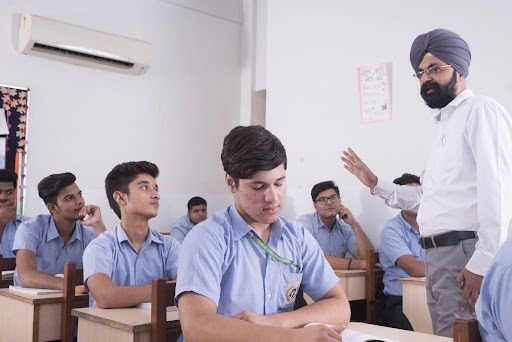
The school's approach to environmental responsibility predates the current wave of green marketing in Indian education. In 2017, Swarnprastha Public School was recognised by the Centre of Science and Environment as one of India's top green school campuses, a recognition based not on claims but on verified practices.
The school practices the following as a part of its green campus initiative:
- Functional solar power installation to turn unused building surfaces into clean energy generators.
- Buildings designed with high ceilings specifically to enable passive cooling.
- CFL lighting with mirror-optic luminaires to ensure that light reaches exactly where it needs to go, reducing consumption without compromising the learning environment.
- Rainwater harvesting network to channel stormwater from its large terrace areas through a designed drain system into recharge pits located near existing borewells.
- Waste segregation at source, active recycling that reportedly achieves close to 99% of campus waste, and a firm institutional policy against burning waste.
- Actively encourages textbook reuse among the students, from one batch to another.
Beyond the green campus, Swarnprastha Public School offers a breadth of opportunities that position it as one of Haryana's more comprehensive residential institutions. It has been ranked the No. 1 Boys' Residential School in Haryana and offers facilities across more than 10 sports disciplines, including tennis, basketball, swimming, boxing, and shooting.
The school also runs the Duke of Edinburgh International Award programme, an Atal Tinkering Lab, and its own innovation framework called D.I.C.E (Design, Innovation, Creativity and Entrepreneurship). Along with such programs, a dedicated counsellor and special educator are part of the permanent staff to cater to the needs of the students.
Swarnprastha Public School rightly conveys that shifting to a greener way of living is not that difficult. Schools that lead such a change are developing the right mindset in children and thus, raising citizens who will know how to protect the planet.
To learn more about this and other boarding schools, check out this list of the best boarding schools in India.







 as a preferred source on