






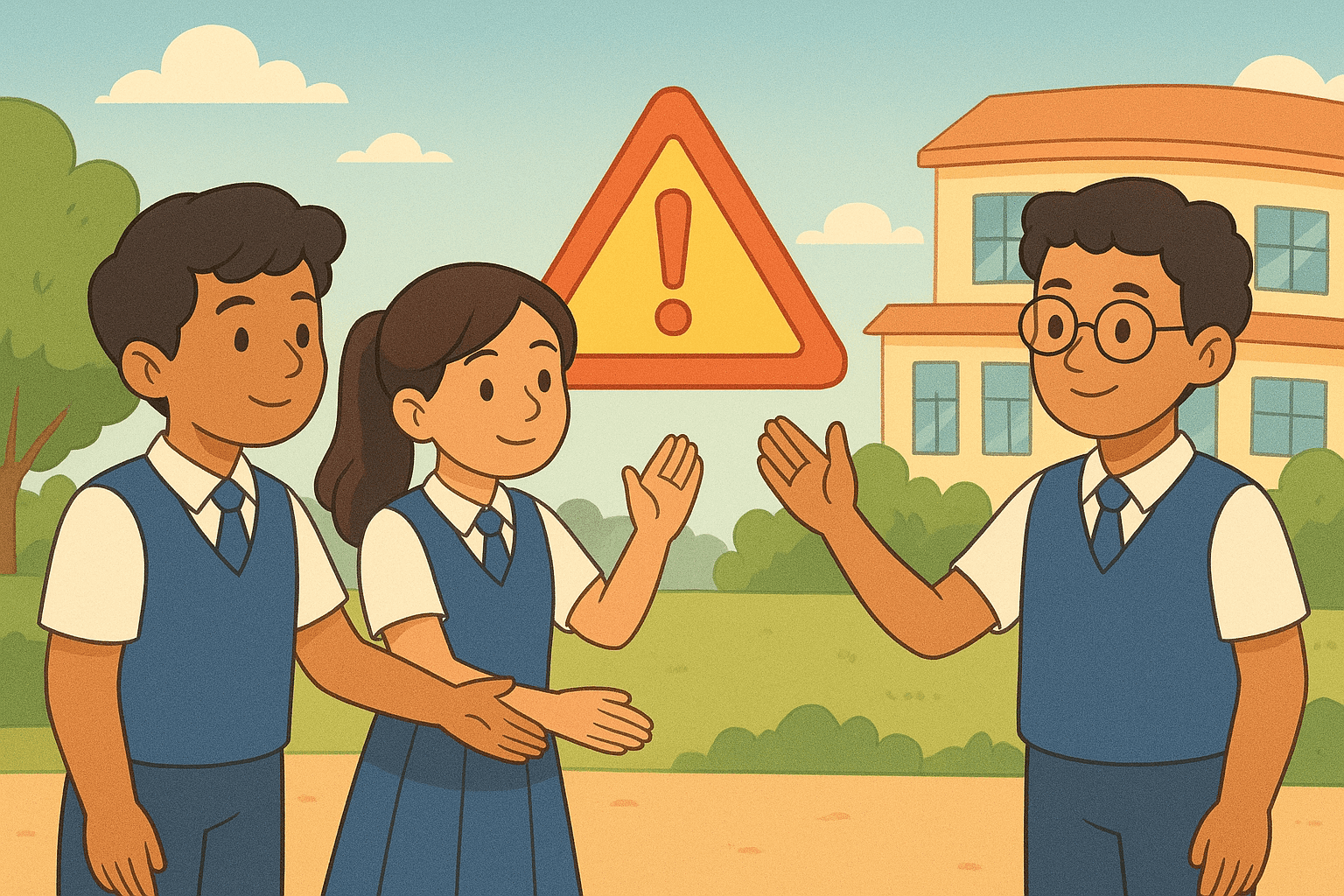

Have you ever noticed how a school hall falls silent the moment an alarm rings and how everyone, without panic, moves with purpose? That’s not happening. It reflects a culture built on practice, attention, and trust.
Parents understand that today, safety cannot be an afterthought; it must be part of the everyday learning environment. And schools like Mayoor School weave emergency preparedness into routines, creating young people capable of responding calmly and confidently under pressure.
In this article, we explore why emergency readiness matters in schools, how realistic drills help both students and staff stay composed in a crisis, and how Mayoor School, Noida, one of the best schools in Noida, through coordinated fire-risk exercises, turns vigilance, communication, and teamwork into second nature.
Also Read: Three Core Learning Theories: Building Balanced Education at Mayoor School, Noida
The Importance of Emergency Preparedness in Schools
Emergencies, whether fires, earthquakes, or other crises, arrive suddenly and without warning. In such moments, hesitation or confusion can make all the difference. Schools must treat safety not as a formality, but as a core responsibility that is prepared for long before a crisis ever occurs.
When schools prepare actively, several vital outcomes follow:
-
Every child knows what to do: Clear instructions and repeated practice ensure even the youngest student understands the steps, following evacuation routes, gathering at safe zones, or waiting quietly for directions. This reduces panic and keeps fear at bay.
-
Safety becomes a lived culture, not just a policy: Manuals and posters alone are not enough. Preparedness becomes real only when drills are woven into daily school life. Over time, procedures stop being abstract and turn into shared habits across the community.
-
Staff are equipped to lead calmly: Children naturally look to teachers during crises. Training staff to respond with composure helps them act as steady anchors, guiding students with clear instructions and calm authority while preventing chaos from spreading.
-
Students gain trust and confidence: Regular drills and strong systems show children their safety is valued. This builds a lasting sense of care, allowing them to act confidently in emergencies and feel secure in their day-to-day school experience.
How Simulated Scenarios Prepare Students and Teachers Alike
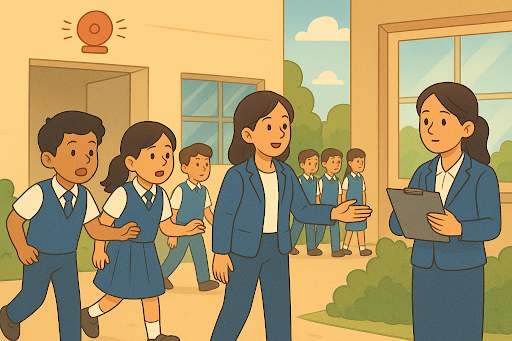
Emergency plans only work if people know how to carry them out under pressure. Simulated scenarios provide this preparation by recreating the urgency of a real crisis in a safe, controlled setting. They allow both students and staff to rehearse specific actions, so that in an actual emergency, responses come naturally instead of with panic.
-
Sounding the alarm: Drills usually begin with a loud siren or bell. The sudden sound is intentional; it trains students to recognize it immediately as a signal to stop what they’re doing and prepare to act. Over time, the alarm becomes associated with discipline and focus, not fear.
-
Orderly evacuation: Once the alarm rings, teachers guide students out of classrooms. Children learn not to run, push, or panic but to walk quickly in lines. This step teaches self-control under pressure and ensures that large groups can move without creating bottlenecks.
-
Following marked routes: Schools map out evacuation routes with arrows or signage. Drills reinforce the habit of using only these designated paths. This prevents chaos, avoids accidents, and ensures everyone moves in the same direction, making it easier to account for students.
-
Assembly at safe zones: Outside the building, students gather in open spaces away from danger, fields, courtyards, or other safe zones. Teachers take attendance or headcounts, confirming that every child has evacuated. This reinforces accountability and reassures students that they are safe once assembled.
-
Feedback and reflection: After the drill, staff and sometimes even students review the process. Were there delays? Did anyone struggle with instructions? Was communication clear? These reflections turn each drill into a learning opportunity, ensuring that responses improve with every practice.
By practicing these steps repeatedly, drills remove the fear of the unknown. Students learn that emergencies can be met with order rather than chaos, and staff build the confidence to lead decisively. Most importantly, the entire community develops a rhythm of response - alarm, evacuation, assembly, review that becomes second nature when it matters most.
Repetition & Realism in Instilling Calm Under Pressure
In the midst of an emergency, it often comes down to three simple but powerful steps - alarm, quiet, exit. When these actions are practiced consistently, they can make the difference between chaos and calm. The goal of realistic, repeated drills is to ensure that safety procedures become second nature, carried out smoothly without fear or hesitation.
Here’s how repetition and realism shape effective readiness:
-
Students experience safety as calm and organized: Rather than imagining emergencies as frightening or overwhelming, repeated drills show children that evacuation can be orderly and controlled. They learn that safety is not about panic; it is about moving with clarity and purpose.
-
Staff refine their responses: Every drill provides teachers and administrators with insights into what works well and what needs adjusting. Perhaps a staircase becomes crowded, or a class takes longer than expected to line up - identifying these small delays in practice allows the school to fix them before they ever become risks in a real crisis.
-
Responsible behavior becomes the norm: When children rehearse the same safety steps again and again, they stop overthinking and start relying on instinct. In a real emergency, they are less likely to freeze because their training kicks in automatically. Acting responsibly becomes the natural response, not the exception.
-
Muscle memory replaces fear: Just like learning a sport or a musical instrument, practice builds confidence. When sirens or alarms sound, students who have drilled regularly don’t hesitate. They rise, fall silent, and follow the exit path with focus because they have done it so many times before.
Check Out: Child Safety in Schools: The Satya School, Gurgaon's Approach
Mayoor School, Noida: Turning Safety into a Shared Responsibility
Mayoor School, one of the best CBSE-affiliated schools in Noida. established in 2003 under the aegis of the Mayo College General Council, Ajmer, is a co-educational institution offering classes from Pre-Nursery to XII. With over 3,200 students, the school is known for blending academic excellence with a nurturing, future-ready environment
.
The school recognizes that safety is as essential as academics in shaping confident, resilient individuals. Preparedness here is not treated as an afterthought but as a daily practice built into the school culture.
Comprehensive Safety Preparedness Framework
Unlike many institutions where drills are occasional, Mayoor School ensures that emergency readiness is systematic and inclusive:
-
Regular fire and evacuation drills involving all students and staff, from Pre-Nursery to Grade XII, to ensure universal awareness and calm execution.
-
The Safety Triangle reinforced in every exercise through vigilance (attention to surroundings), communication (clear directions), and teamwork (coordinated movement).
-
Campus-wide safety infrastructure with CCTV monitoring, proximity awareness, and controlled access, embedding vigilance into daily life.
-
Staff readiness programs that train teachers to remain calm leaders, guiding students with clarity and confidence in high-stress situations.
Through these efforts, Mayoor School has created a community where safety is not just taught but lived. Students grow up knowing that preparedness is a shared responsibility, and when practiced regularly, it becomes second nature.
By making safety a culture of clarity, confidence, and collective care, Mayoor School proves that readiness is not about fear; it is about empowerment. Here, children don’t just learn to study; they also learn to protect, respond, and stand united in the face of challenges.
For more information on this and other such schools in the area, check out this list of the best schools in Noida.









 as a preferred source on