









Your daughter comes home one evening, not buzzing about a test score, but about how she finally spoke up in a debate. Voice shaking, eyes lit. That moment won't appear on any marksheet. But every parent who has witnessed it knows: that is real growth.
We are raising children in an age obsessed with percentages. And yet, the qualities that will carry them through life - resilience, empathy, the ability to lead and recover are rarely taught from a textbook. The gap between a child who scores well and a child who does well in life is filled not by extra tuition, but by experience.
In this article, we explore why learning outside the syllabus is not supplementary, it is foundational and how schools like Guru Nanak Fifth Centenary School (GNFC), one of the best schools in India, are redefining what it truly means to educate a child.
Also Read | Separate Campuses, Unified Vision: Boarding Life at Guru Nanak Fifth Centenary School
Marks Open Doors, but Character Decides What You Do Once you go Inside
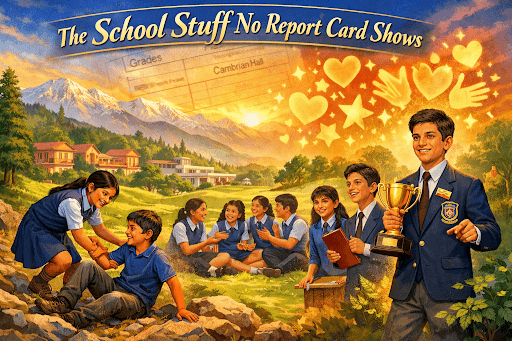
Think back to your own school years. What do you remember most? Rarely a chapter from a textbook. It's the teacher who believed in you, the competition you nearly gave up on, the friendship formed backstage during a school play.
Research consistently shows that social-emotional learning, creative expression, and physical activity are deeply intertwined with cognitive development. Children given space to explore beyond academics show better problem-solving, higher self-esteem, and stronger interpersonal skills - the very traits life will demand of them.
Grades measure what a child has memorised. Extracurricular engagement measures who they are becoming. Along with that, your child needs the skills that no academics gonna teach. What are those? Let’s get the answer.
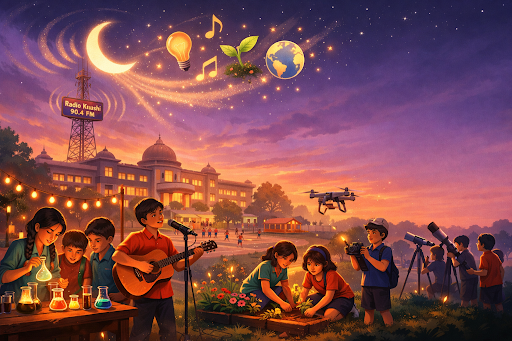
The Skills No Syllabus Can Teach, but Every Child Needs
When a child joins the school debate team, she isn't just practising public speaking. She is learning to hold a position under pressure, to listen with intent, and to fail gracefully in front of an audience. These are life skills disguised as after-school activities.
-
Emotional Resilience
Sports, drama, and competitive activities all involve the experience of losing and recovering. A child who has learned to pick herself up after a missed goal or a forgotten line on stage is far better equipped to handle failure in adulthood. Resilience is not taught in a chapter; it is lived in a field.
-
Communication and Confidence
Whether anchoring a school event, performing in a concert, or presenting a project, every public moment builds a child's ability to communicate with clarity and conviction. This is the confidence that speaks in interviews, boardrooms, and difficult conversations decades later.
-
Teamwork and Discipline
No team sport works without cooperation. Children who participate in group activities learn to lead, to follow, and to honour commitments.
A child who balances studies with a sport or an art form quietly learns one of adulthood's most coveted skills: how to manage time and show up consistently. And now, it’s time to jump into the next section and decode how boarding schools are helping students get that effortlessly.
Why Boarding Schools Often Get This Right
The boarding school environment, when thoughtfully structured, may be one of the best models for holistic education that exists. It isn't simply about living away from home, it is about what happens in the hours between lights-out and the first bell.
When a child's entire day is woven into a rhythm of community living, she learns accountability, empathy, and grit, not because someone demanded it, but because daily life requires it. The lessons are quiet, cumulative, and irreplaceable.
If you are exploring the best boarding schools in India for your child, look for institutions where extracurricular life is taken as seriously as academics, like Guru Nanak Fifth Centenary has been doing for years. Wanna explore it? Check out the next section.
Check Out | Holistic Learning from Values to Competitive Exams

Guru Nanak Fifth Centenary - A School That Remembers What Childhood Is Actually For
Nestled in the Himalayan town of Mussoorie, Uttarakhand, Guru Nanak Fifth Centenary School has been quietly doing something remarkable since 1969: raising not just students, but thinkers, athletes, performers, and leaders.
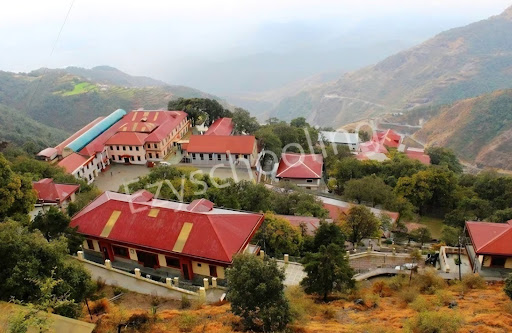
Spread across an 85-acre campus and affiliated with the ICSE and CISCE boards, the school caters to students from Nursery through Class 12 in a full boarding format with a student-teacher ratio of 15:1. Among the best boarding schools in Mussoorie, GNFC stands out for treating extracurricular life not as an add-on, but as the core.
What Makes GNFC's Approach Distinctive?
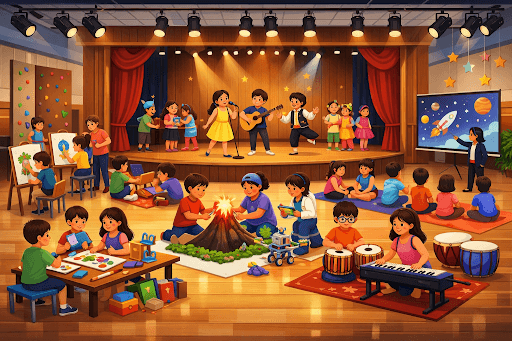
The school's commitment to learning beyond the syllabus shows up in tangible ways:
-
Radio Khushi 90.4 FM
GNFC runs India's first community radio channel owned by a school. Students script, anchor, and broadcast real programmes, building media literacy, confidence, and civic responsibility, all in one activity.
-
Project Jagriti
The school provides free coaching to over 745 students from financially weaker sections, teaching enrolled students firsthand, that privilege carries responsibility.
-
Sports at scale
Both campuses feature running tracks, tennis courts, basketball courts, cricket and hockey fields, a swimming pool, a gym, and a skating rink. Training is regular, and discipline is real.
-
Arts and expression
Dance, drama, music, and art and craft are valued disciplines, not optional extras scheduled after "real" classes.
-
Academic technology
Every student from Class 9 upwards is assigned a personal laptop, normalising digital learning as a habit, not a privilege.
The results speak for themselves. GNFC is ranked among the Top 5 boarding schools in India and No. 1 in North India for Co-curricular Education (ICSE, Uttarakhand) by Education Today.
Conclusion
Education, in its truest form, is the development of a whole human being. The syllabus will always matter, but what your child learns outside it, in the way they carry themselves, handle a teammate, or rise after a fall, is the education that lasts a lifetime.
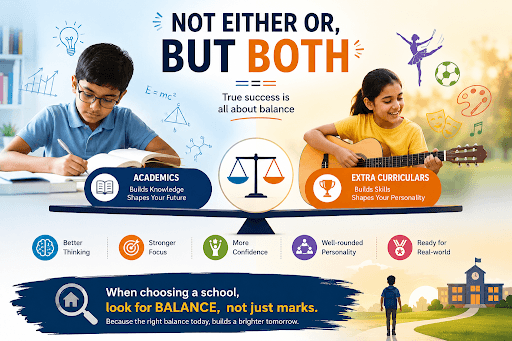
When choosing a school, look beyond the board results on the banner. Ask what happens after school hours, whether the arts are funded, sports genuinely played, and students given real responsibilities, not just rules.
The world your child graduates into will not ask for their Class 10 marks. It will ask what they built, how they led, and how they handled the moments that did not go their way.
For more information on this and other such schools in the area, check out this list of the best boarding schools in India.









 as a preferred source on