







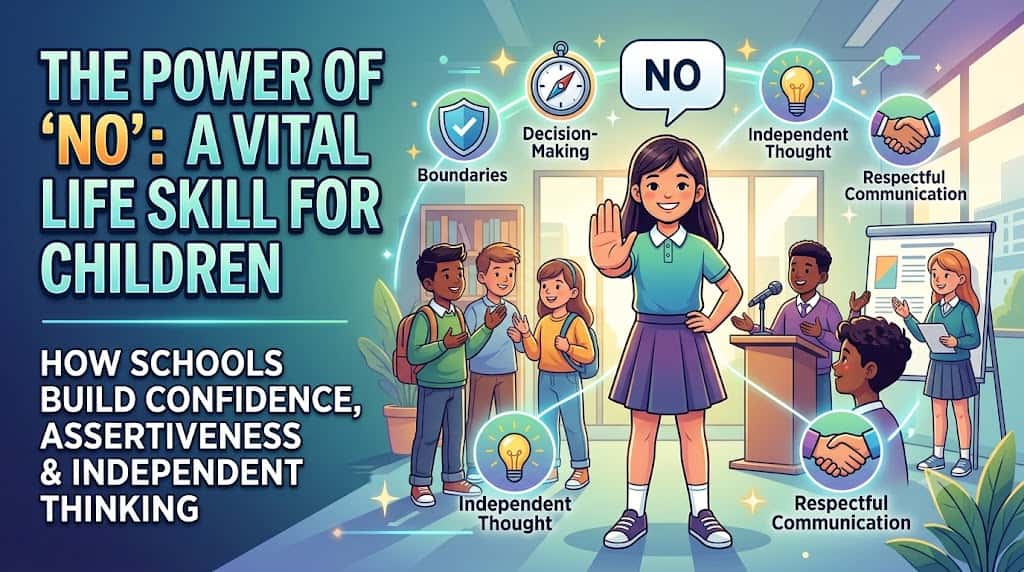

A child saying “no” can sometimes sound rude to an adult. But as children grow, knowing when and how to say no becomes an important life skill. It could be refusing to copy a classmate’s homework, telling a friend that a joke has gone too far, or choosing not to join something simply because everyone else is doing it. For parents exploring the Top Schools in Noida, it is worth looking beyond marks and facilities and asking whether a school also gives children the confidence to make their own choices. Sapphire International School, Noida, for example, places emphasis on leadership, communication and student ownership, areas that can help children gradually learn to express their choices with confidence.
Also Read| Enlightened Minds & Adept Hands: How SIS Noida Redefines 21st-Century Learning
Why Is Learning to Say No So Important?
Children naturally want to belong. Think about a simple situation: three friends are laughing at a classmate, and one child knows it is unkind but joins in because they do not want to be left out. The difficult part is not always knowing what is right; it is having the confidence to act on that knowledge.
Research supports the importance of peer influence during childhood and adolescence. A 2021 meta-analysis covering 60 independent studies found a small but significant and robust effect of peer behaviour on changes in young people's behaviour over time. More recent research has also found that adolescents can be particularly responsive to social influence, especially when they are trying to understand what is considered normal within their peer group.
This is where saying “no” becomes more than a polite word. It is connected with personal boundaries, independent thinking, and decision-making.
A child who can say no respectfully is learning to communicate things such as:
- “I don't want to do that.”
- “That makes me uncomfortable.”
- “I have a different idea.”
- “I need more time to decide.”
- “I don't agree with you.”
Saying no also does not mean rejecting people. A child can disagree with a friend and still remain a good friend. In fact, learning to disagree without becoming disrespectful is an important part of healthy communication.
Saying No Is Not About Being Stubborn
There is a difference between assertiveness and stubbornness. Stubbornness can mean refusing to listen even when another person's point makes sense. Assertiveness means expressing your own thoughts and boundaries while still respecting the other person.
Imagine a child being asked to join a football game while they are finishing a project. Saying, “No, I need to finish this first. I can play after that,” is very different from simply ignoring everyone. The child has communicated a choice and explained it clearly.
This idea connects with Self-Determination Theory, developed by psychologists Edward Deci and Richard Ryan. The theory identifies autonomy, competence and relatedness as three basic psychological needs. Autonomy is particularly relevant here because it involves feeling that your actions are genuinely your own choices rather than something forced upon you. Research in education has linked autonomy-supportive environments with motivation and students' sense of competence.
Parents can therefore look at “saying no” as a small everyday exercise in autonomy. When children are allowed to make age-appropriate choices, explain their reasoning and experience reasonable consequences, they gradually learn to take ownership of decisions.
|
Situation |
A passive response |
An assertive response |
|
A friend asks for homework to copy |
“Okay, take it.” |
“I can explain the question, but I won't give you my homework to copy.” |
|
Friends want to exclude another child |
Staying silent |
“I don't think we should leave them out.” |
|
Someone interrupts while the child is speaking |
Giving up |
“Please let me finish, and then I'll listen to you.” |
|
A child does not want to join an activity |
Going along reluctantly |
“I don't want to join this time, but you can go.” |
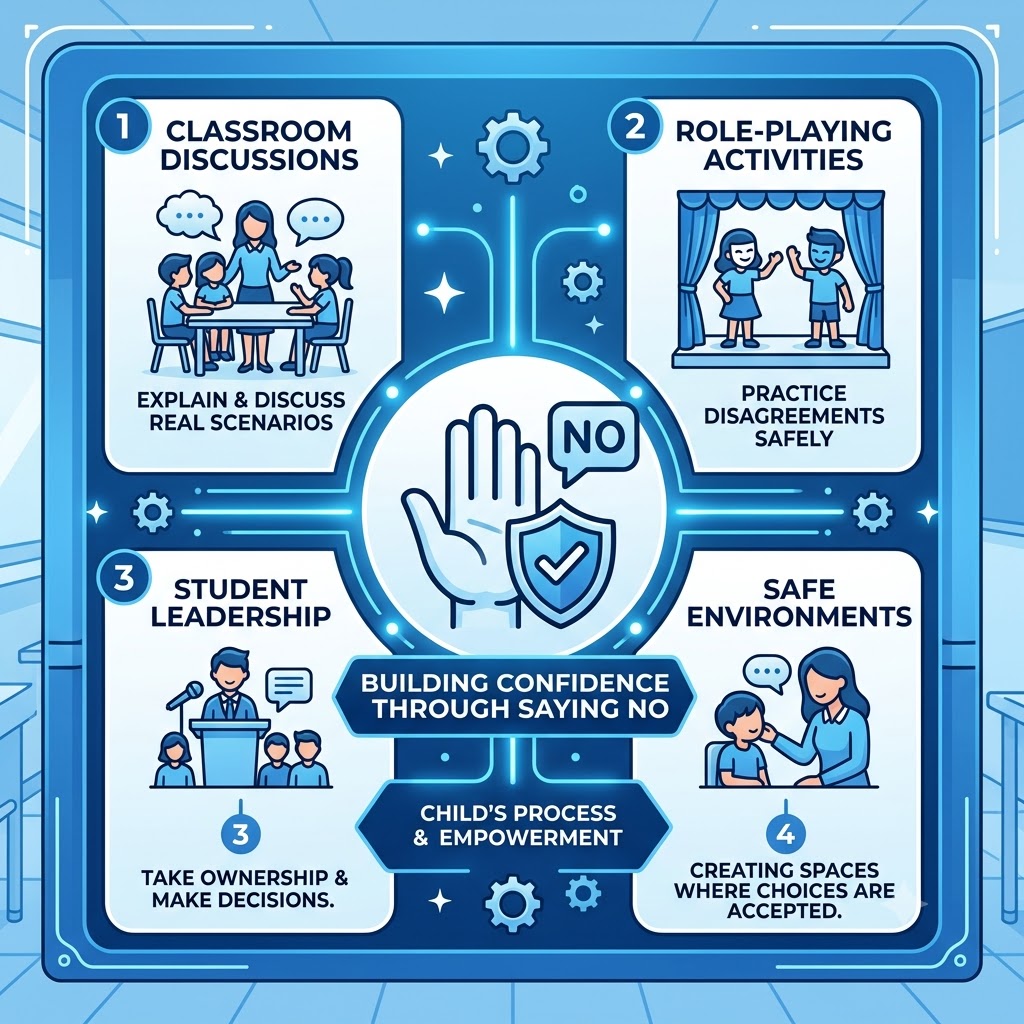
How Can Schools Teach Children to Say No?
Children rarely learn assertiveness through a single lecture. It develops through repeated situations where they are encouraged to speak, choose, question and take responsibility.
Classroom discussions are one simple starting point. A teacher can present a situation such as, “Your friends want you to break a classroom rule because they think it will be funny. What could you say?” Instead of giving children one correct answer, the class can discuss several possible responses.
Debates and role-play can make the lesson more practical. A child may play the role of someone who disagrees with a group, while another student practises responding respectfully. This gives students a chance to experience disagreement in a safe setting before they encounter similar situations outside the classroom.
Student leadership offers another useful opportunity. When children are given responsibility for projects, events or teams, they have to make decisions, listen to different opinions and sometimes disagree with others. Sapphire International School's stated “Every Child is a Leader” philosophy focuses on giving learners opportunities to take ownership through projects, sports and community initiatives.
The school's calendar also includes activities connected with leadership and sportsmanship, presentations, projects and student participation, all of which can create situations where children practise expressing themselves and working with others.
Most importantly, schools can create an environment where respectful disagreement is accepted. If every “no” is treated as disobedience, children may learn to stay quiet rather than communicate honestly. If teachers listen to a child's reasoning while maintaining appropriate boundaries, students get to see that disagreement and disrespect are not the same thing.
What Should Parents Look for in a School?
When visiting a school, parents can observe how much opportunity children get to make decisions and express their thoughts. Instead of only asking about facilities, parents can ask questions such as:
- Do students participate in discussions and debates?
- Are children given leadership responsibilities?
- Can students explain their reasoning when they disagree?
- Does the school use projects and activities where children have to make choices?
- Are teachers encouraged to listen to students' concerns?
- Does the school teach communication and decision-making through everyday activities?
These questions can reveal something important about school culture. A child does not become confident simply because a school tells them to “be confident”. Confidence grows when children repeatedly get opportunities to speak, make choices, solve problems and learn from the results.
How Sapphire International School, Noida, Encourages Independent Thinking
At Sapphire International School, Noida, the focus on student ownership and leadership connects naturally with the ability to make independent choices. The school's stated vision is to develop future-ready learners who explore, enjoy and realise their potential, while its “Every Child is a Leader” philosophy gives students opportunities to take ownership of projects, sports and community initiatives.

The school also highlights debates, theatre, student council, MUN and leadership activities as part of its co-curricular opportunities, providing platforms for communication, negotiation and decision-making. Its leadership team also describes the aim of developing self-regulated learners who can think independently, collaborate meaningfully and approach challenges with courage. For parents comparing the Best Schools in Noida, such opportunities can be useful indicators of whether a school is creating space for children to develop a voice of their own.
Conclusion
Learning to say no is not about teaching children to reject everything they dislike. It is about helping them understand their boundaries, communicate their choices and stand by a decision when they believe it is right. From a child refusing to copy homework to a teenager resisting pressure from friends, these small moments gradually build a larger skill: the ability to think before following the crowd. Schools and families can support this by giving children safe opportunities to speak, disagree, make choices and take responsibility. After all, education is not only about teaching children what to know; it is also about helping them decide what to do with what they know.
Want to know more about schools in Noida offering tech-driven learning





 as a preferred source on