







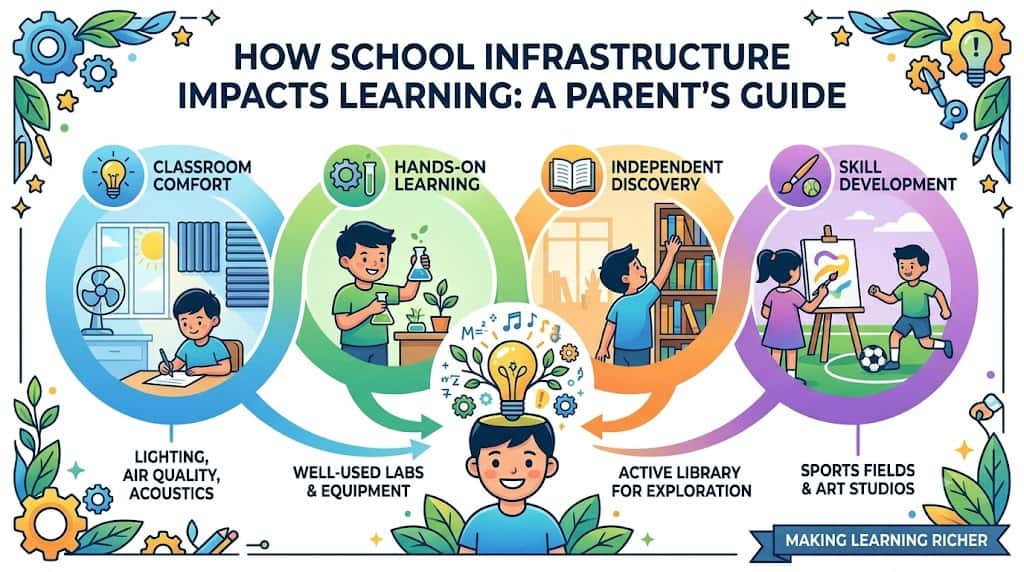

When parents shortlist the Top schools in Noida, shiny buildings and impressive facilities can easily become part of the decision. But does a beautiful campus really help a child learn better? And is a smart classroom more useful than a simple classroom with a good teacher? These are fair questions, especially when parents are also comparing schools such as Manav Rachna International School (MRIS), Sector 51, Noida.
The answer is not simply “yes” or “no”. Infrastructure does not teach a child by itself, but the environment in which children spend several hours every day can make learning easier or harder. Research has linked factors such as lighting, air quality, temperature, and classroom acoustics with students’ comfort, attention, and learning.
Also Read| How Manav Rachna International School, Sector 51, Noida, Sets Standards in School Health & Hygiene
Why Does the Physical Environment Matter for Learning?
Think about trying to finish your homework while someone is drilling a wall nearby. You may know the answer, but keeping your attention on the question becomes difficult. Children face the same problem at school.
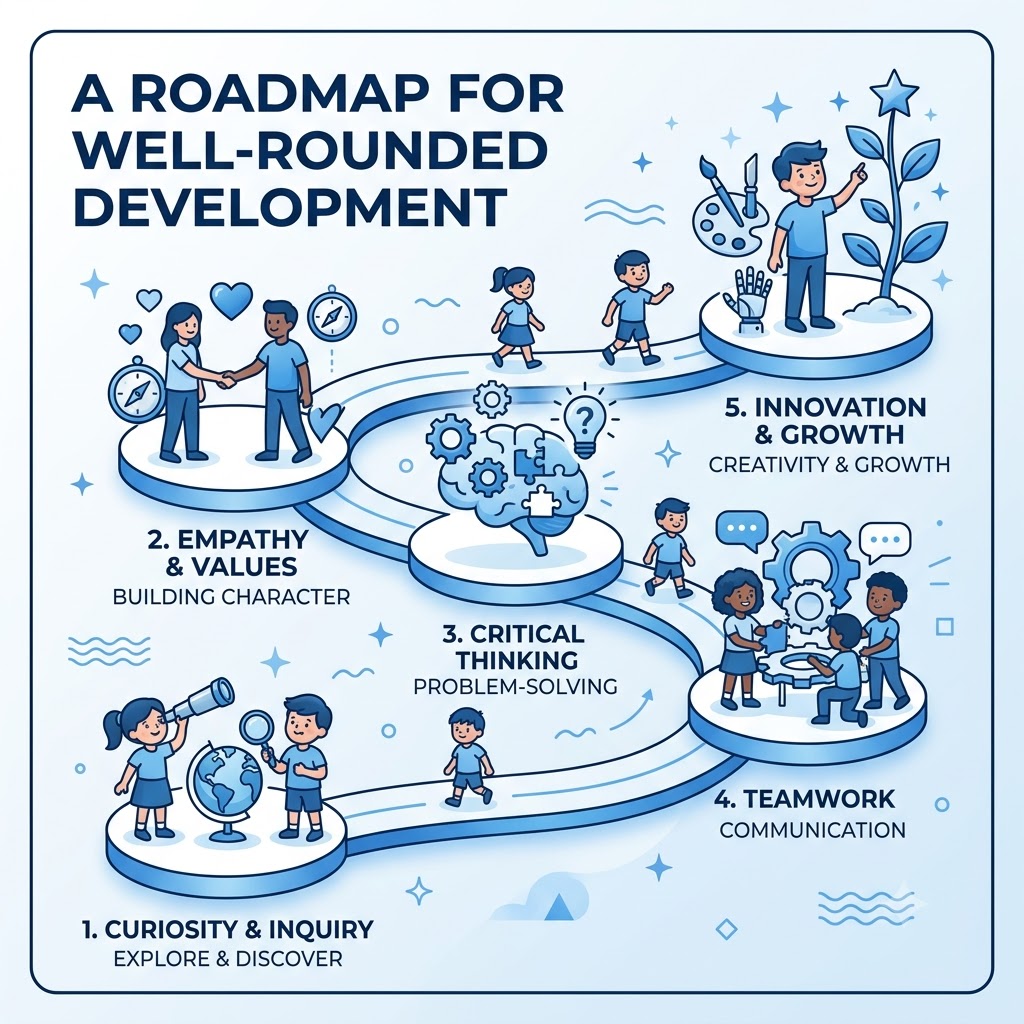
A 2023 systematic review of some studies found that environmental conditions in school buildings are important to the teaching-learning process, with thermal comfort being one of the most studied factors. Another review covering studies highlighted air quality, lighting, temperature, and noise as important parts of the classroom environment.
|
Part of the environment |
Why it can matter |
|
Lighting |
Helps children see books, boards and activities comfortably |
|
Ventilation & air quality |
Poor air quality can affect comfort, attention and performance |
|
Temperature |
An overly hot or cold room can become distracting |
|
Acoustics |
Too much noise can make listening and understanding harder |
|
Space |
Enough room allows children to move, work, and participate comfortably |
This connects with a simple idea from psychology: when the brain has to spend extra effort dealing with discomfort or distractions, there is less attention available for the actual task. A child who is constantly trying to hear the teacher over background noise, for example, has another problem to solve before even thinking about the lesson.
Good Infrastructure Is More Than Smart Boards
This is where parents need to look beyond the word “modern”. A classroom full of screens is not automatically a better learning space. The real question is: What can the child do because this facility exists?
Consider a science lesson. Reading about evaporation in a textbook gives a child information. Watching water change into vapour during an experiment gives the child something to observe, question and remember.
A library gives a child the chance to discover books beyond the prescribed syllabus. A sports ground gives them space to practise teamwork and coordination. An art room allows them to experiment without worrying about making the living-room table messy.
Good infrastructure should therefore create opportunities for learning, rather than simply looking impressive.
Parents can ask:
- Can students actually use the laboratories regularly?
- Is the library used for reading and research?
- Are sports facilities available beyond occasional annual events?
- Can classrooms support group activities?
- Are spaces comfortable, safe and accessible for different learners?
- Does technology add something useful to the lesson?
What Should Parents Actually Check During a School Visit?
A school tour is a useful opportunity to look at the things that photographs cannot show. Instead of only checking how large the campus looks, notice how children are using the space.
For example, a laboratory may look excellent, but the more important question is whether students are actually experimenting there. Similarly, a library with thousands of books is valuable when children are encouraged to read, explore and find information independently.
The World Bank’s review of evidence on school infrastructure also stresses that infrastructure should be considered in relation to learning rather than treated as an isolated investment.
A practical checklist for parents could look like this:
Step 1- Look at the space
Step 2- Ask how it is used
Step 3- Observe the children
Step 4- Understand how it supports teaching.
This also helps parents avoid another common mistake: comparing schools only by the number of facilities. A smaller but well-used laboratory may provide more learning value than a large laboratory that students rarely enter.
Yes, but infrastructure is an enabler, not the teacher.
Research on classroom environments shows that factors such as air quality, noise, and temperature can influence learning conditions. For example, a review of classroom air-quality studies found a relationship between lower carbon dioxide levels and improved school performance. Research on classroom acoustics has also found that excessive sound can reduce learning efficiency.
This gives parents a more balanced way to think about infrastructure:
|
A strong learning environment needs |
Why it matters |
|
Comfortable classrooms |
Children can focus on the lesson |
|
Practical learning spaces |
Concepts can be experienced, not just memorised |
|
Library and reading spaces |
Supports independent learning |
|
Sports and activity areas |
Gives space for physical development |
|
Technology |
Can make certain concepts more visual and interactive |
|
Safe and inclusive spaces |
Children can participate with greater confidence |
Also Read| Lab-Based Learning: The Secret Behind Better Results at MRIS Sector 51, Noida
Does Infrastructure Really Impact Learning? How is MRIS Sec 51, Noida excelling in this?
At Manav Rachna International School (MRIS), Sector 51, Noida, the approach reflects this broader understanding of learning spaces.
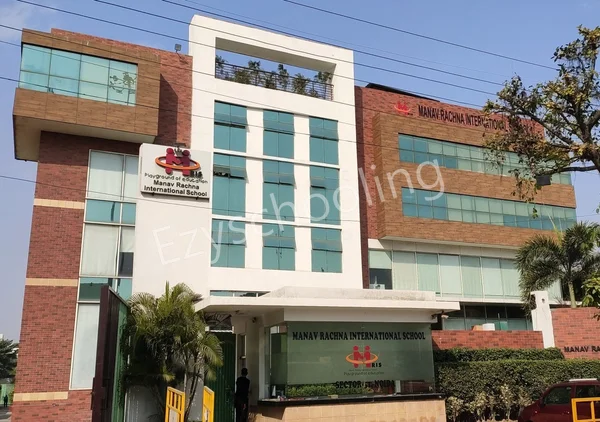
The school lists smart classrooms, advanced science and AI labs, a Future Skills and Sustainability Hub, a multilevel library, professional sports facilities and arts studios among its facilities. Its learning spaces page also describes interactive classrooms, ICT, Biology, Chemistry, Mathematics and Techno Skills labs, along with a library containing many books.
These facilities are connected with the school's wider focus on experiential learning, life skills, sports, arts and interdisciplinary learning rather than treating infrastructure as decoration.
For parents exploring the Best Schools in Noida, infrastructure deserves attention, but it should not become a competition about who has the biggest building or the most screens. The better question is whether the school has created spaces where children can think, experiment, move, read, create, collaborate and feel comfortable while learning.
A good school building cannot replace a thoughtful teacher or a strong curriculum. But when the right people, teaching methods and learning spaces come together, the physical environment can quietly make a child’s everyday learning experience richer and more meaningful.
To know more about other schools in this area, click on the link below
 as a preferred source on