






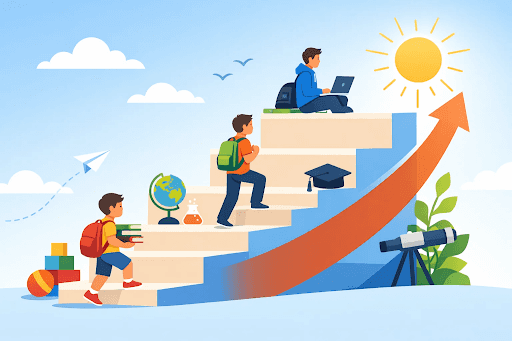

When we look at a child entering school for the first time, a tiny backpack almost bigger than their shoulders, we rarely think about the long academic journey ahead. Yet education is not a single leap from kindergarten to board exams. It is a carefully structured progression, a series of stages, each one building quietly on the previous one.
The idea of stage-wise growth in education has gained stronger attention in recent years, especially after frameworks like India’s National Education Policy (NEP) 2020 emphasized structured developmental phases: Foundational (ages 3-8), Preparatory (8-11), Middle (11-14), and Secondary (14-18). These divisions are not random but align with cognitive development research.
According to UNESCO data, nearly 85% of brain development happens before the age of eight. That means foundational years are not “basic” in the casual sense; they are critical. What children experience during those early years shapes attention span, emotional regulation, and even long-term academic confidence. With so many choices available for parents searching for the best school in Bangalore, this article will help you navigate your options and ease your dilemma by the end.
Also Read | From Vidyaarambh to World Records: How KTIS Bagalur Blends Ancient Wisdom with Modern Excellence
The Foundational Stage: Building Curiosity Before Content
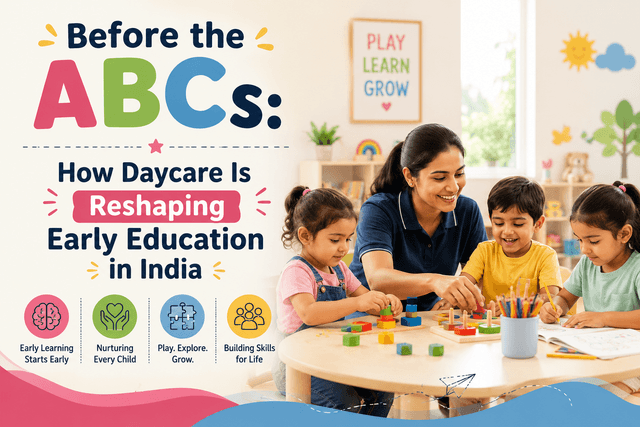
In the foundational years, learning is not about heavy textbooks or academic pressure. It is about curiosity, language exposure, social interaction, and motor skills. Research from the Harvard Centre on the Developing Child shows that early interactive learning environments significantly improve language acquisition and memory retention. When young learners engage through storytelling, activity-based learning, music, and play, they develop stronger neural connections.
You know how children ask “why” about everything? That phase should not be shut down. It should be nurtured. A well-designed foundational curriculum focuses on literacy and numeracy without overwhelming the child.
Sometimes we forget that confidence in higher grades begins with small early successes. When a child learns to read fluently or solve simple problems independently, that sense of “I can do this” quietly forms. And that feeling becomes the base for everything later.
1. The Preparatory Stage: Structured Learning Begins
As children transition into the preparatory stage, usually around Grades 3 to 5, learning becomes slightly more structured. Concepts become layered. Analytical thinking begins to develop.
At this stage, studies indicate that students start forming attitudes toward subjects. A 2022 education survey reported that over 60% of students decide whether they “like” or “dislike” mathematics before the age of 11. That’s powerful. It shows how important curriculum design and teacher engagement are during these middle years.
A balanced academic structure ensures that foundational skills are strengthened while gradually introducing independent thinking. Students are encouraged to ask deeper questions, engage in group discussions, and participate in project-based assignments.
This stage is delicate. Push too hard, and you risk anxiety. Under-challenge them, and you risk stagnation.
2. The Middle Stage: Where Identity and Intellect Meet
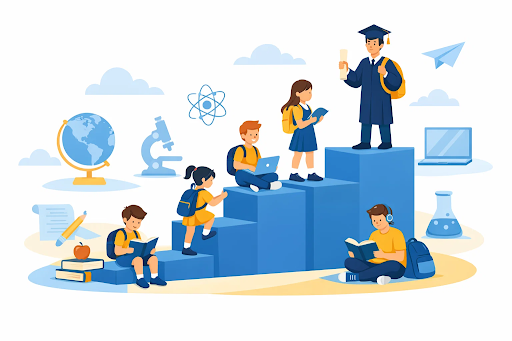
By the time students enter middle school, something interesting happens. Cognitive abilities expand significantly. Abstract reasoning improves. Peer influence grows stronger. Self-awareness increases.
According to research in developmental psychology, early adolescence is a phase of identity exploration. Academically, this is when interdisciplinary learning becomes effective. Science can be connected to real-life applications. Mathematics can be linked to data analysis. Language skills can evolve into persuasive communication.
The academic structure during this stage must balance rigor with support. Students begin to prepare for more formal assessments while still needing emotional guidance.
Sometimes, children in this phase feel confused about their strengths. They may perform well in some subjects and struggle in others. And that is completely normal. Growth is not linear. It moves in waves.
Sometimes students don't even understand why certain subjects suddenly feel harder or why expectations seem higher. They might feel like they are just trying to keep up without realizing that their brain is actually evolving, adapting, and stretching in ways it has never done before. That quiet stretching is growth, even if it doesn’t always feel comfortable at the moment.
3. The Secondary Stage: Preparing for the Real World
Secondary education marks a shift toward specialization and future readiness. Students begin to consider career paths, competitive examinations, and higher education goals. Academic structure becomes more focused and rigorous.
Globally, secondary education completion significantly impacts long-term earning potential. World Bank data suggests that each additional year of secondary education can increase an individual’s earnings by approximately 10% on average. That statistic highlights the importance of structured academic progression.
At this stage, clarity becomes essential. Students need subject depth, career guidance, and exposure to practical applications. The curriculum must prepare them not only for board examinations but also for independent decision-making.
Confidence at this stage is often a reflection of how well earlier stages were handled. A strong foundation supports resilience under academic pressure.
Check Out | Balancing Academics and Co-Scholastic Activities: The MRIS Sector 21C Approach
Why Stage-Wise Structuring Matters More Than Ever
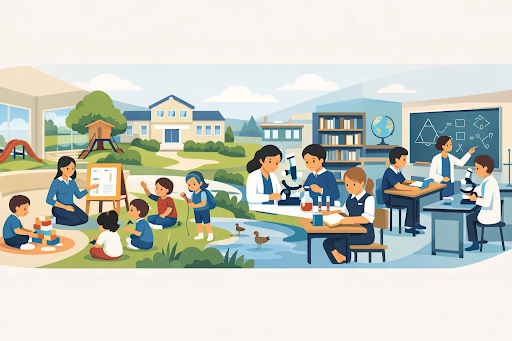
Modern education is becoming increasingly competitive, but it is also becoming more personalized. Data from global education trends indicates that students perform better when curriculum pacing aligns with developmental readiness rather than arbitrary grade-level expectations.
Stage-wise structuring respects natural growth patterns. It recognizes that a six-year-old and a sixteen-year-old cannot be taught using the same psychological assumptions. It understands that learning maturity evolves gradually.
When academic architecture reflects this understanding, students experience less burnout and more sustainable progress.
How KTIS Aligns with Stage-Wise Academic Growth?
Now let’s connect this framework to a practical example. One of the best CBSE schools in Bangalore, Kesar The International School integrates a stage-wise academic structure that mirrors developmental needs rather than imposing uniform expectations across all grades. The institution emphasizes gradual progression, ensuring that foundational skills are solid before advancing toward complex academic challenges.
In the foundational and preparatory stages, KTIS focuses on nurturing curiosity, communication skills, and conceptual clarity. Classrooms are structured to encourage interaction and collaborative learning rather than passive memorization.
As students transition into middle and secondary levels, the academic rigor increases strategically. Advanced subject depth, structured assessments, and skill-based projects are incorporated to prepare students for higher education pathways.
What makes the approach effective is continuity. Instead of treating each stage as isolated, the progression feels interconnected. Teachers understand where students are coming from and where they are headed. That alignment reduces academic shock during transitions.
The Final Thoughts
If I had to explain this simply to you, I would say that education works best when it respects time. Growth cannot be rushed. It must be layered, a thoughtful stage-wise academic structure, such as the one implemented at KTIS, acknowledges that development is cumulative. Foundational years build curiosity. Preparatory years shape discipline. Middle school refines identity and reasoning. Secondary education prepares direction and ambition.
When these stages are aligned intentionally, academic success becomes a natural outcome rather than a forced achievement and honestly, that is what we should want for every child not just good grades, but steady, confident growth from the very first classroom to the final board examination.
If you want to know more about this and other nearby day schools, then check out the list of the top Schools in Bangalore.



 as a preferred source on